Osaka police to trial bodycams, sometimes on the side of their heads

22:13 cherishe 0 Comments

To serve and protect and vlog.

Body cameras have become widely used by police forces in various countries, both as a way to secure evidence and provide transparency. The trend has yet to catch on with Japanese police, but that may soon change with a trial program set to take place in Osaka from 1 September.

13 members of the Mobile Patrol Unit of the Abeno Police Department’s Community Affairs Division will be given cameras for the purposes of evidence gathering and verifying the appropriateness of police conduct in the event of complaints. The First Security Division will employ three cameras as a way to understand real-time crowd levels for the purpose of crowd control.

There are three types of cameras that can be worn on the head or chest. The chest cameras come in small and large versions, and officers wearing them will also either have an armband or other marking to clearly indicate that they are recording. Video will not be recorded on private property to protect privacy, and all footage will be deleted after a certain period of time.

▼ The chest cameras seem similar to those used by police in other countries, but that cap-mounted one is a little jarring.

Even those of us innocent of any wrongdoing can sometimes tense up around the police, and I’m not sure making them look more like a cyborg will help with that.

▼ Captain Jean-Luc Picard of the Osaka Prefectural Police

Readers of the news online were also largely distracted by the big head-mounted camera, but were divided over whether it was cool or cumbersome.

“I’m not sure how well you can chase criminals with that thing on your head.”
“Cybersideburns.”
“I think the head camera is no good because the officer can point it anywhere they want.”
“We don’t have gunfights like in the U.S.A., but it’s a good visible deterrent.”
“Those look really big. Can’t they make them more wearable?”
“They’re probably intentionally big, so everyone knows they have cameras.”
“They look hard to wear in the summer.”
“They should wear a visor-type camera.”
“They’re like the head vulcans from Gundam.”
“I like the bigger ones because they look cooler.”
“I guess it’s better to have them than not to have them.”

Well, it certainly sounds like the public is enthusiastic about these cameras. This trial is a part of a model project by the National Police Agency of Japan, so similar ones might be held in other parts of the country down the road as well.

So, if you see someone with a big hunk of plastic and metal sticking out of their head out on the street, remember to say hi, because it’s just your friendly neighborhood patrolman. Well, maybe take a good look first, because it might also be a Predator.

Source: Yomiuri Shimbun Online, Golden Times
Featured image: Pakutaso
● Want to hear about SoraNews24’s latest articles as soon as they’re published? Follow us on Facebook and Twitter!


Credit:

0 comments:

Manga is More than Just Reading, It’s a Cultural Experience – Expo 2025 with The Seven Deadly Sins

20:13 cherishe 0 Comments

Japanese manga is one of the most popular types of reading material around the globe, but manga isn’t just something you read. For fans, manga is something you experience, and a way to connect with Japan’s rich culture.

With the Expo 2025 world’s fair currently underway in Osaka, the venue’s EXPO2025 OFFICIAL STORE EAST GATE MARUZEN JUNKUDO is pleased to have the opportunity to offer a collection of merchandise inspired by manga creator Nakaba Suzuki’s international hit The Seven Deadly Sins. These items have been created with the purpose of conveying the cultural value of the world of manga to Expo visitors from around the world. The starting point for their design is artwork from the original Seven Deadly Sins manga reinterpreted as a traditional byobu-e folding screen painting, produced using the Denshoubi® cultural reproduction technology developed by Dai Nippon Printing Co., Ltd. (DNP). These creations serve as a symbol on the international Expo stage of the cultural value of manga and Japan’s pride in the artform, delivering the cool Japan joy of manga to fans from around the world.

Reinterpreting The Seven Deadly Sins through cultural reproduction technology – Manga not just as something to read, but something to experience

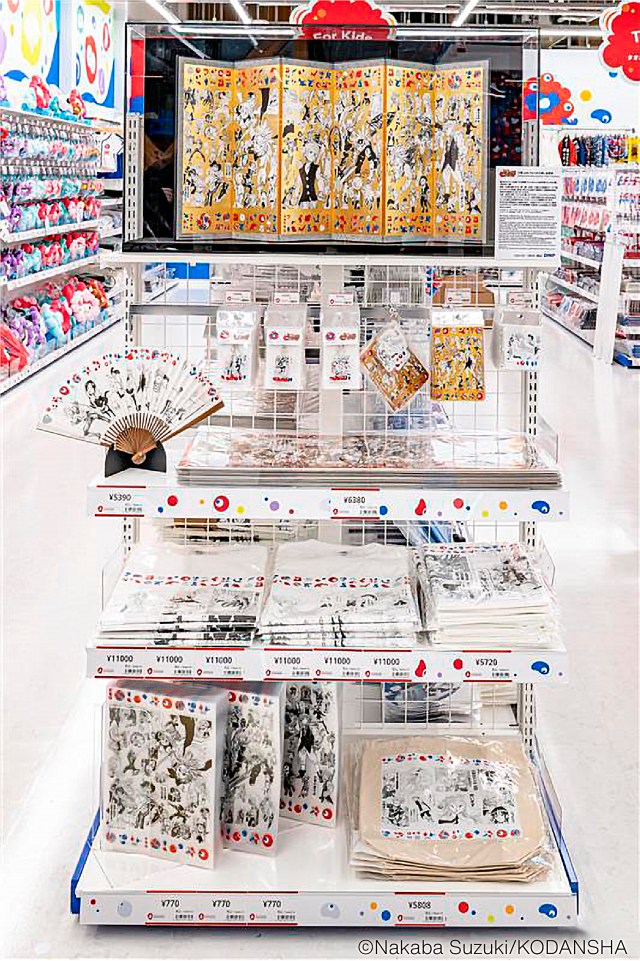
The Seven Deadly Sins folding screen painting is on display at the EXPO2025 OFFICIAL STORE EAST GATE MARUZEN JUNKUDO, but it also serves as the motif for a line of T-shirts, posters, fans, and other items. The design combines the beauty of traditional Japanese artistic composition and stylish modern manga illustration through advanced printing technology, forming a symbol of the cultural value of manga.

Wearing the T-shirt, touching the fan, and hanging up the poster become ways to incorporate the lore of The Seven Deadly Sins into your daily life, and take manga beyond being only something to read and into the realm of being something to experience.

The experience of not just reading manga, but wearing manga

● Expo 2025 The Seven Deadly Sins Double-Sided Print T-shirts (2 designs, medium/large/extra-large sizes, ¥11,000 taxes included)

Each shirt is packed with unforgettable that fans of The Seven Deadly Sins will instantly recognize, showing the heroes’ fighting spirit and love. Every time you slip the shirt on will bring back the excitement of those dramatic moments as you enjoy the world of manga through the experience of wearing the artform.

The experience of decorating with manga – Bringing artistic passion into your home

● Expo 2025 The Seven Deadly Sins Special Print Poster (¥6,380 taxes included)

This horizontal poster version of the folding screen artwork concentrates iconic scenes of The Seven Deadly Sins and its world of grand fantasy adventure into the atmosphere of a single sweeping visual story. The details conveyed through the printing process’ split between glossy and matte textures for maximum evocative effect makes this a physical expression of the world of manga that creates the experience of decorating with the artform.

Bringing back memories with every flick of the fan

● Expo 2025 The Seven Deadly Sins Folding Fan (¥5,390 yen taxes included)

Every time you crave a refreshing breeze and open up this fan, the cast of The Seven Deadly Sins fans out before you too. In traditional Japanese culture, fans are a way to both feel cool and look cool, and this one is also a dynamic way to enjoy the world of manga.

One more memory from your journey

● Expo 2025 The Seven Deadly Sins Postcard Set (3 postcards, ¥825 taxes included)

Each card is covered with captivating artwork from The Seven Deadly Sins. With these postcards that let you feel the culture of Japanese comics, you can share the joy of the world of manga with family and friends while sending them another story of your own.

EXPO2025 OFFICIAL STORE EAST GATE MARUZEN JUNKUDO

Located in the East Gate Marketplace, a one-minute walk from the East Gate, “The EXPO SUPER STORE – A Place Where You Can Meet Your Favorite Things” is a concept store filled with the playful spirit of Expo 2025 mascot character Myaku-Myaku and waku-waku, the Japanese word for the feeling of excitement and wonder. We look forward to seeing you all in our store that’s overflowing with Myaku-Myaku items. With a wide selection of memorabilia bursting with originality, we offer shopping experiences that give everyone a chance to find their “SUKI” (favorite things) and make their day at Expo 2025 even more super waku-waku.

Hours of operation: 9 a.m.-9:45 p.m. (last admission 9:20 p.m.)
Location: the East Gate Marketplace
Website
Access: For visitors to the shop, the most convenient arrival route is via Yumeshima Station (C09) on the Osaka Metro Chuo Line, which is located in front of the Expo 2025 East Gate

<For those arriving in Osaka by Shinkansen>
● From Shin Osaka Station (A46), proceed to Osaka Station (A47) by the JR Kyoto Line. At Osaka Station, transfer to the Osaka Loop Line (inner loop) and proceed to JR Bentencho Station (O15), then transfer to the Osaka Metro Chuo Line and proceed to Yumeshima Station.
● Alternatively, from Osaka Metro Shin Osaka Station (M13), proceed by the Osaka Metro Midosuji Line to Hommachi Station (M18), then transfer to the Osaka Metro Chuo Line and proceed to Yumeshima Station.
<For those arriving in Osaka by airplane>
● From JR Kansai Airport Station (S47), proceed by the Kansai Airport Line or Hanwa Line to Tennoji Station (R20), then transfer to the Osaka Loop Line (outer loop) and proceed to JR Bentencho Station (O15). At Bentencho Station, transfer to the Osaka Metro Chuo Line and proceed to Yumeshima Station.
● Alternatively, from Nankai Kansai Airport Station (NK32), proceed by Nankai Airport Line or Nankai Main Line to Namba Station (NK01), then transfer to the Osaka Metro Midosuji Line and proceed to Hommachi Station (M18). At Honmachi Station, transfer to the Osaka Metro Chuo Line and proceed to Yumeshima Station.

Images ⓒExpo 2025 ⓒNakaba Suzuki/KODANSHA


Credit:

0 comments:

Why does this sushi restaurant serve raw tuna in an ice cream cone?【Taste test】

18:13 cherishe 0 Comments

Totomaru shatters our expectations, but can they win our hearts?

In Japan, kaitenzushi/conveyor belt sushi chains tend to be a little more creative and less bound by tradition than more formal sushi restaurants. Even still, our Japanese-language reporter Natsuno Futon was immensely startled, yet incredibly intrigued, by what she saw at a kaitenzushi restaurant during her recent trip back to her hometown in Gifu Prefecture.

Totomaru is a local chain with about two dozen branches, mostly in Aichi Prefecture but also with locations in Gifu and Shizuoka. They’ve got a reputation for outstanding freshness and flavor, so Natsuno always makes a point of eating there at least once when she’s back home visiting friends and family.

Staring off with some more or less standard fish, everything was as delicious as Natsuo remembered it being. Since this was her first visit in a while, though, she decided to also peruse the menu of limited-time summer dishes, such as the seared salmon with mirin lees and yuzu zest, which was both original and outstanding.

At one point, the sound of a taiko drum rang out, signaling the start of a warayaki cooking session. Warayaki is a style of cooking in which rice straw is burned to produce intense flames, over which katsuo (bonito) is seared.

But as attention-grabbing as the warayaki performance was, it still didn’t match the eyeball-pulling power of this menu item which had Natsuno asking…

…wait, is that ice cream cone sushi!?!

Yes, that really is minced tuna scooped into the cone, and not some sort of strawberry or peach ice cream. However, since the actual criteria for something to be sushi is the presence of vinegared rice, it’d be more accurate to call this ice cream cone sashimi, since the cone has no rice inside.

Whether sushi or sashimi, though, Natsuno knew that she had to try this, so she punched in an order for it on her table’s tablet.

As odd as it looked in the menu photos, it was even more surreal to have it standing on the table.

So…why? Because this is Totomaru’s unorthodox take on yukke, which is itself Japan’s riff on Korean cuisine’s yukhoe. In sushi restaurants, yukke refers to minced tuna served with raw egg yolk, negi (green onion), and shiso (Japanese basil). Instead of serving it in a bowl like most restaurants do, though, Totomaru brings it to you in a waffle cone for the 319-yen (US$2.15) Yukke Crush, as they call it.

You do still get a plate, though, because the restaurant’s recommended way to eat the Yukke Crush is first to tip the cone over…

…pour out the contents and make sure all the egg drizzles out…

and then crush the cone with a spoon.

▼ Ah, sorry, we mean “crush!” the cone with a spoon.

It’s up to you how thoroughly you want to pulverize the cone, depending on your desired texture, or perhaps how much pent-up stress you have at the moment.

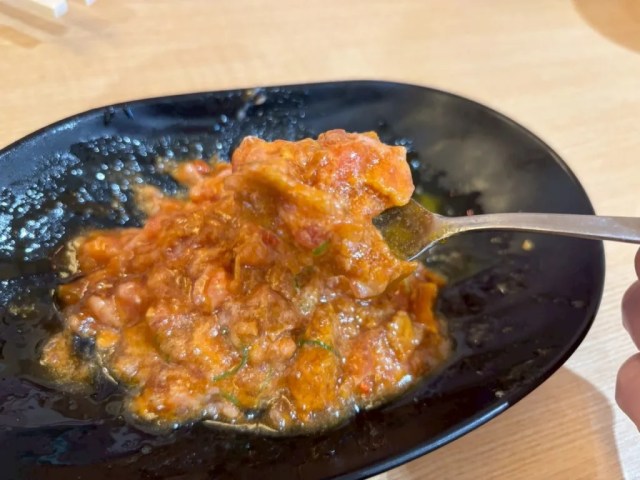
So how does it taste? Not bad. Honestly, with such an unusual guest ingredient, it wouldn’t have been shocking if the Yukke Crush had turned out completely inedible. Maybe, though, because yukke itself is already a dish with a lot of strong, stimulating flavors, adding one more, even one as unexpected as this, can’t completely derail it.

It was noticeably sweeter than normal yukke, though. Without the presence of vinegared sushi rice (which has a touch of sweetness to it), yukke doesn’t ordinarily light up too many of your sweet flavor receptors, and while the waffle cone wasn’t sweet enough to qualify as a dessert without any ice cream in it, Natsuno’s taste buds told her right away that this wasn’t any ordinary yukke.

On this day, Natsuno wasn’t completely won over by the Yukke Crush, but she wouldn’t advise anyone to avoid it either. With its deviations from the yukke norm, we can probably say that this is an acquired taste, and if it’s one you’re interested in acquiring, it’s worth a shot, and even if you don’t immediately fall in love with it, you’ll probably never forget it either.

Related: Totomaru location list
Photos ©SoraNews24
● Want to hear about SoraNews24’s latest articles as soon as they’re published? Follow us on Facebook and Twitter!


Credit:
0 comments:

Monster Hunter’s grossest monster is now a cute super-deformed room lamp【Photos】

06:13 cherishe 0 Comments

Designers say Khezu will not electrocute you, but no promises about him not freaking your guests out.

Though the series is called Monster Hunter, a lot of the creatures you’re tracking and slaying in Capcom’s hit video games have some pretty clear real-world animal influences in their designs. Quite a few resemble dinosaurs, and others are reminiscent of weasels, wolves, or birds of prey.

But then there’s Khezu, who looks like a…well…let’s just say it’s kind of linguistically ironic that Khezu’s design is disturbing enough that it leaves many who encounter it feeling less than cocky.

With hundreds of different species in Monster Hunter, sometimes all the dino-dragons can start to feel like they’re blending together, but Khezu always stands out, which is perhaps why it was chosen as the muse for this very unique interior lamp.

Granted, it’s been given a super-deformed makeover, becoming cuter than its in-game version. Still, the long, tubular neck filled with 360-degree fangs and protruding, probing tongue leave no doubt for experienced hunters that this is Khezu.

The lamp, molded from PVC, measures 14 centimeters (5.5 inches) in length. It can be powered via USB cord or AAA batteries, meaning that Khezu could be anywhere in your home.

▼ We’ll leave it up to you to decide if that’s a heartwarming or terrifying proposition.

In addition to two brightness settings, there’s also a special flickering blue light mode that can be initiated, a reference to Khezu’s in-game electricity attacks. The manufacturers, however, make a special point of explaining that the Khezu lamp does not actually electrocute you, and that the function is purely aesthetic.

The Monster Hunter Khezu Room Light is priced at 5,500 yen (US$37) and can be ordered online through retailer Amiami here. Shipping is scheduled for mid-December, making this the perfect gift for any Khezu-loving friends or family members on your Christmas list who already have the Khezu plushie.

Source, images: PR Times
● Want to hear about SoraNews24’s latest articles as soon as they’re published? Follow us on Facebook and Twitter!


Credit:

0 comments:

Discovering Paapo, the secret flavor behind the happosai enjoyed by Osakan families

22:13 cherishe 0 Comments

It tastes just like what mom used to make.

While souvenir shops are often a great place to pick up a memento from your recent trip, sometimes you can find hidden gems beloved by locals within a local supermarket, adding a little extra dose of “special” to your travels. This is what happened when our Japanese-language reporter Takuya Inaba was wandering around a supermarket in Osaka the other day, when he happened to spot a product with an intriguing name: Paapo.

A powdered seasoning sold by Tamanoi, Paapo is advertised as being used to make the dish called happosai, or babaocai in Chinese. While literally meaning “eight-treasure vegetables,” this Chinese dish can use any assortment of meat, fish, and vegetables in its recipe, so it is by no means limited to eight vegetables. Happosai is typically made by cutting up the ingredients, stir-frying them, and seasoning them with soy sauce and sesame oil. A very beginner-friendly dish, but Paapo makes the process even simpler.

Inside the box were two packets, each containing a serving for three to five people, and all that’s needed to prepare it is just three simple steps.

The back of the box does list off eight example ingredients—pork, squid, Chinese cabbage, bamboo shoot, onion, shiitake mushrooms, carrots, and green peppers—however, it does also say you can just use whatever ingredients you’ve got lying around in your fridge, which means it’s great when you realize you’ve forgotten to prepare something ahead of time.

The first step is to take whatever you’ve scavenged from your fridge and chop them up.

Then, stir-fry the ingredients that take longer to heat through on a high heat first.

Once everything has softened up nicely, pour in the Paapo that has been dissolved in 250 milliliters (about 8.8 ounces) of water.

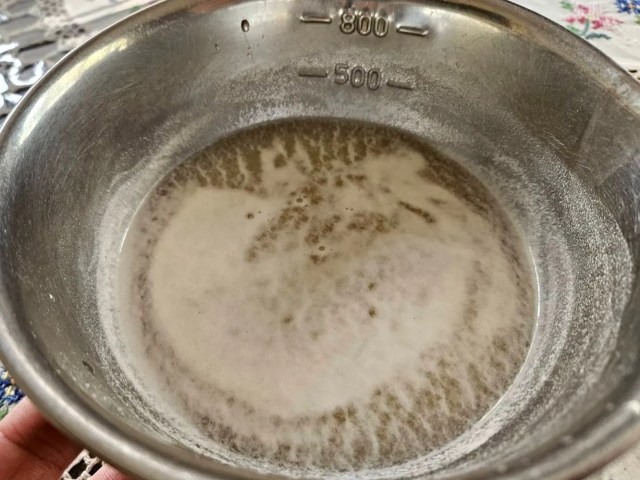
Paapo’s original form is actually a white powder that has a smell that kind of resembles Korean salad dressing.

It dissolves really easily in the water, without leaving any lumps.

Time to pour it in.

Turn the heat down to medium and stir well. Once it thickens, it’s done.

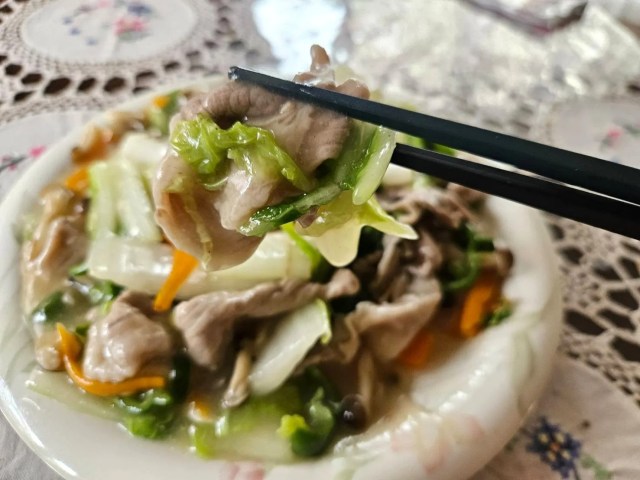
It’s really that simple, it’s practically idiot-proof. Even Takuya, a self-proclaimed “cooking novice” was able to make it beautifully.

Just by looks alone, it seemed to compare favorably when compared to a famous Chinese chain restaurant.

As for the taste? It was absolutely delicious. Given that there were no additional seasonings, Takuya had been kind of worried about it, but it turned out to not be a problem at all.

The faint tanginess that lingers in the aftertaste really adds a nice touch. It was the taste of a professional cook.

The sauce was beautifully thickened too. It could probably taste amazing just poured over plain, white rice, or noodles too.

When he later discussed it with fellow reporter Seiji Nakazawa, who is from Osaka, Seiji mentioned that his mother most likely used to use it when she made happosai. It might be that, for many people in Kansai, the taste of happosai is in fact the taste of Paapo.

After Takuya did a little more digging online, he found that there was a recipe called Milk Paapo Hot Pot on Tamanoi’s official website, so naturally he had to try that too.

The basic steps are the same as the original recipe, but…

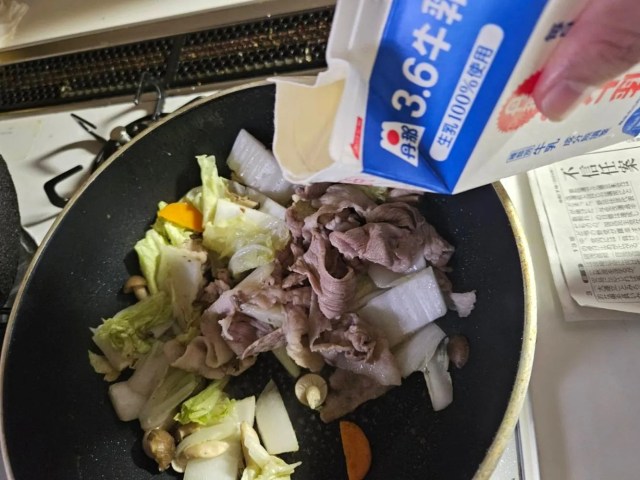
…before you add the Paapo, you’re supposed to add milk and let it simmer.

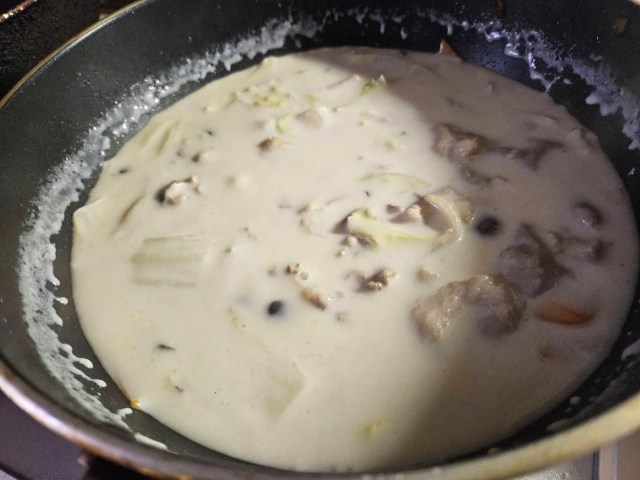
Once it comes to a boil, add the dissolved Paapo, and simmer further on low heat to completion. Just a couple of extra steps and you have an entirely different dish.

It looks exactly like cream stew.

The first taste is very similar to cream stew. However, gradually the Chinese-style flavor starts to come through, almost as if it is a cream stew made by a Chinese restaurant. An absolutely fantastic flavor that’s mild, yet still has a punch.

Takuya later contacted Tamanoi to find out if the product could be purchased in any stores outside Osaka, and the larger Kansai region. It turns out that it is sold in a few stores in east Japan’s Kanto region, but even after hunting around in several local supermarkets, Takuya went home in defeat. It seems there’s still progress to be made until Paapo is nationally renowned. However, if you can’t make it to Kansai, Takuya recommends giving online shopping a try, since it’s definitely worth keeping a stock of in your pantry.

Next time you’re traveling around Japan, be sure to swing by a local supermarket, as you might just find a beloved local food that never makes its way to the tourist shops.

Photos ©SoraNews24
● Want to hear about SoraNews24’s latest articles as soon as they’re published? Follow us on Facebook and Twitter!


Credit:

0 comments:

Krispy Kreme releases a special tsukimi moon-viewing doughnut in Japan

18:13 cherishe 0 Comments

A sweet twist on a Japanese tradition.

Krispy Kreme is world-famous for its original glazed doughnuts, but in Japan, where competition for doughnuts is fierce, the chain is consistently compelled to up its game with new limited-edition releases, and its latest is one of the best we’ve seen.

Called the Krispy Kreme Premium Tokyo Moon-Viewing Marron & Cream, this new doughnut is crafted to resemble the full moon in the night sky. Timed to coincide with the early autumn tradition of “tsukimi” or “moon-viewing“, the doughnut contains a centre of whipped cream with a swirl of chestnut paste against a bitter chocolate coating to depict the full moon “floating gently in the night”.

On top of the golden chestnut paste is a soft and chewy gyuhi (a soft version of mochi rice cake), with candied chestnuts added as a garnish for an autumnal touch. To finish, gold leaf is sprinkled over everything to evoke the “twinkle of stars”, giving it an eye-catching look that really does conjure up thoughts of the starry night sky.

The Sweet Tsukimi Full Moon is the newest member of Krispy Kreme’s”Premium Tokyo” range, a series of limited-edition releases available exclusively at the chain’s flagship Tokyo International Forum Store.

Priced at 410 yen (US$2.79) for takeout and 418 yen for dine-in, this exclusive doughnut will be on the menu at the flagship store from 3 September until the end of October, with limited stocks available each day. With tsukimi officially occurring on 6 October this year, the doughnut will be the perfect partner for the traditional event, adding some extra sweetness to the beauty of the harvest moon that inspired it.

Source, images: Press release
● Want to hear about SoraNews24’s latest articles as soon as they’re published? Follow us on Facebook and Twitter!


Credit:

0 comments: