After trying 2,500 different kinds of Japanese curry, these experts have picked the top three

We get recommendations from someone who’s eaten more than 2,500 kinds of instant curry.

If you’re a curry fan and you haven’t yet been to Curry Land in Asakusa, you’re missing out. They’ve got a huge array of instant curry packs, known as “retorts” in Japanese, from all over the country, with hundreds of different flavors that are all neatly arranged by region to make them easy to find.

But if you don’t know what you’re looking for, or even what kind of curry you like, the choices can be overwhelming. That’s why we asked a pair of curry experts! Sanae Inomata is the chairman of the Japan Local Retort Curry Association and the owner of Curry Land. She and her husband Yoshiaki have traveled all around Japan trying out different local instant curries, so they know a thing or two about curry.

In fact, Mrs. Inomata has tasted over 2,500 different kinds, so she and her husband are just the people to ask when you’re looking for new instant curries to try. They didn’t even need time to think when we asked; almost immediately they recommended this “Hoshi-imo Curry”, made with dried sweet potato.
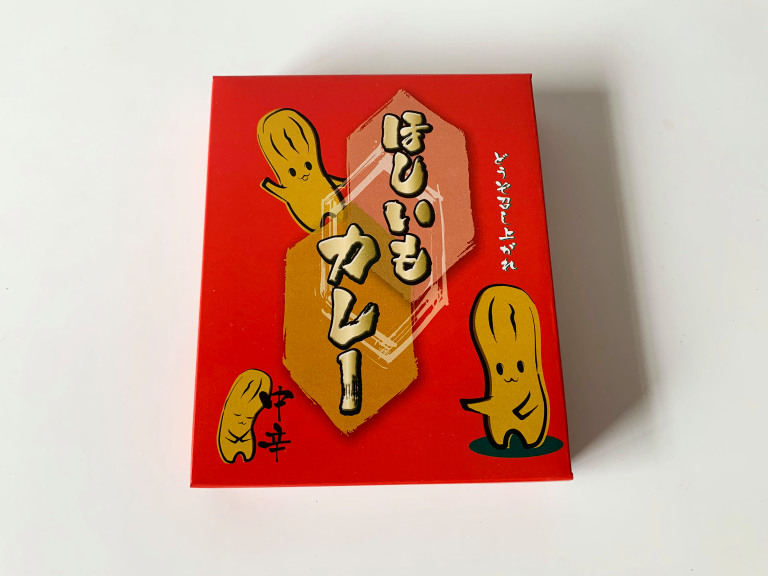
“It’s a rich and sweet curry made with sweet potato dried using traditional methods. It’s so delicious, it’s always selling out!” said Mrs. Inomata as she pointed out its spot on the shelf. Sadly, there was truth to those words, as that spot was empty, and they had no Hoshi-imo Curries in stock at the moment.

But we had to try their top recommendation, so after we got home, we searched and managed to find it on the JA Hitachi online store. It sold in sets of five for 3,580 yen (US$32) or 10 for 6,080 yen, which comes out to about 600 to 700 yen a package, which isn’t a bad price for fancier kinds of instant curry.

You know how soupy dishes are sometimes better the day after they’re made? Curry is like that, and we found the Hoshi-imo Curry to have the same tastiness of leftover curry. The thick roux was rich and complex, and we definitely caught a hint of sweetness. The dried sweet potato pieces were so soft and moist that the fibers were almost sticky. They lent an unmistakable delicious addition to the flavor of the curry.

But there was more than sweet potato in there; there was plenty of meat too, and it was so juicy and tender that it just melted in the mouth. In fact, every part of this curry was melt-in-your-mouth. Mrs. Inomata had told us, “If there’s one thing I want to leave for future generations, it’s this.”

The Inomatas’ second recommendation, brought by Mr. Inomata, is the Hitachi no Kagayaki Pork Curry (1,100 yen), about which he said, “Can’t forget this one!” “Hitachi no Kagayaki” is a brand of pork raised in Ibaraki Prefecture, and this curry was made under the supervision of the Curry Land owners themselves.
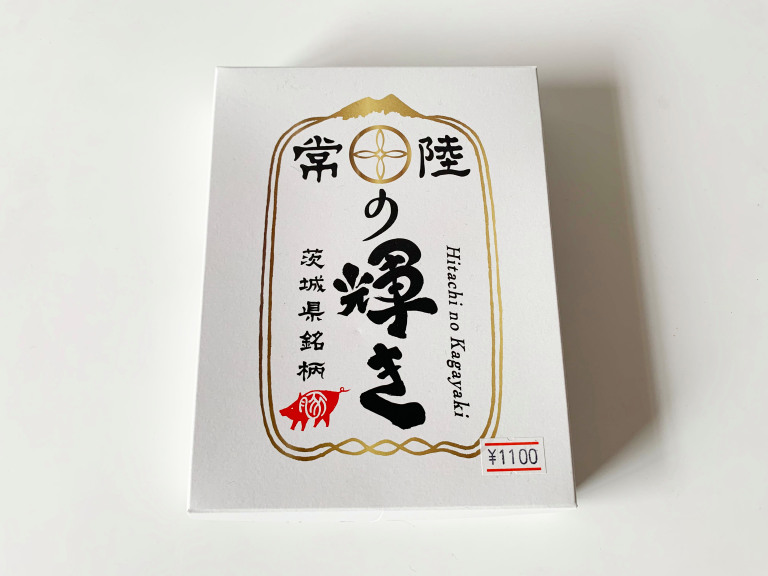
Mr. Inomata told us that this curry was special because, while people normally try to add fat to pork dishes to increase their flavor, in the case of this curry, they actually removed fat from the pork and minced it to draw out the best flavor. As ordinary people without much knowledge of food science, we didn’t really know what kind of difference that would make, but we tried it anyway.

We’re glad we did. It did, in fact, produce a slightly different flavor from other pork curries. The lack of fat actually seemed to elevate the dish into something a bit more sophisticated. We could really taste the umami of the meat, which was jam-packed in the curry sauce, but it also had a very natural flavor to it.

That flavor was actually kind of familiar, and when we asked about it, we learned that it’s because the first curry we tried from Curry Land, the Tropical Dragon Curry, also uses ground meat to draw out the best flavor of the meat. It’s a secret ingredient that you can taste, but not see. But there was one thing that the Hitachi no Kagayaki Pork Curry had that was extra nice: the very visible (and delicious-looking) chunks of meat in it!

It was a paradise of pork. Though we can appreciate the subtle science of using meat elements to make a curry delicious, we also very much appreciated seeing the meat in there, too. We usually like a good visual impact when it comes to food, after all–especially when it comes to meat.

Mrs. Inomata had a recommendation for a curry that had a visual impact as well as a flavor one: the Saba Curry (700 yen). This curry comes with a topping of mackerel. Mackerel (saba in Japanese) is a pretty ordinary fish, popular for home cooking, so we had to wonder if this curry was really going to be anything special when we hesitantly accepted the box handed to us.

But when we opened the curry pouch and poured it over the rice, out plopped a huge mackerel filet! It didn’t come out without a fight, either. It was so big that it kept getting stuck in the packaging. Imagine our shock to find that the box’s picture of a mackerel filet over the curry was in no way a lie.
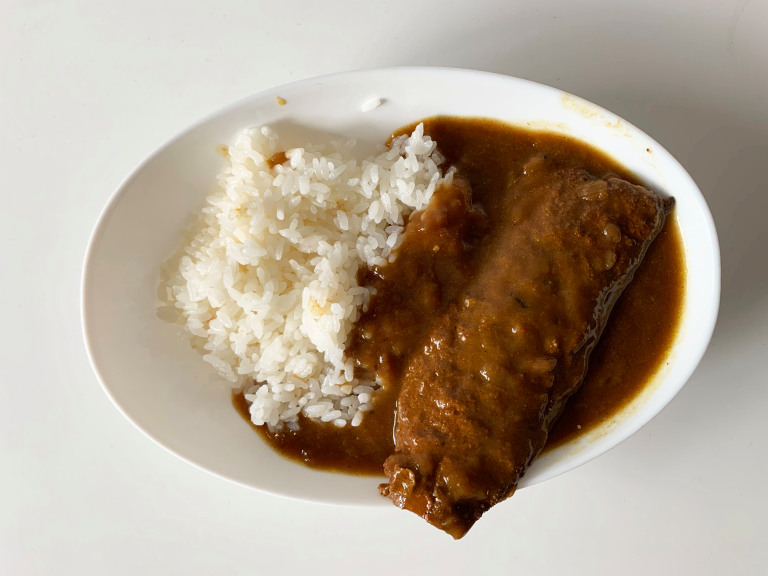
We don’t even have to tell you how delicious that mackerel filet was. What’s even better is that the curry base was made with vegetables, so it’s actually a pretty healthy curry with a nice aftertaste. Its appeal was not limited to visual impact, that’s for sure.

All in all, we were very impressed with our curry experts’ recommendations! We had expected instant curry to have hits and misses, but in actual fact, each one was so good that, if they were served to us in a bowl over rice, we would never have known they were instant.

Curry Land has been around for about eight years now, although they were originally located in Tokyo’s Adachi Ward. It was six years ago that they moved to Asakusa in Taito Ward to be allowed to set up their Curry Retort vending machine (which, by the way, sells one of the best curries we’ve ever eaten in our lives). Seriously, these curry experts know what they’re talking about.
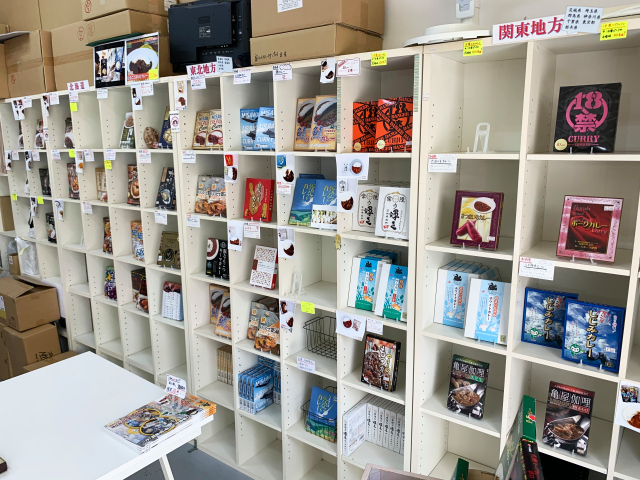
Still, you have to wonder if there’s anything new to gain after eating more than 2,500 kinds of instant curry. When we asked, Mrs. Inomata said, “Lots of new varieties come out every year, so there are still so many to discover and try!”

Those words were said with so much joy that we couldn’t help but be impressed by their love for curry. If you have a similar appreciation for one of our favorite foods, then make sure to stop by Curry Land when you’re in the Asakusa neighborhood to take advantage of their expertise!

Shop information
Curry Land / カレーランド
Address: Tokyo-to Taito-ku Nishi-Asakusa 2-24-7
東京都台東区西浅草2丁目24−7
Open 11 a.m.-7 p.m.
Closed Tuesdays
Website

Photos © SoraNews24
● Want to hear about SoraNews24’s latest articles as soon as they’re published? Follow us on Facebook and Twitter


Credit:

Final Evangelion movie streams on Amazon Prime in over 240 countries, subbed and dubbed, in August

Creator Hideaki Anno thanks “every Eva fan in the world,” asks them to watch it on a big TV.

The premiere of an anime movie is always an exciting time for fans, and that was especially true in March when Evangelion: 3.0+1.0 Thrice Upon a Time, the conclusion for the entire Evangelion franchise, finally made it to Japanese theaters after multiple delays.

However, a Japanese theater premiere is really just the start the start of a different kind of waiting for overseas fans, since they can’t just hop on over to a cineplex in Tokyo or Osaka and catch a matinee. Add in Evangelion rights holder Studio Khara’s reputation for taking a long time in approving its works for international release, and it would have been an understandable choice for Eva fans outside Japan to not get their hopes up about seeing Thrice Upon a Time anytime soon…but thankfully, as it turns out, an unnecessary one.

“Evangelion: 3.0+1.01 Thrice Upon a Time on Prime Video on August 13,” announced the official Evangelion website on Friday, and this treat is strictly for overseas fans, as the movie will be available to users of Amazon’s video service in over 240 countries and territories, but not in Japan, where Thrice Upon a Time is still playing int theaters. While a complete list of the 240-plus countries has not been made available, the news on Amazon’s side was broken by the company’s U.K. division, which adds that Thrice Upon a Time will offer subtitles in 28 different languages and also optional dubbed dialogue in English, French, German, Portuguese, Spanish, Italian, and four other languages.

The subtly different title of Evangelion: 3.0+1.0 seemingly implies that the Amazon Prime version will incorporate the retouched animation of the enhanced version that began showing in Japanese theaters some time after the original Evangelion: 3.0+1.01 release. Amazon Prime will also be streaming the three previous Rebuild of Evangelion movies, for anyone who wants to revisit the earlier installments of the tetralogy.

The announcement was accompanied by a message from Evangelion creator Hideaki Anno:

“I’d like to thank every Eva fan in the world for your continued support. We were looking for the best way to offer the movie to fans overseas as early as possible in a challenging situation with movie theatres during COVID-19, and are happy to have found Prime Video as a partner to stream it globally. We highly recommend watching it on a big TV screen for the best viewing experience.”

Considering that the previous Rebuild of Evangelion film, Evangelion: 3.0 You Can (Not) Redo, had more than a three-year between its Japanese and overseas release, the five-month wait for Thrice Upon a Time is a major improvement, and soon people all over the world will get to know what’s up with rice farmer Rei.

Source: Evangelion official website, Amazon U.K.
Top image: Evangelion official website
Insert images:
● Want to hear about SoraNews24’s latest articles as soon as they’re published? Follow us on Facebook and Twitter!


Credit:

We adopted a furry, cuddly, tailed cat cushion to keep us company at home

We ride Japan’s latest virtual pet sensation: a cushion with a moving tail.

Our Japanese-language reporter Punico Ninoude loves visiting her parents’ home because she gets to enjoy the unconditional love and warmth of her family job. However, being a working girl with all the responsibilities and worries that entails, she doesn’t have the time to dedicate to having a dog, or a cat, or anything else at her own place.

This is why she decided to take the virtual pet route. But rather than opting for the sterile digital company of a Tamagotchi, she chose to rent a Qoobo—a cushion-style, “therapeutic” robot that comes with its own happily wagging tail. It costs 13,200 yen (US$118.87) to purchase the robot for your own, but you can also rent one for a much more reasonable 800 yen a month through rental service Rentio here. Plug it in to charge it up, and then set it wherever you need it!

The draw of Qoobo is its intelligent tail wagging system. If you pet the cushion’s soft, furry body, the tail will respond in kind by wagging quickly or slowly.

▼ The box includes everything that Qoobo needs. No food, no litter!

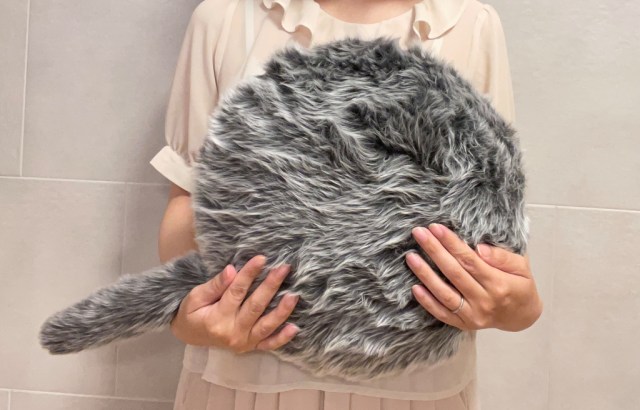
Though it’s surprisingly large, Punico found that it only weighed as much as a typical large cushion. And what weight it does have lends a pleasing physicality to it, so it really does feel a bit like a pet.

▼ Snuggly, cuddly Qoobo.

Though Qoobo is just a big fluffy disc without a head or any limbs, Punico’s impression was definitely that of a cat. It just…felt feline somehow, the long, tactile tail in particular. Punico had long given up on ever owning a cat due to her allergies, but now she could realize that long-forgotten dream with Qoobo!

It was time to activate Qoobo’s twitchy tail. Punico gave the beige switch next to the base of its tail a firm boop and the tail immediately began swooping to-and-fro, causing her to emit a gasp of delight.

Just as promised, the tail speed responded to how she pet it. First, she tried long, languid strokes…

▼ The tail movements became lazy and slow to match!

▼ Then, when she sped up, the tail sped up too!

Qoobo will also wag its tail unprompted, which leads to Punico’s final experiment. You see, she’d always felt just a little bit jealous of those people on social media who share pictures of their pets hampering their work.

▼ Admittedly, you have to set it in place yourself.

Still, it felt incredibly novel to Punico to be able to whine “I can’t work like thiiiiis” at her fuzzy little friend.

Qoobo does come with some unfortunate downsides that Punico ran into during her month-long rental. For one thing, the movement of swishing its tail is accompanied by a gentle whirring sound. It’s too quiet to be very noticeable in the daytime, but at night it might startle you. Punico adjusted for this by treating it as Qoobo’s equivalent of a bark.

The other issue is that it’s very easy for Qoobo to revert into a lifeless, basic cushion before you notice. It can operate for eight hours, but then it needs to be charged again. Punico would accidentally leave the switch on and forget to “feed” Qoobo its requisite diet of electricity, so poor Qoobo ended up staring at the wall for long periods of time.

▼ Sorry, Qoobo.

Also, since Qoobo has a lustrous, fluffy coat, it is necessary to remove it and wash it occasionally to stop it from getting dirty, especially if you have a young human child in your home, like Punico does, who may be spreading mess and grime around.

Don’t assume that because Qoobo is a robot that it will last forever, either. The company assures that its lifespan will last for around 700,00 shakes of its fluffy tail. Assuming its tail wags 100 times per day, that’s a lifespan of about two years. Nothing gold can stay…and nothing so cute can last, either. Still, if you’re interested in cuddly robots, Qoobo is here for you, as is the Lovot brand.

Related: Qoobo, Rentio
Images © SoraNews24

● Want to hear about SoraNews24’s latest articles as soon as they’re published? Follow us on Facebook and Twitter!


Credit:

Japanese dad turns ordinary photos of his daughter into amazing fantasy world scenes【Photos】

Image editing transports her from the living room to a world of amazing beauty and magical creatures.

Ever since cameras became affordable enough for private individuals to own, parents have been snapping photos of their kids. A key difference for the current generation, though, is that pressing the shutter button isn’t necessarily the end of the process. With photography having gone digital and the wealth of photo editing software out there, a loving mom or dad can tinker with all sorts of settings and filters to give the image some extra flair and pop.

So when Japanese Twitter user Kogame (@TauonQ) recently took a photo of his daughter, she asked him to retouch it too.

▼ The original photo

Kogame, though, is especially skilled at image editing, and so he went far beyond fiddling with the brightness and color sliders. By the time he was finished working his digital magic, the everyday photo of his little girl striking an out-of-place dramatic pose in their living room had been transformed…

…to a striking snow queen with wings on her back and a company of woodland minions rushing off to do her bidding!

“My daughter told me how she wanted me to retouch the photo, and this is how it ended up” tweets Kogame, as though it’s the most natural thing in the world. Then again, this isn’t the first time he’s transported her into a fantasy realm, as he also shared some previous after-editing photos of his kid.

▼ Clockwise from top left: “Dinnertime,” “Look Out Behind You,” “Trick or Treat,” and “Ice Dragon.”

Some of Kogame’s other photos show he’s got quite the eye for capturing the beauty of the real world too…

…but we’re already looking forward to what the next otherworldly adventure of this father-and-daughter duo will be.

Source: Twitter/@TauonQ via IT Media
Images: Twitter/@TauonQ
● Want to hear about SoraNews24’s latest articles as soon as they’re published? Follow us on Facebook and Twitter!


Credit:

Starbucks releases 47 Frappuccinos around Japan, we try the one for Nara Prefecture

Can this Frappuccino capture the flavour of a region famous for deer and the giant Buddha? 

Earlier this month, Starbucks surprised us with the announcement that they would be celebrating their 25th anniversary in Japan by releasing a total of 47 regional-exclusive Frappuccinos around the country, with one sold in every prefecture.

The series, called 47 Jimoto Frappuccino, with “jimoto” meaning “local,” was finally released today, and our Nara-based Starbucks expert K. Masami wasted no time in heading down to her local branch to pick up the Nara-exclusive beverage.

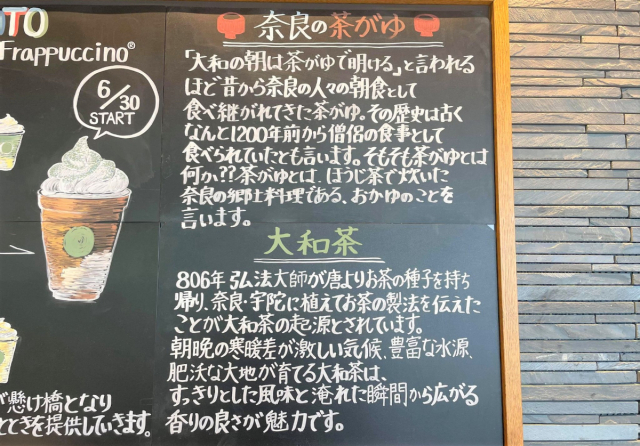
▼ This is where Nara sits in the grand scheme of new Frappuccinos

Each regional-exclusive Frappuccino has been created with input from local baristas, and Nara has been blessed with the Hojicha White Chocolate Frappuccino. This might seem like an odd choice at first, especially considering Nara is known for other local specialties like persimmons and kudzu (Japanese arrowroot), but according to Starbucks, hojicha was chosen because it’s the main ingredient in chagayu (tea gruel).

This tea porridge has a long history in Nara, where earliest records of the dish being eaten for breakfast can be traced back 1,200 years. Tea production in the area has an equally long and esteemed history, which is why hojicha, or roasted green tea, was chosen to represent Nara for this special release.

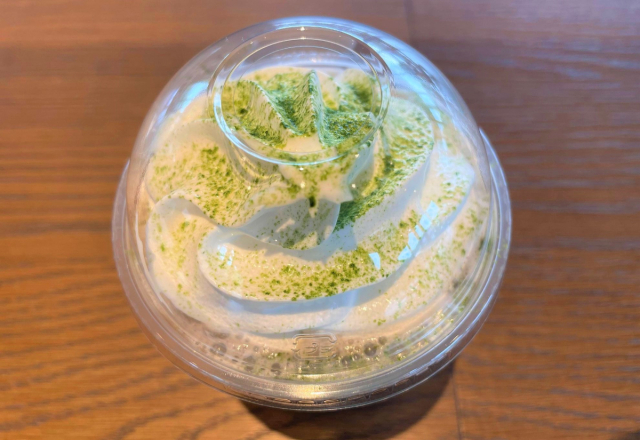
▼ The roasted green tea base is given a matcha powdered green tea topping.

The visuals attached to the drink are somewhat reminiscent of Nara Park, which is home to the prefecture’s famous deer. The matcha topping resembles Mt Wakakusa, located to the east of the park, and the fresh aroma is reminiscent of the grass on its slopes.

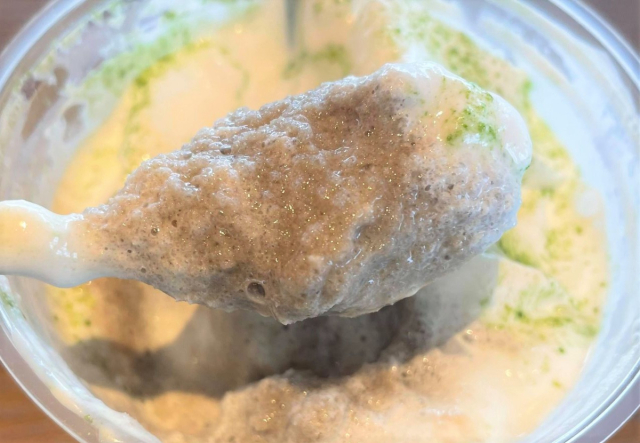
▼ As for the actual body of the drink, the pairing of roasted green tea with mellow white mocha syrup was sublime, and thankfully, not like gruel at all.

Nara’s exclusive Frappuccino turned out to be a great-tasting drink, and one that Masami is happy to have represent her prefecture. In fact, the focus on hojicha as a symbol of Nara made her rethink her own preconceptions of the area and she vowed to explore some of the famous tea stores she usually walks past on a day-to-day basis.

There are still 46 other flavours around Japan waiting to be tasted, so why not visit your local Starbucks while they’re on the menu, until 3 August, to see what flavours represent your locality? Like Masami, you might be able to discover a few new things about your area, and view your prefecture in a whole new light!

Photos ©SoraNews24
● Want to hear about SoraNews24’s latest articles as soon as they’re published? Follow us on Facebook and Twitter!


Credit:

Japanese whiskey fan gets a shock when he forgets about the drink he left in the freezer【Photos】

Drink ends up looking very different than what it started as.

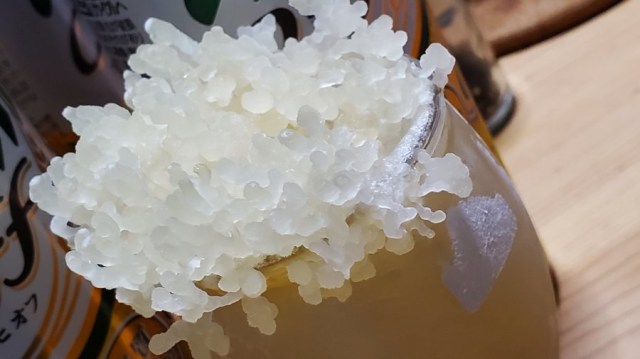
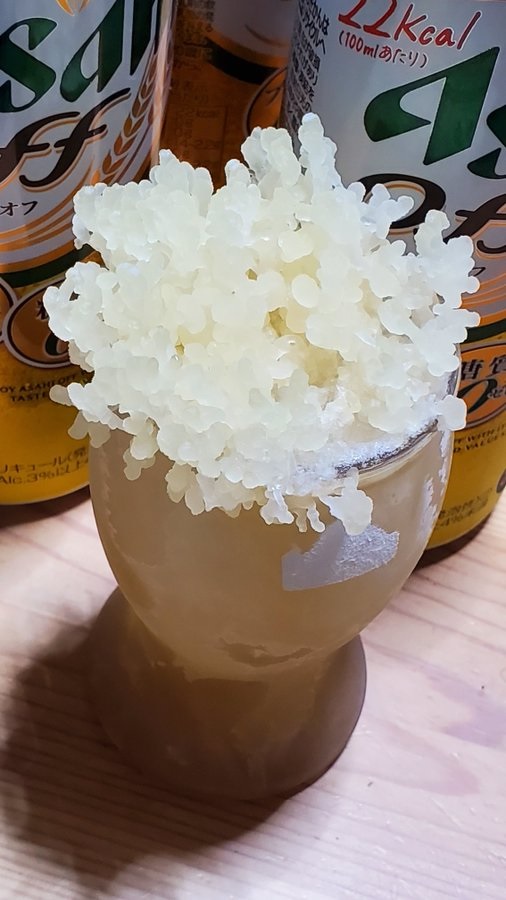
A stiff drink and a relaxing bath are both effective ways of unwinding at the end of the day, and recently Japanese Twitter user @kiku000084 wanted to enjoy both. First he poured himself a whiskey and water, but deciding he wanted to take the bath first, he put the glass in his freezer to chill while he soaked.

Unfortunately, when he got out of the bath, he forgot about his drink until much later, and by the time he finally did remember, it was startlingly unrecognizable.

“If you leave your whiskey and water in the freezer, it’ll end up looking like it has a punch, perm, so be careful,” cautions @kiku000084, referring to the tight-curl hairstyle sported by old-school tough guys in Japan (and also sometimes SoraNews24’s own Mr. Sato).

So why did this happen? @kiku000084 isn’t entirely sure, but the most plausible theory seems to be that it has something to do with differences in the volatilization and freezing temperatures for water and whiskey. Ordinarily, a home-use freezer won’t get cold enough to turn whiskey into a solid, but mixing it with water seems to have allowed sections of the solution to freeze, resulting in the uneven crystallization.

Further credence to that explanation comes from a follow-up experiment @kiku000084 performed using two different kinds of whiskey: the same Kirin Riku as in his first tweet and Suntory’s Kakubin. Between the two, Riku has the higher alcohol content, and the ice that formed on the top of its cup looks shaper and spikier than the slush for the Suntory’s.

@kiku000084 says he’s planning to dig deeper into this research on a day when he has time to drink several glasses of whiskey. In the meantime, though, this all makes a pretty compelling argument to just take your whiskey into the bath with you.

Source: Twitter/@kiku000084 via Hachima Kiko
Images: Twitter/@kiku000084
● Want to hear about SoraNews24’s latest articles as soon as they’re published? Follow us on Facebook and Twitter!


Credit:

This Japanese theme park just made a real-world Pokémon forest for you to go Pokémon spotting in

4,500-square meter Pokémon Wonder combines the fun of Pokémon with the beauty of nature.

The mainline Pokémon games are all about training your team of Pocket Monsters so they can beat up every other team in the world, and Pokémon GO is focused on the joy of capturing the critters in the first place. But the recently released New Pokémon Snap was an important reminder that Pokémon don’t have to be fighting to be fun, and that there’s a special joy just to spotting them out in the wild.

So it’s good timing on the part of Yomiuriland, a theme park on the northern outskirts of Tokyo, to create an entire Pokémon forest for fans to wander through and see how many different species they can find.

Billed as a “nature adventure,” Pokémon Wonder casts you as a newly arrived member of the research team of Professor Kureso, who’s voiced by veteran anime voice actress Maaya Sakamoto. After the professor and Pikachu give you an orientation about what kind of Pocket Monsters they want you to find and where you might see them, you’re let loose in Wonder Field, the first area of the Pokémon forest.

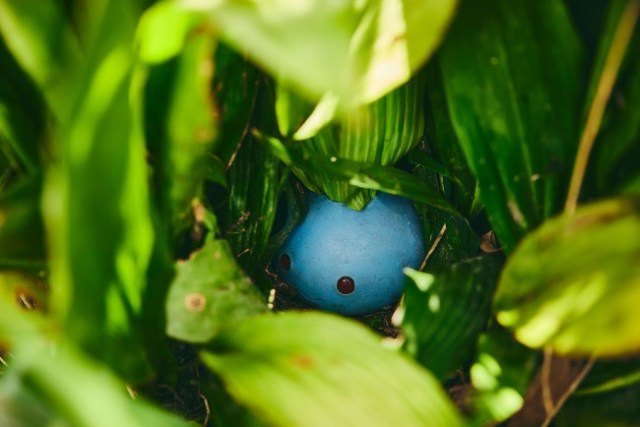
The venue is a vast area at the back of the Yomiuriland property where the vegetation has been left to grow wild for nearly 20 years. Waiting for you in the 4,5000-square meter (48,438-square foot) space is not only lush greenery, but cleverly concealed Pokémon!

▼ Why hello there, Oddish…

▼ …Diglett…

▼ …and Rowlet!

In total, there are more than 50 different species of Pokémon to find. Of course, having more humans than Pokémon in the forest would really hurt the sense of immersion, so you’ll be happy to know that a maximum of two teams, with no more than six people each, are allowed into the Pokémon Wonder attraction at any given time. Each team is given 90 minutes, and part-way through they split off into their own separate courses, with one group heading to an area called the Whispering Bamboo Forrest…

…and the other to the Ancient Stone Walls.

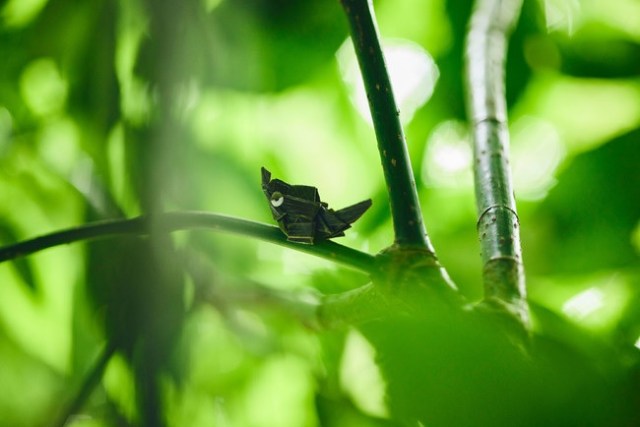
The organizers haven’t said if there’s any sort of point/ranking system for how many species you find, but they have talked about the philosophy behind how they created their creatures. Taking inspiration from how Satoshi Tajiri’s original idea for the Pokémon franchise grew out of his love of catching bugs as a child, the goal of Pokémon Wonder is to create an experience where “kids and adults alike can experience the beauty of nature through Pokémon,” and also one where the Pocket Monsters fans see aren’t illustrations, CG, or stuffed animals. To that end, all of the Pokémon you’ll see are made using natural materials. The Rowlet above, for example, is carved from camphor wood, with a camelia leaf bowtie. The Omanyte below is a stone carving…

…and this Metapod is a folded palm leaf, with silverberry leaf eyes.

▼ Metapod also showed up in the mysterious Pokémon Wonder teaser video.


Since it’s part of Yomiuriland, Pokémon Wonder participants will need both a regular admission ticket to the park (which starts at 1,800 yen [US$16] for adults and 1,000 yen for children) plus an additional Pokémon Wonder ticket (4,900 yen for adults, 1,800 yen for children, with discounts available for groups of three or more). You’ll also need a reservation, which can be made online here.

Pokémon Wonder opens on July 17 and is currently scheduled to run until April 3 of next year.

Related: Yomiuriland
Sources: PR Times, Pokémon Wonder
Top image: PR Times
Insert images: PR Times, Pokémon Wonder
● Want to hear about SoraNews24’s latest articles as soon as they’re published? Follow us on Facebook and Twitter!


Credit: