The next evolution in begging for forgiveness has arrived: the dogeritsu

A breakthrough in penance.

In Japan, mid-spring is when most new employees join the workforce for the first time. As such, at this time of year it’s important for them to be developing and improving skills they may not have been taught in school, things like calling in sick while doing yoga positions for a believable voice, and more importantly, how to grovel after you get caught calling in sick while doing yoga positions for a believable voice.

In Japan, the ultimate gesture of apology is called the “dogeza.” This is the posture often referred to by the Chinese name “kowtow” in English, in which a person gets down on their hands and knees and touches the ground with their forehead.

▼ It’s not uncommon for a dogeza to occur in our office.
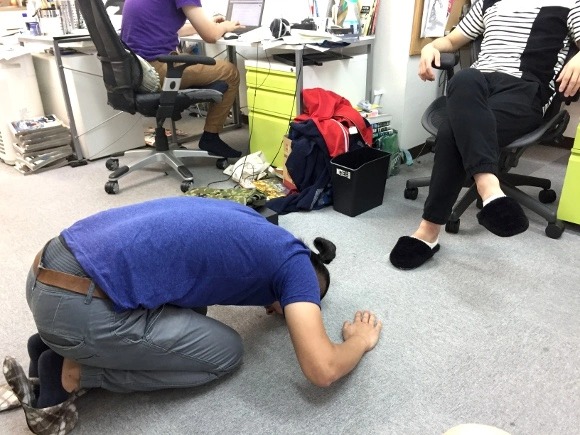
It is the height of deference in the sense that one cannot bow any further without somehow breaking through the floor…or can they?

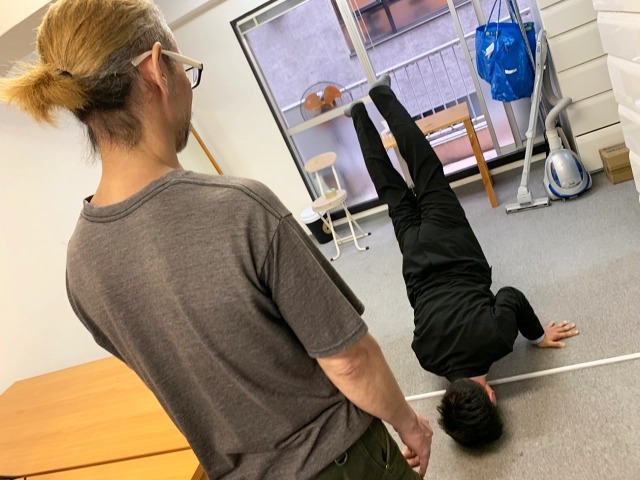
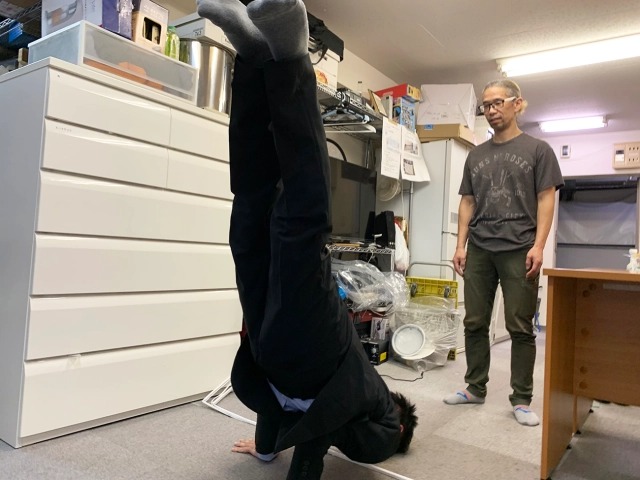
Our resident screw-up Seiji Nakazawa, after repeatedly angering friends, co-workers, and loved ones, found that his dogeza was losing its potency and conducted research to develop something more pacifying: the dogeritsu.

As a demonstration, let’s watch Seiji apologize to Mr. Sato for accidentally emailing a sexy Sato photo to Mr. Sato’s father in rural Shimane.

“Subject: Happy Birthday Pa!”

Seiji: “Mr. Sato, I have something important to tell you.”
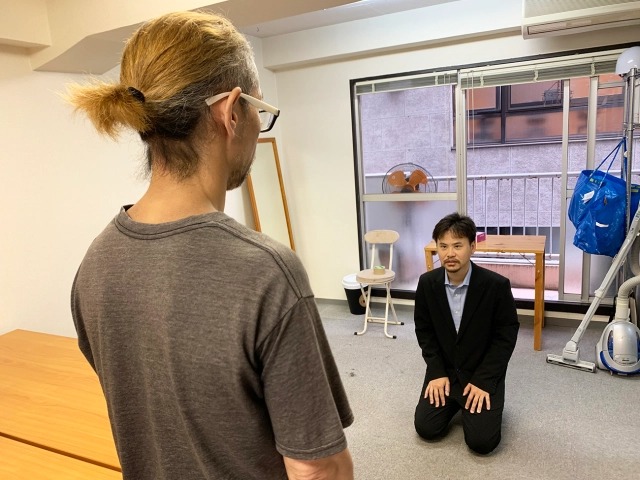
Seiji: “Just a…ugh…sec…unh”

Mr. Sato: “Cool…”

Mr. Sato: “That was so surprising and impressive I forgot why I was angry. Just seeing something like that is kind of overwhelming.”
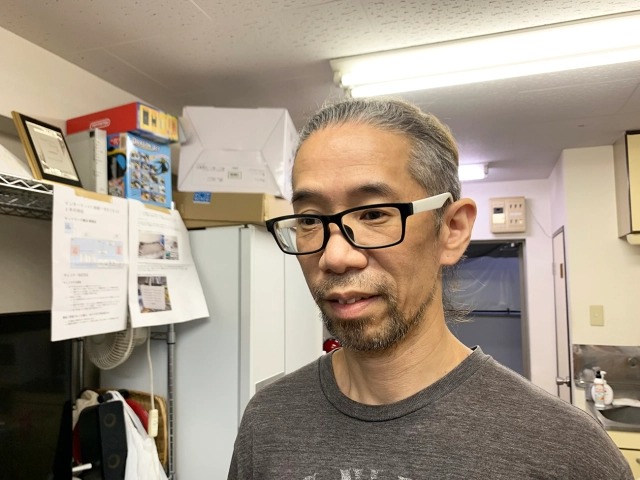
And therein lies the true power of the dogeritsu. Unlike the token gesture of a dogeza that merely leaves the offended party stewing in their juices or rage, the dogeritsu employs shock and awe to relieve that person of their anger, flushing it away with a wave of absurdity.

And now you can too!

Watch as Seiji teaches us all how to do a dogeritsu:

1) Kneel down and align your hands on the ground.
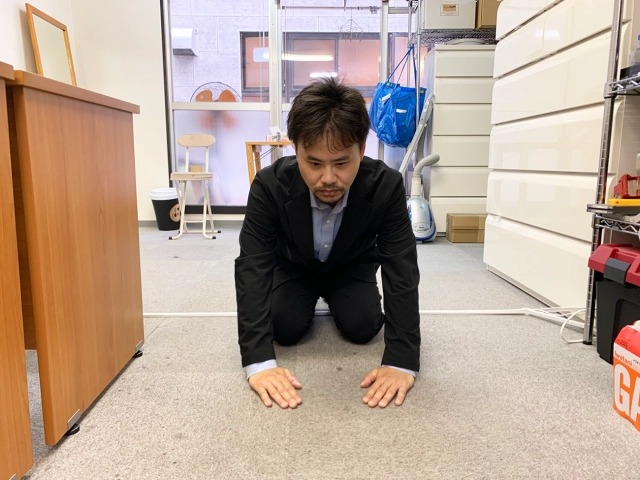
2) Press your head on the ground while shifting your stronger hand under your stomach.

3) Wedge the elbow or your dominant arm under your midsection for support as you lift your legs straight in the air. Your other arm will simply provide balance but can take on weight as needed.

▼ A better look at how your hands and head should be oriented
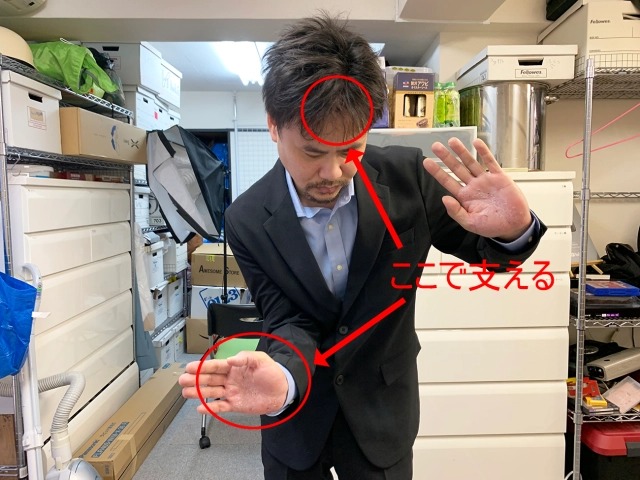
4) Ensure your legs are straight and aligned for the maximum effect.
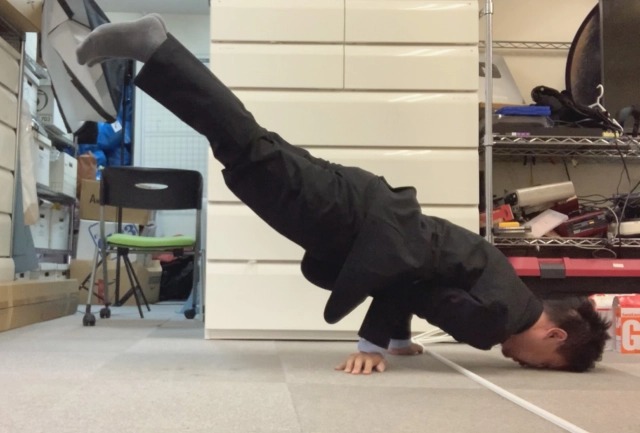
And that’s it!

Seiji also advises to be aware of the distance between your dominant hand and head. The closer they are together, the steeper your dogeritsu will be. A steep dogeritsu will certainly be impressive, but requires more strength to hold up against gravity. Be sure to find a suitable distance for your own body type and strength.

▼ A sideways dogeritsu is also acceptable
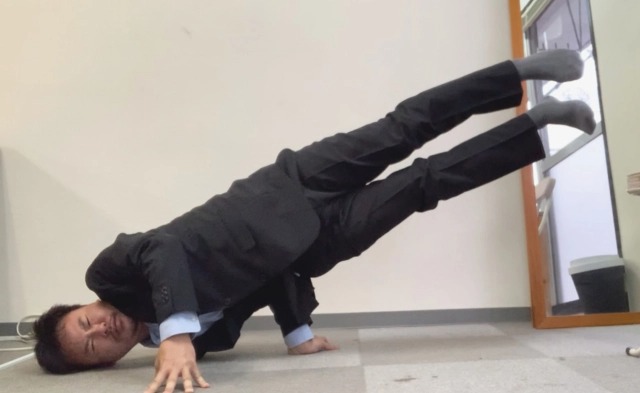
In an age of ever more inexplicable and inexcusable offenses, more sophisticated apologizing techniques are needed to keep pace. So be sure to add the dogeritsu to your repertoire before it too fades in impact.

Photos ©SoraNews24
● Want to hear about SoraNews24’s latest articles as soon as they’re published? Follow us on Facebook and Twitter!


Credit:
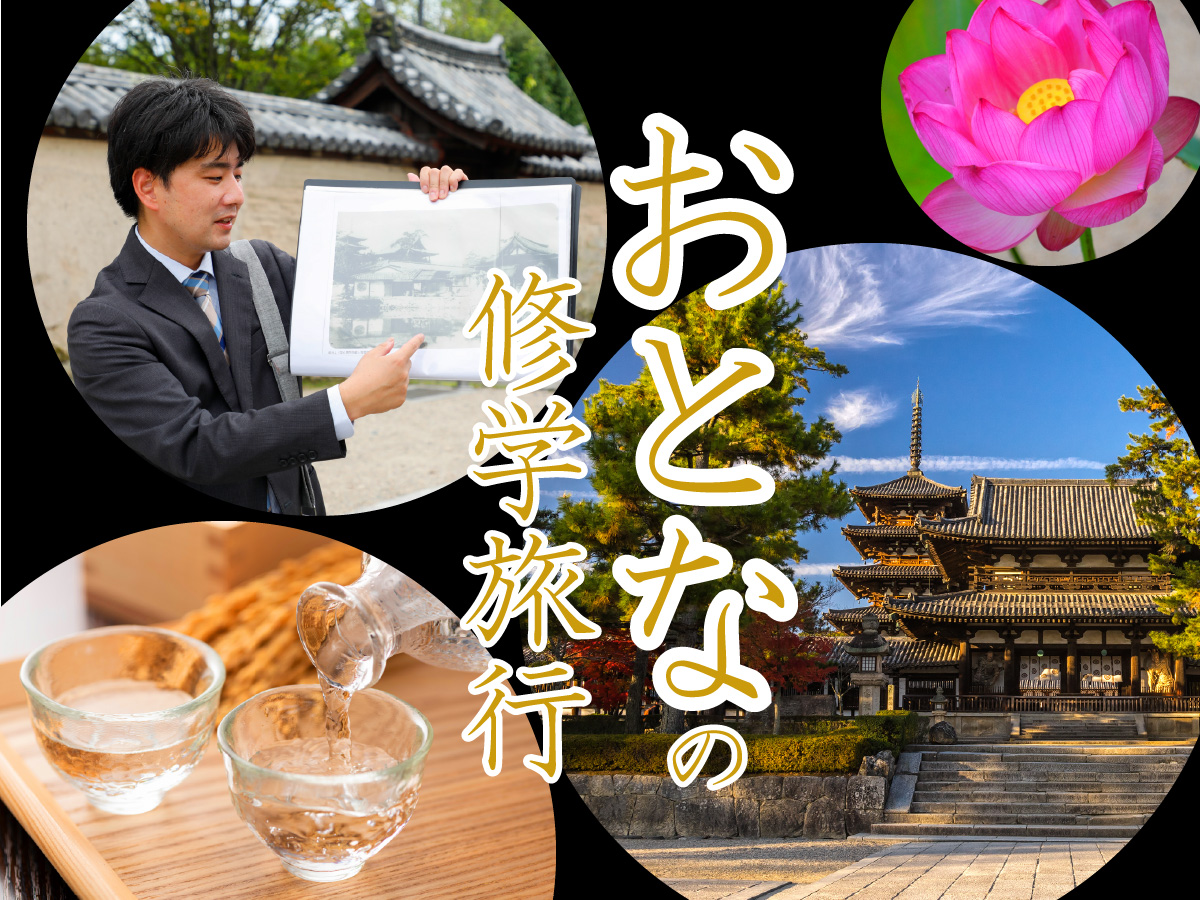
Miss school field trips? Now adults can go on a “school trip” too with new plan at Nara hotel

With lots of tour-like features and educational experiences, you’ll learn a lot and have fun, too!

You may already know that, in Japan, schools organize an annual “shugaku ryoko” for their students: a long-distance trip to historical places like Kyoto or Nara. In these school trips, classes as a whole travel together, stay in hotels, and tour local temples and monuments as a part of their school curriculum.

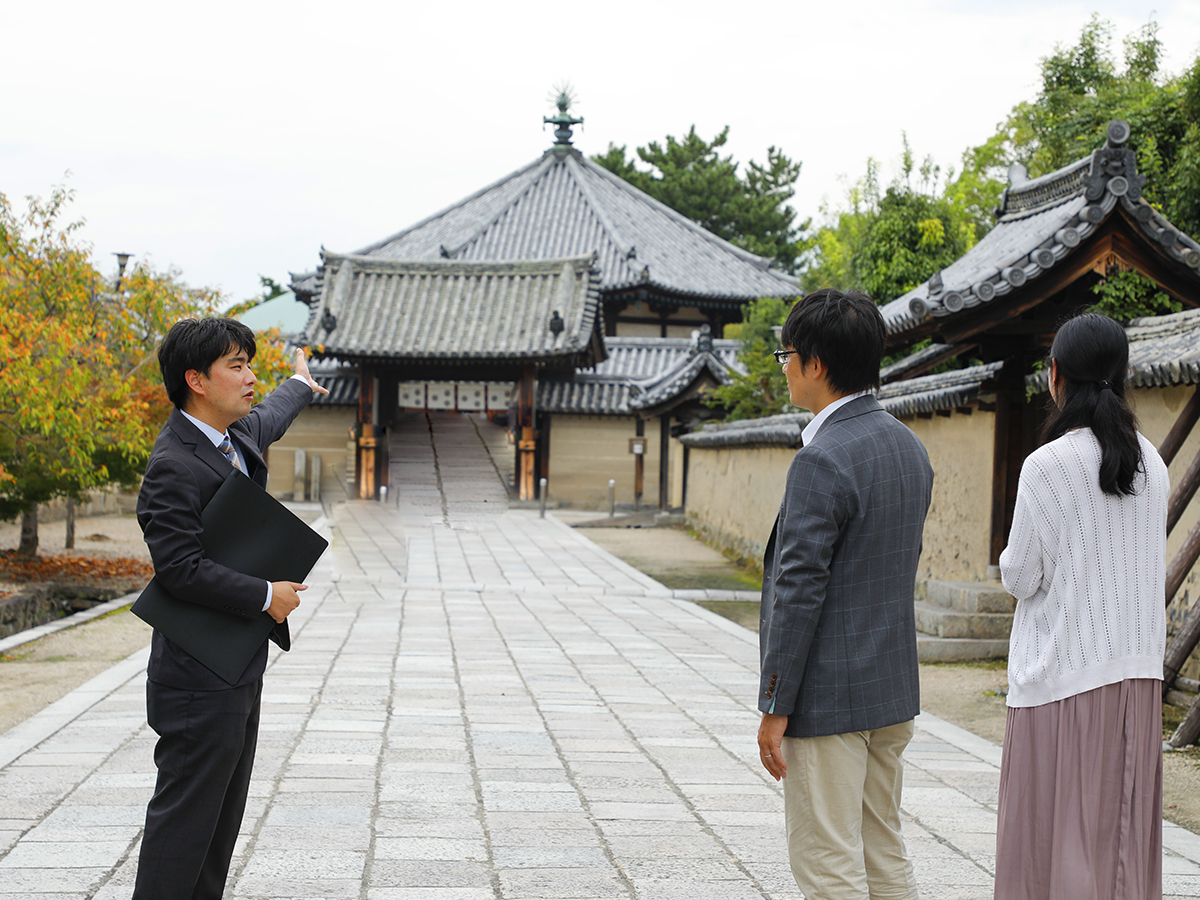
School trips are a great opportunity for students to bond and build great memories–but unfortunately, a lot of those memories don’t involve the actual tours they went on. That’s why we’re pretty excited that Nara inn Waqoo Horyuji is offering a new hotel plan called the “Adult School Trip Plan”, which includes not only a stay just outside Horyuji Temple, one of Nara’s most famous temples and a place everyone should visit once before they die, but a host of educational opportunities.

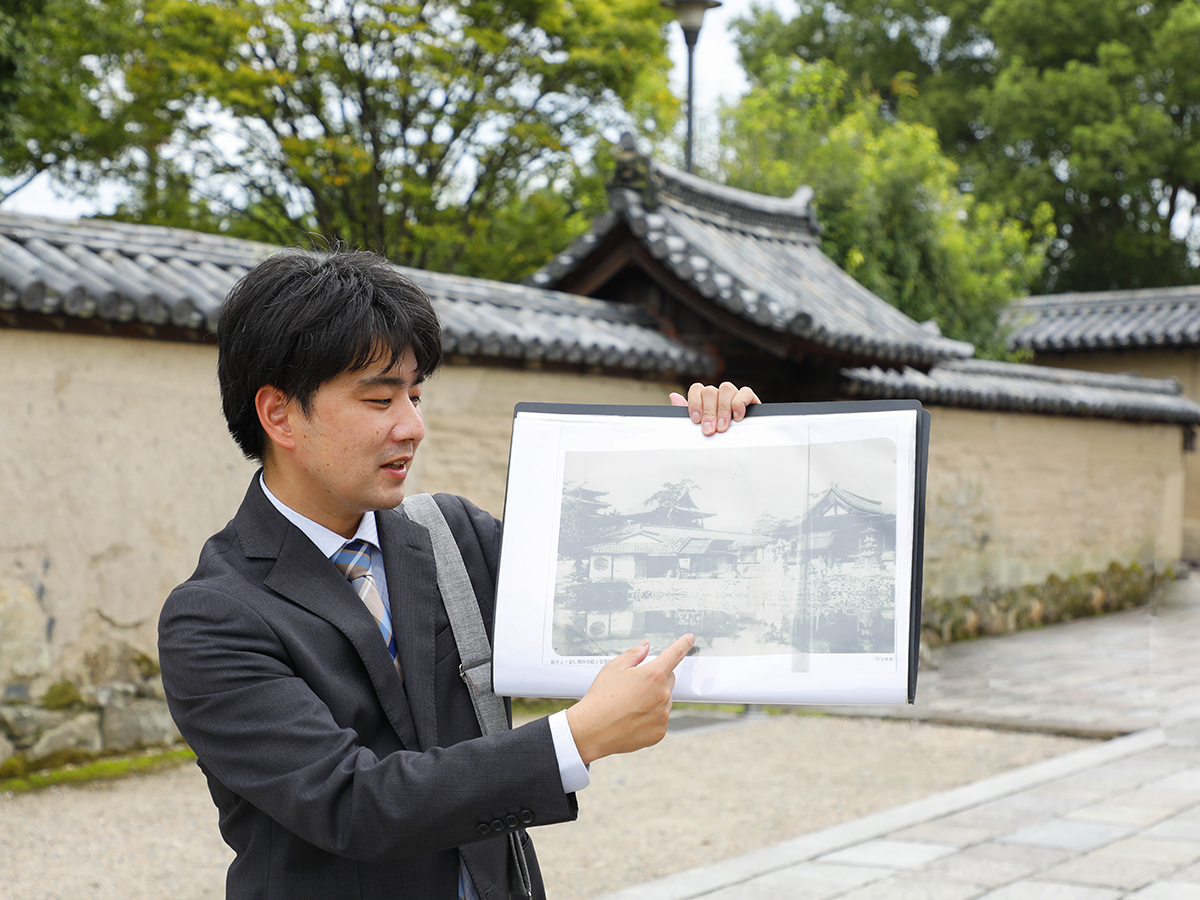
This plan is different from other tour packages in that it includes one of the inn’s famous storytellers who will guide you through Horyuji Temple, whose main hall is considered one of the oldest buildings in the world. Through stories like “The Battle of Wits between Buddha and Humans” and “The Suffering of the Asura Statue”, they can offer a whole new perspective on Nara and Buddhist history that you won’t find in a textbook or guidebook.

They can also point out spots on the grounds that you might ordinarily miss. With a wealth of knowledge of and stories about Buddha and Buddhist statues as well as the sites within the temple grounds, the storytellers will offer you a more interesting experience of Horyuji Temple that you might not be able to find on your own–or that you might be able to remember from your childhood.

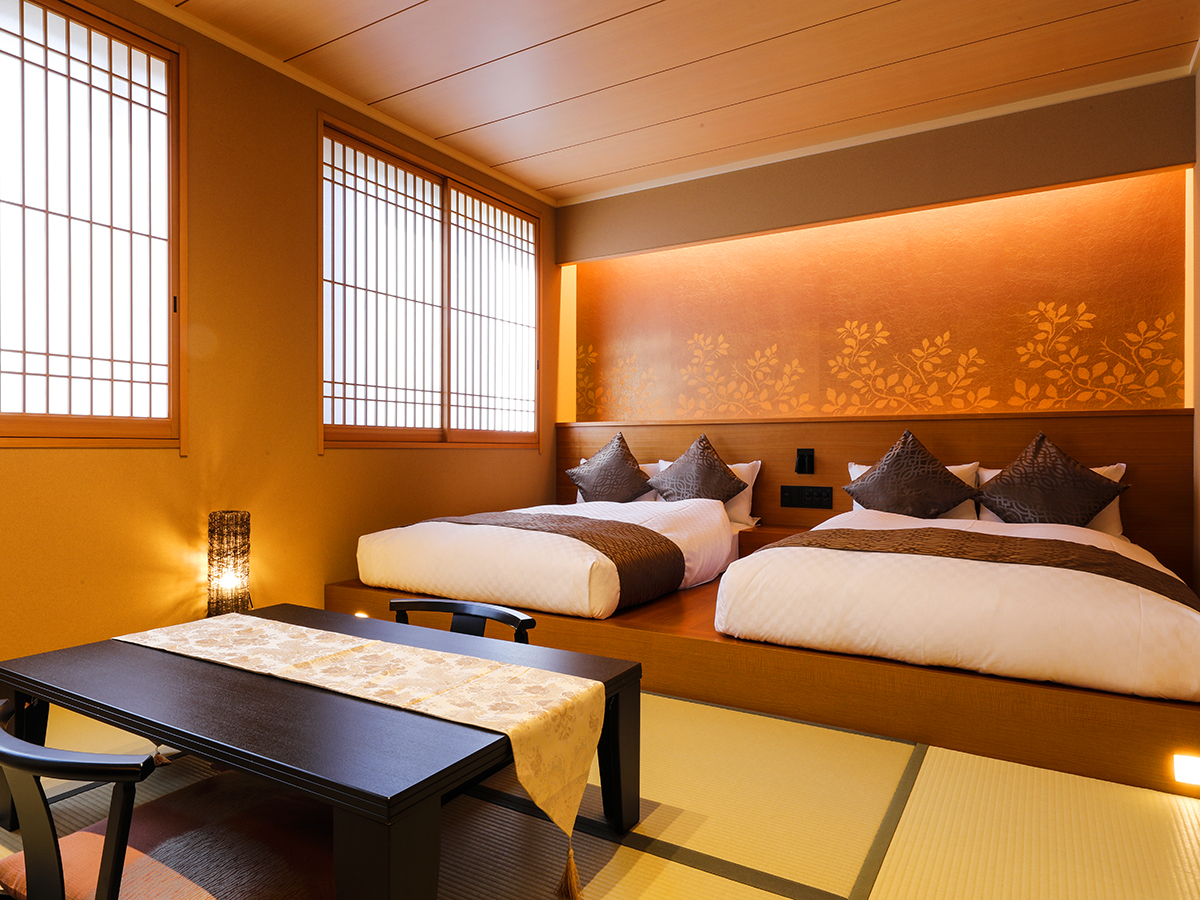
Naturally, the plan also includes a stay in one of Waqoo Horyuji’s rooms, which are luxurious spaces steeped in Japanese culture. With a mixture of Japanese-style leisure and western-style comfort, these rooms offer a nice place to kick back, relax, and sleep away any exhaustion.

In the lobby, there’s also a neat gift shop to peruse that stocks and displays local souvenirs as well as Buddhist statues.

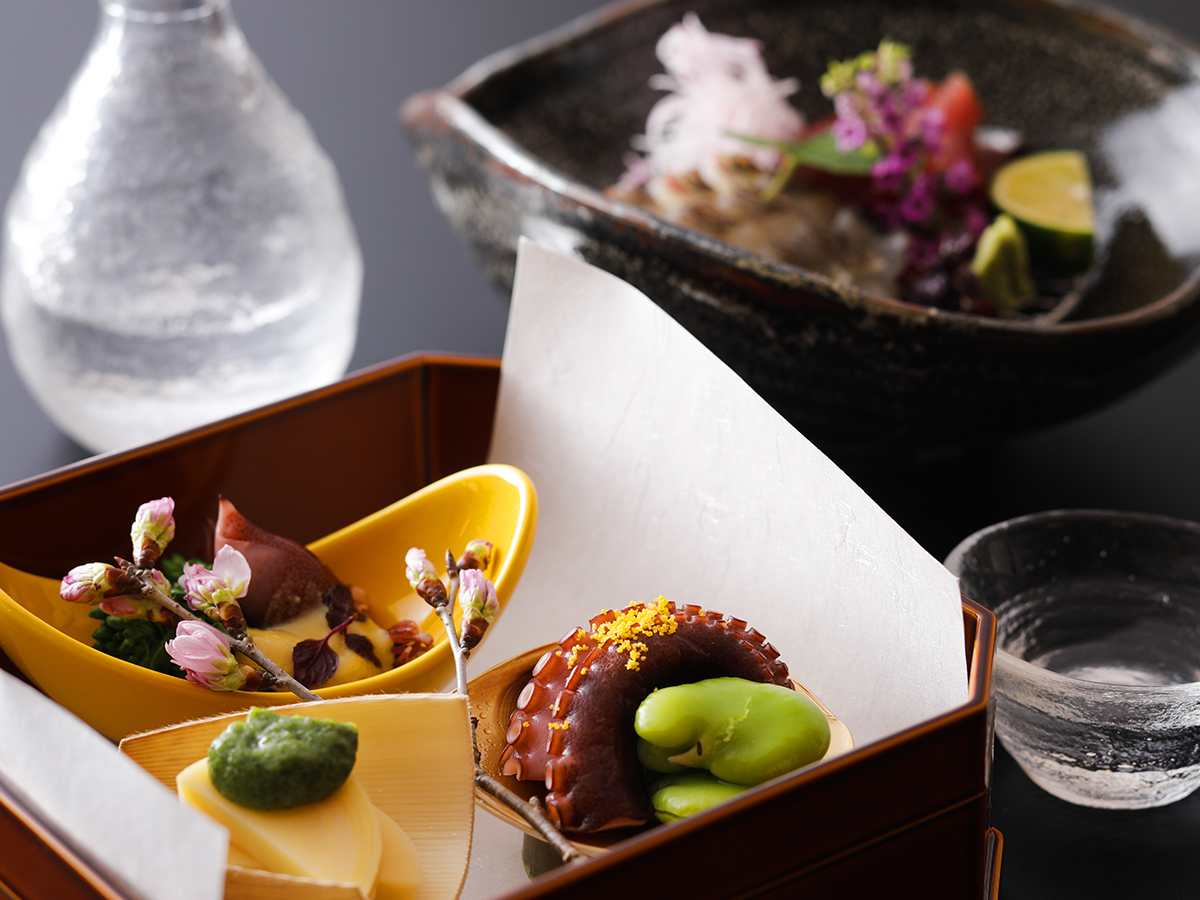
The inn itself also offers various activities. Included with your meals is a tasting of three kinds of local sake, which the chef carefully selects to match your meal.

Dinner is also composed of kaiseki ryori, a Japanese-style multi-course meal, which affords you plenty of time to savor the alcohol.

What’s more, every night “talk shows” are hosted in the inn’s Gallery Bar, where guests can learn about Nara’s history and culture as they enjoy sake or other drinks.

Plus, the inn’s prime location, just a 30-second walk from the gate to Horyuji Temple, means that you can go out to explore the temple any time you like. If you’re lucky, maybe you’ll be able to catch an Instagram-worthy shot of the temple’s pagoda at sunset!

The Adult School Trip Plan is available now through July 15, and prices start at 25,200 yen (US$195) per person for a two-person room. Bookings can be made through Waqoo Horyuji’s official site. Even if you’ve been to Nara before or you remember all you saw when you went as a child, this trip offers a different perspective and new experiences, so why not book an adult school trip for yourself? Besides, you can never get enough of the polite deer that hang around the area!

Source, images: Newscast
● Want to hear about SoraNews24’s latest articles as soon as they’re published? Follow us on Facebook and Twitter!


Credit:
Starbucks Japan’s Melon Frappuccino: One of the most memorable drinks in recent history

Melon upon melon upon melon upon melon upon melon…

After bidding goodbye to Starbucks’ devilishly good strawberry Frappuccino, it’s time to welcome a new temptation into our lives — the beautifully named Melon of Melon Frappuccino.

▼ On sale from 1 June, this  eye-catching green beverage retails for 690 yen (US$5.34)

Melons are a rare flavour at Starbucks, having appeared only briefly in a frappe six years ago (with the exception of a high-calorie Ibaraki Prefecture-exclusive). Needless to say, our Frappuccino expert K. Masami wasn’t going to let this rare opportunity pass her by, so she headed out to purchase the Melon of Melon, stopping to admire its beauty before the tasting.

▼ Look at those melon-y layers!

As you can see, there are two types of melon in the drink — orange melon appears in the saucy middle layer, while green melon abounds in the milky base and even in the sauce and whipped cream topping.

▼ Mmmmmelon.

That’s a whole lot of melon in one humble beverage, but when Masami dipped her spoon beneath the surface, she was surprised to find there was more — the orange melon middle was delectably pulpy.

▼ Is this the melon of melon?

The buried golden treasure enticed Masami to keep delving into the drink again and again, and each time she lifted a spoonful to her mouth, her eyes opened wide at the marvellous melon flavours.

The drink was light and refreshing, but also had a good full body to it, thanks to the creamy milk component. The thick pulp was absolutely divine, delivering intense hits of melon against the more mellow milky green melon flavours.

▼ According to Masami, this is one of the most memorable Starbucks drinks in recent history.

Despite being filled with melon upon melon upon melon upon melon upon melon, this was a well-rounded drink that was the Goldilocks of Frappuccinos for Masami — every sip was just right.

The Melon of Melon Frappuccino looks set to be a popular drink at Starbucks this summer, and though it’ll only be on the menu until 12 July, Masami has her fingers crossed that it’ll return in future, like the pink strawberry Frappuccino did earlier this year.

Images © SoraNews24
● Want to hear about SoraNews24’s latest articles as soon as they’re published? Follow us on Facebook and Twitter!


Credit:
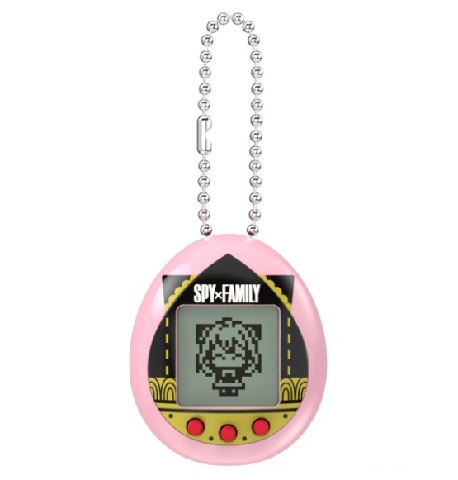
You can start your virtual found family with a Spy x Family Tamagotchi【Photos】

Anya needs someone to take care of her, and how could anyone say no?

It’s genuinely impressive that the original Tamagotchi managed to become such a hit. Though the idea was essentially untested at the time, fans quickly formed bonds with their virtual pets, despite having never seen them before they appeared on the pixely screen.

Fast forward to the present day, when virtual pets of various types have become part of the electronic entertainment landscape, and the appeal isn’t hard to see anymore. But that appeal is even more apparent when the Tamagotchi concept is applied to a character that fans already know, adore, and want to take care of, which is exactly what’s happening with the Spy x Family Tamagotchi.

The plot of the Spy x Family anime/manga revolves around a trio of characters posing as a family, each keeping aspects of their true identities secret from the others. But while secretly-a-spy Loid and secretly-an-assassin Yor each have a compelling character arc, pretty much anytime precocious six-year-old-psychic Anya shows up, she immediately steals the show, and so she alone is the star of the Tamagotchi collaboration.

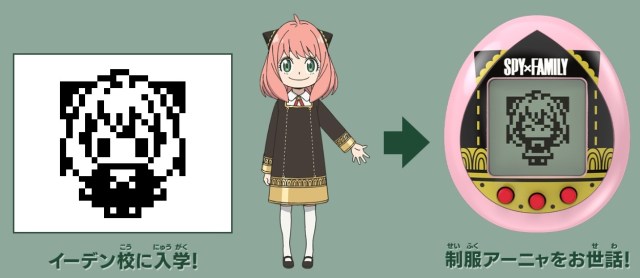
As Anya’s caretaker, you’ll watch over her as she enrolls in the prestigious Eden Academy. Your parental duties will include making sure she has both a sound body and mind, so make sure to play dodgeball and word-match mini games with her. You’re also responsible for taking care of her nutritional needs, and if she gets hungry between meals you can give her some peanuts, her favorite snack, to munch on.

▼ If you want the full-on peanut pancakes, though, you’re going to have to go to the Spy x Family Cafe in Tokyo.

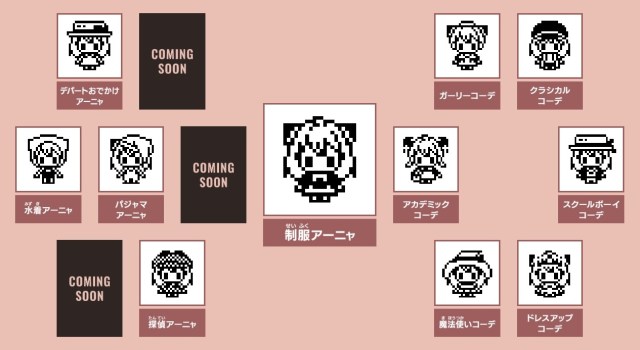
Depending on how things progress, Anya will don one of more than a dozen outfits, including her Eden school uniform, fancy party attire, and even witch and detective costumes.

▼ A few clothing sets are being kept secret, so there’s still a chance that one is a Uniqlo Spy x Family T-shirt.

Anya’s mood is also reflected in her facial expressions, and don’t worry, her fan-favorite unnerving smile is accounted for.

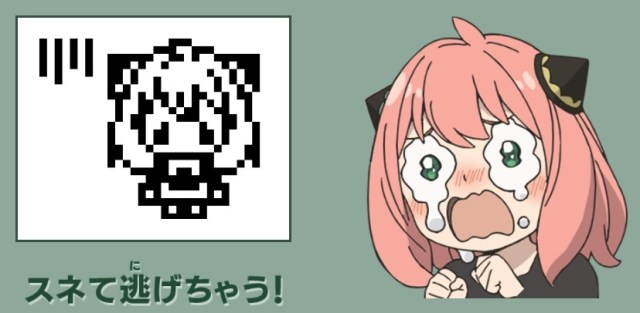
One thing you don’t want to see, though, is Anya being weighed down by the dark vertical lines of anime depression. It seems her mind-reading powers can’t transcend the border between the Tamagotchi and human worlds, and if she comes to feel neglected and unloved, she’ll run away from home (ostensibly since having her die, like a normal, animal/pet-style Tamagotchi, would be too grim).

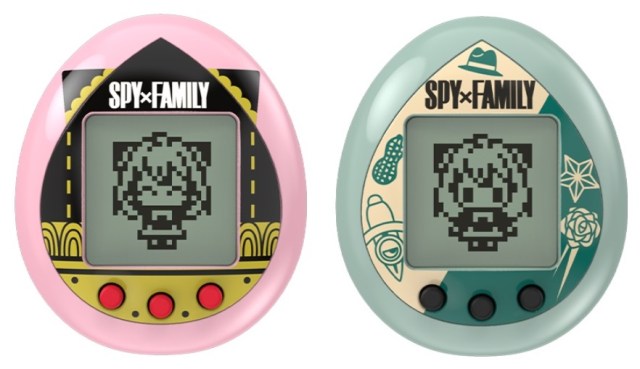
▼ The 2,530-yen (US$19.90) Spy x Family Tamagotchi comes in two colors, Anyacchi Pink and Spy Green, but it’s Anya inside both.

The familial themes of Spy x Family make the Anya Tamagotchi arguably more of a virtual child than a virtual pet. Since it goes on sale December 17, though, you’ve still got some time to mentally prepare yourself for being a virtual parent.

Source: Bandai via IT Media
Top image: Bandai
Insert images: Bandai (1, 2)
● Want to hear about SoraNews24’s latest articles as soon as they’re published? Follow us on Facebook and Twitter!


Credit:
This futon blanket with built-in fans will save your life this Japanese summer

Say “no more” to waking up in the middle of the night drenched in sweat.

Japanese company Thanko–yes, the company that brought us one-person bento box rice cookers, a device to help you play smartphones games on the train, and more–has come up with yet another genius invention to beat the rapidly rising heat.

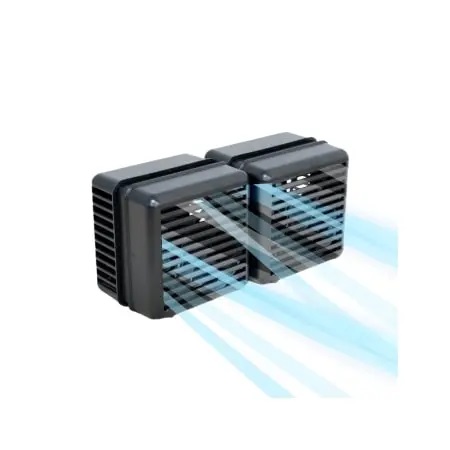
▼ Introducing: The Fanneru.

The Fanneru, a combination of “fan” and “neru“, the Japanese word for “sleep”, is a super-ventilated futon blanket with two built-in fans (perhaps not coincidentally, fanneru is also the Japanese pronunciation of the word “funnel”). Thanko wanted to solve the problem many have of waking up in the middle of the night to let built-up heat escape, only to get chilly again and have to fully cover up. This solves both problems with no effort on your part!

▼ No more sleeping with the air conditioner on with these babies.

Along with the two built-in fans, the Fanneru includes a remote so you can operate the fans without having to sit up. You can set the fans to three different strengths, and it even comes with a timer function in case you tend to regularly get chilly at certain points in the night.

▼ Less sweating means less dehydration

The Fanneru also has six air vents on the inner layer, so even if you don’t have the fan on, you’ll still let all that hot air out, and the outer material of the futon blanket is cool to the touch and fast-drying. One of the best parts is that it’s fully machine washable (with the exception of the fans, of course) for easy cleaning!

Thanko’s Fanneru is available now on their online shop for 9,800 yen (US$76.29). It may seem a bit more expensive than the average blanket, but if you use this instead of leaving your air conditioner on all night, it basically pays for itself. Just make sure you decide quickly, though, because they’ve already sold out once! And when summer is finally over and the seasonal allergies kick back in, there’s gear for that, too. Thanks, Thanko!

Source and images: PR Wire
● Want to hear about SoraNews24’s latest articles as soon as they’re published? Follow us on Facebook and Twitter!


Credit:

Opening delay for Ghibli theme park has very Ghibli reason, but free no-ticket area is good news

A little bad news, but plenty of good news too as two more Ghibli anime are getting attractions at the theme park.

So there’s good news and bad news about Ghibli Park, the anime theme park currently under construction near Nagoya in Aichi Prefecture. The good news is that three of the park’s areas are still on track to make their opening date this November. The bad news, though, is that the opening for one of the remaining areas, the one where fans can visit Howl’s Moving Castle, is being delayed.

To quickly review, Ghibli Park, in its final form, is going to consist of five sections, all located inside Expo 2005 Aichi Commemorative Park in the town of Nagakute. Three of those sections, Dondoko Forest (a.k.a. the My Neighbor Totoro area), Hill of Youth (drawing inspiration from Whisper of the Heart), and Ghibli’s Grand Warehouse, are set to open on November 1. The two remaining sections, though, Mononoke Village (based on Princess Mononoke) and Witch’s Valley (featuring locations from Howl’s Moving Castle and Kiki’s Delivery Service), were originally scheduled to open a year later, in the fall of 2023.

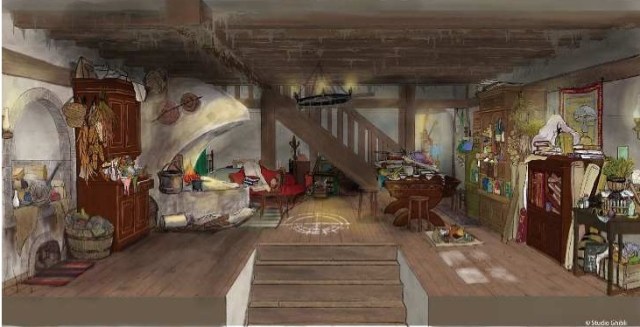
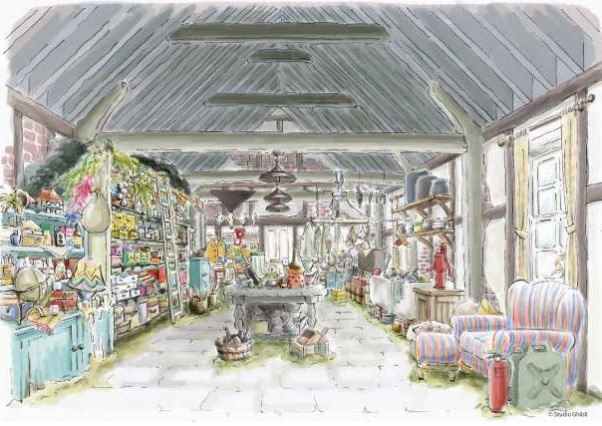
▼ Interior entryway design for Howl’s castle at Ghibli Park

Mononoke Village is still sticking to that timetable, but the opening of Witch’s Valley is being pushed back. While that’s sure to make fans sad, they can at least take solace in the fact that the delay is happening because of a very Studio Ghibli-like attention to artistic details.

Within the anime themselves, the settings of Howl’s Moving Castle and Kiki’s Delivery Service aren’t explicitly stated to be anywhere specifically in the real world, but both films have heavily European aesthetics. Because of that, Ghibli Park’s planners are adamant about using traditional European building materials and architectural techniques for the structures in Witch’s Valley, such as a recreation of Kiki’s home and bakery and Sophie’s hat shop from Howl.

▼ Kiki’s bakery

The designers feel that broad-leaf hardwood, such as oak, chestnut, ash, and zelkova are the best artistic match for this purpose, but unfortunately hardwood panels from those trees aren’t commonly sold in the Japanese market, Ghibli Park’s planners say.

The lumber itself can be sourced from within Japan, with available sources in Aichi, Gifu, Hokkaido, Nagano, and Yamanashi Prefectures. It will take time to log, dry, and cut, though, and that means the opening of Witch’s Valley is going to be pushed back until March of 2024.

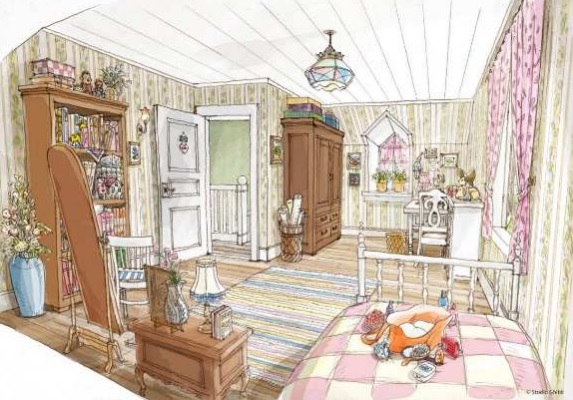
▼ Kiki’s childhood home

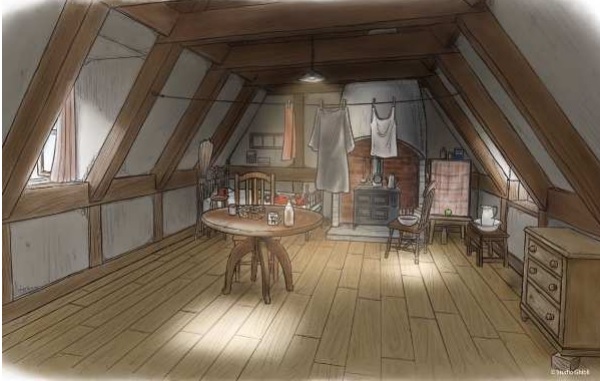
To soften the blow, the planners have released a new batch of concept art for the Witch’s Valley attractions, as seen throughout this article.

▼ Kiki’s attic and childhood rooms

And in a surprise twist, the new batch of preview images for Witch’s Valley includes concept artwork for something called the “Witch’s House”…

…which it turns out is a recreation of the home of Bella Yaga from Earwig and the Witch, Studio Ghibli’s first all-CG anime.

▼ Witch’s House potion workshop

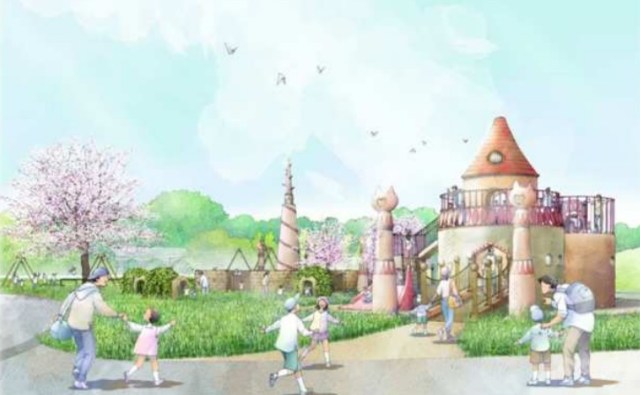
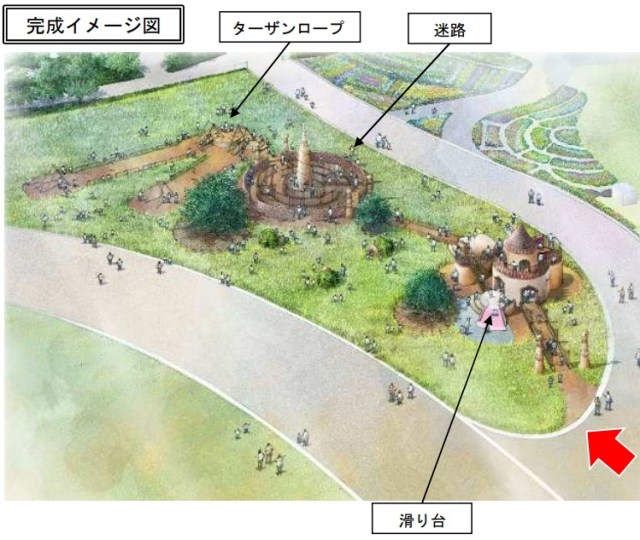
That’s not the end of the good news either. Ghibli Park’s planners also revealed that they’re building a maze, slide, and “tarzan rope” play area modeled after the settings of The Cat Returns, the side-story/semi-sequel to Whisper of the Heart.

So where are the Cat Returns attractions going to be? Next to Mononoke Village. Yes, next to Mononoke Village, not inside of it, because they’ll be in a public section of Expo 2005 Aichi Commemorative Park that anyone can access, even if they haven’t purchased a ticket to Ghibli Park.

▼ The Cat Returns play area is scheduled to open in summer of 2023.

It’s a thoughtful and generous decision, and another example of how Ghibli Park is trying to keep things affordable for fans.

Source: Aichi Prefecture (1, 2)
Top image: Aichi Prefecture/Studio Ghibli
Insert images: Aichi Prefecture/Studio Ghibli (1, 2)
● Want to hear about SoraNews24’s latest articles as soon as they’re published? Follow us on Facebook and Twitter!


Credit:

Japanese schools banning nicknames, mandating use of -san divides opinions

Proper manners, or forcing kids to be too polite?


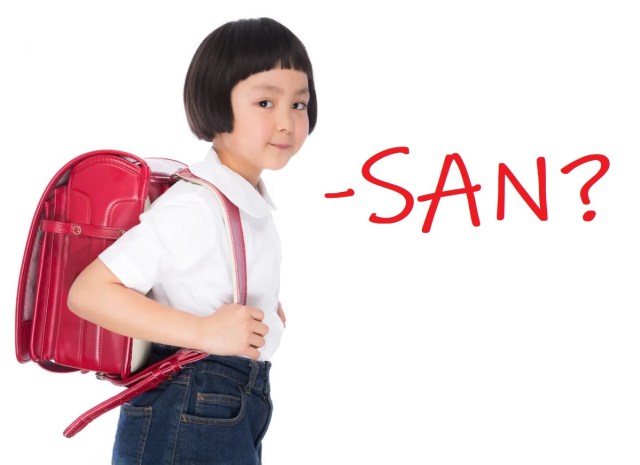
“-san” is often though of as the Japanese version of “Mr.” or “Ms.” A difference, though, is that -san can also be used with a person’s given name. So, for example, if someone is talking with Yoshio Yamada, they might call him Yamada-san, or they might call him Yoshio-san.

Or they might just call him Yoshio, with no -san at all, or maybe he’s got a nickname, like Yosshi, that people call him by instead.

But at certain elementary schools in Japan, plain Yoshio and Yosshi wouldn’t be options, because some Japanese schools prohibit students from calling each other by nicknames or dropping the -san. There aren’t any official statistics about how widespread such rules are, but one Tokyo public elementary school principal, speaking with the Yomiuri Shimbun newspaper, said he thinks it’s becoming a more common rule at schools in the city.

Tokyo’s Kasai Elementary School, for example, has its teachers instruct students to use -san when talking with their friends. “If you foster a sense of respect for the person they’re talking to from a young age they won’t take actions that hurt others,” says Masaaki Uchino, Kasai Elementary’s 60-year-old principal.

▼ Did this guy spend his formative years not calling his friends with -san?

Advocates of having even children call each other with -san tend to feel that way for two reasons. First, dropping the -san when speaking with someone, a practice called yobisute, can be interpreted in multiple ways. In a positive sense, it can be seen as a sign that there’s no need to stand on stuffy ceremony, and it’s not at all uncommon for especially close friends in Japan to yobisute each other. But on the other hand, since -san is, fundamentally, a polite form of address, dropping it can also be seen as a sign that the person isn’t worthy of respect, especially if the people in the conversation aren’t that close.

Another issue is that, at least among the educators who spoke with Yomiuri Shimbun in favor of mandating the use of -san, there doesn’t seem to be a clear distinction between ordinary nicknames and derogatory ones. “Many nicknames that are based on a person’s physical appearance, or a mistake they made, are insulting,” says Mitsuo Nobuchi, the 51-year-old vice principal at Mito Eiko Elementary, a private school in Ibaraki Prefecture whose conduct rules for students include “Use -san when talking to your friends.” “We don’t believe that rules for how students should address each other will completely stamp out bullying,” admits Nobuchi, “but we do believe it’s a component of deterrent measures.”

However, some believe that forbidding yobisute and nicknames entirely negatively limits their ability to establish their own communication norms with their peers. “By prohibiting nicknames, I worry that they might be making it difficult for children to communicate smoothly and openly with one another,” said a 40-something elementary teacher from Saitama Prefecture. Many Twitter commenters also feel like such rules are going too far, with some citing nicknames as a potentially positive force.

“Such a dumb idea. What’s next? ‘Please call your classmates by their student ID number?’”
“Instead of stopping kids from using nicknames, how about if we stop them from bullying?”
“There are kids who feel embarrassed because their parents gave them a weird, flashy name…but with rules like this, they can’t ask their friends to call them by a nickname instead.”
“There are people whose nickname helped them create an outgoing persona and make friends, and there are people who got saddled with a hurtful nickname they don’t like. It’s pretty complicated.”
“In the third grade, my teacher just had us tell the rest of the class how we wanted them to call us…Worked out great.”

It could be that schools that don’t allow nicknames or yobisute are aware of the benefits that can come from those more casual forms of address, but feel the potential negatives outweigh them. Still, it’d be nice if they could find a way to not throw the baby out with the bathwater, so to speak, in regulating how kids communicate with each other.

Source: Yomiuri Shimbun via Livedoor News, Twitter
Top image: Pakutaso (edited by SoraNews24)
Insert image: Pakutaso
● Want to hear about SoraNews24’s latest articles as soon as they’re published? Follow us on Facebook and Twitter!


Credit: