
Japanese train station building set up in just two hours with the help of 3D printing
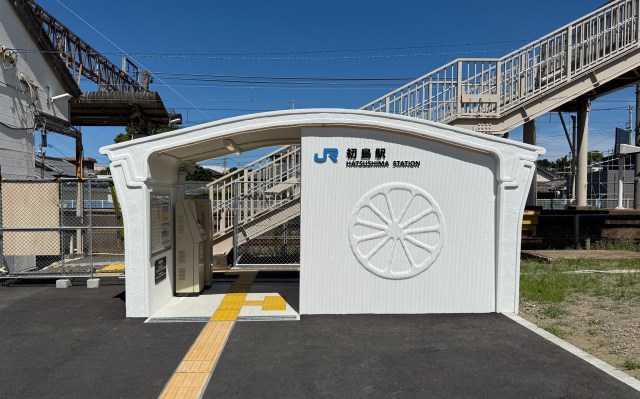
It’s a license to print train stations.
Earlier this year, we reported on rial operator JR West’s plans to create the world’s first 3D-printed train station building. In a fitting tribute to the speed this technology affords us, the building is already completely set up at Hatsushima Station on the JR Kisei Main Line in the town of Arida, Wakayama Prefecture, as of 22 July.
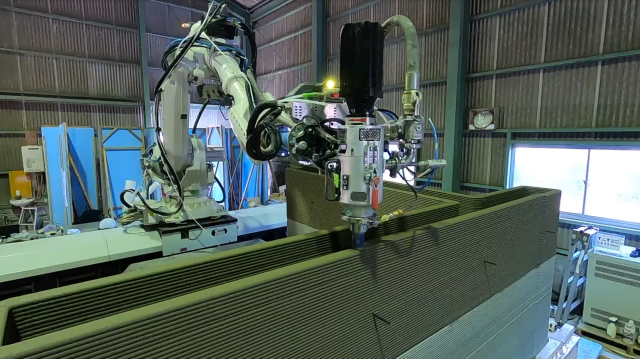
First, to get semantics out of the way, the building itself wasn’t 3D printed; rather, a mold to pour reinforced concrete was printed. However, this technique allows more complex shapes using curves and reliefs to be formed in a small fraction of the time of conventional concrete pouring methods.
Although the result is a somewhat simple-looking building, Hatsushima Station takes elegant advantage of this with a rounded roof and classical-looking trims. A slice of mikan orange made of concrete can be seen on the front, and a concrete relief of a beltfish is on the side, these being two famous foods of the region.

JR West hopes to use this technology to replace a number of its aging buildings, particularly unmanned ones in rural areas such as Hatsushima Station. However, construction projects near train tracks are very difficult, and work can only be done during a six-hour window between the last and first trains of the day. Had the new station building been set up by conventional methods, it would have taken one or two months to complete.

But with the help of 3D printing, the pouring could be done offsite in pieces over the course of seven days. These pieces could then be transported on four trucks to the station for assembly, which only took two hours to complete. Not only that, but about 45 minutes of that time was spent swapping out trucks, so the actual construction work was about one hour and 15 minutes in total.

The new station building is 9.9 square meters (106 square feet) and has a ticket machine, ticket gate, and a bench that seats two. Osaka-based company Serendix was behind the concrete formation and is also known for its 3D printed houses.
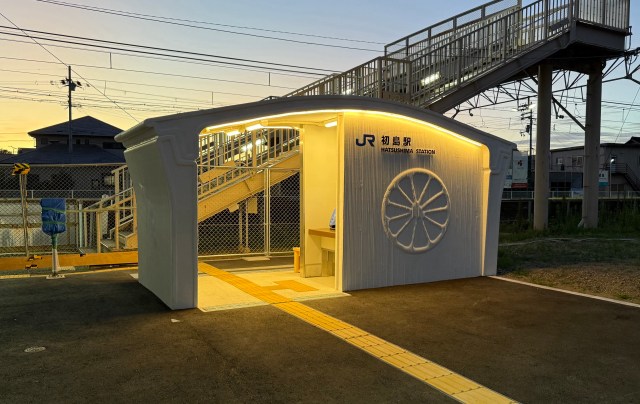
The successful creation of the new Hatsushima Station building with the help of 3D printing would suggest JR West will continue to replace its deteriorating infrastructure this way. Not only is this new method considerably cheaper and faster, but the buildings look rather nice too.
Source, images: PR Times
● Want to hear about SoraNews24’s latest articles as soon as they’re published? Follow us on Facebook and Twitter!
Credit:

0 comments: