
Super-salty pizza sends six kids to the hospital in Japan, linguistics blamed

Home economics class pizza had more tsumami than it was supposed to.
Pizza, famously, is hard to screw up, so much so that “_____ is like pizza. Even when it’s bad, it’s still pretty good,” became shorthand for things in which acceptable quality is very easy to find.
Here’s the thing about something that’s hard to screw up, though: When someone does somehow manage to screw it up, it’s probably going to be really, really bad. Case in point, a half-dozen teens in Japan recently sat down for some pizza, then ended up in the hospital from it.
The incident occurred on January 23 in the town of Kitakyushu, Fukuoka Prefecture. On that day, the assignment for the students in a home economics class at Honjo Middle School was to make pizza, and when it was done they got to eat it. After the meal, though, several students said they weren’t feeling well, and six were in bad enough condition that they were sent not just to the nurse’s office, but to the hospital for examination.
The students had used a from-scratch recipe, with the task for some of the students being to make the dough for the pizza crusts. If you’ve never made pizza dough, you might be surprised to learn that salt is a crucial ingredient. Even if you don’t necessarily want your pizza to have a salty flavor, you’ll still need to add salt to the dough to keep the yeast from fermenting too quickly. Don’t add any salt, and the dough will lose its structural integrity during baking, giving you a flimsy crust that tears apart under the weight of the sauce, cheese, and other toppings.
The recipe the students were following called for three tsumami of salt. Tsumami is the noun form of the word tsumamu, which means to close the fingertips around something. In other words, “three tsumami” would mean “three pinches” of salt.
However, according to a statement from the Kitakyushu Board of Education following an investigation, the students in charge of making the dough weren’t familiar with the term tsumami, at least in this cooking context, and used a lot more. It’s unclear exactly how much salt they put into the dough, but they might have gotten confused by tsumami’s connection to tsumamigui, a combination of tsumami and an alternate pronunciation of kui/“eating.” Tsumamigui means to “nibble” on something, but by extension it’s also often used when talking about snacking on finger foods, where the image of using just the fingertips can sometimes get a little less ironclad.
▼ For example, this stock photo of a man eating a steamed meat bun is classified with a tag of “tsumamigui.”
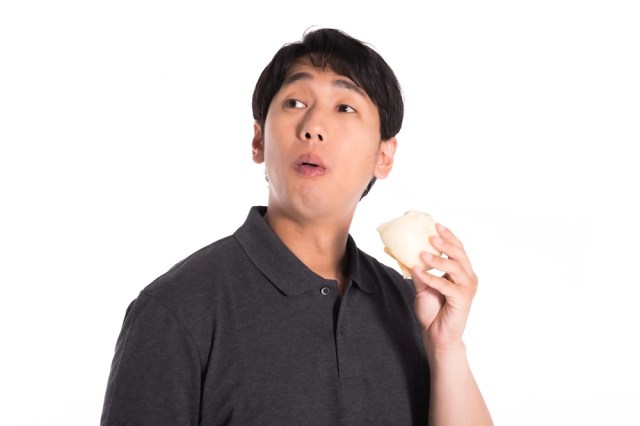
With that in mind, it’s likely that the students in charge of making the dough took the recipe’s “three tsumami of salt” to mean not three pinches, but three handfuls, and so the dough contained an amount of salt several magnitudes larger than it was supposed to. Regardless of the exact nature of the misinterpretation, the six students who were hospitalized after eating the pizza were found by doctors to be suffering from symptoms caused by excessive sodium intake.
While tsumami, much like pinch, is an inexact measurement, it’s one that’s easy for most cooks to visualize, and only tends to be used for recipes in which the amount of that particular ingredient doesn’t need to be so precise. However, taking into account that middle school-aged kids probably have a lot more personal experience with snacking than they do with cooking, a little more guidance from the teacher would probably be a good idea the next time pizza day rolls around, especially since many students might not have been previously aware that pizza dough has any salt at all, and so aren’t likely to have a sense of how much salt is too much to use.
Thankfully, all of the hospitalized students have fully recovered, leaving them with no lasting damage except the possible psychological trauma of having, against all odds, eaten bad pizza that actually was bad.
Source: Yomiuri Shimbun
Top image: Pakutaso
Insert image: Pakutaso
● Want to hear about SoraNews24’s latest articles as soon as they’re published? Follow us on Facebook and Twitter!
Credit:

0 comments: