Tokyo family serves totally non-traditional super old-school katsudon at century-old restaurant
The Kojima family’s pork cutlet bowl recipe is both startlingly innovative and really, really old.

In a standard katsudon, or pork cutlet bowl, the cutlet is wrapped in omelet-like egg, for a tender, moist mouthfeel. Recently, though, there’s been a bit of a schism among katsudon fans in Japan, with some preferring the upstart style known as tojinai (“unbound”) katsudon, in which the meat and omelet are kept separate, resulting in a crispier texture when biting into the cutlet.

But on a recent stroll through Tokyo’s Ningyocho neighborhood, we came across an even more innovative style of katsudon…only to find out it actually predates the tojinai katsudon by more than a century.
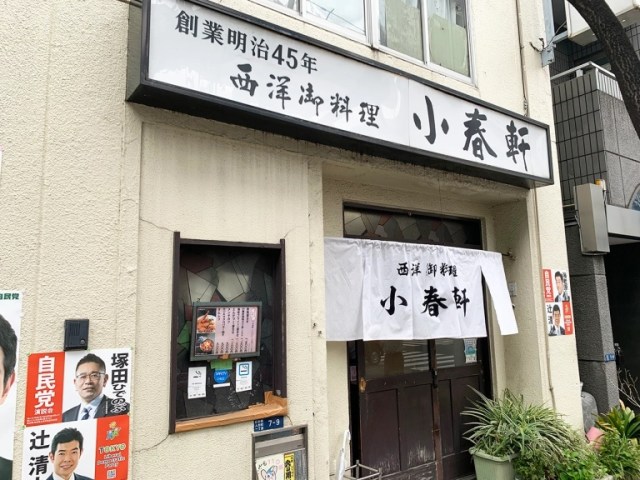
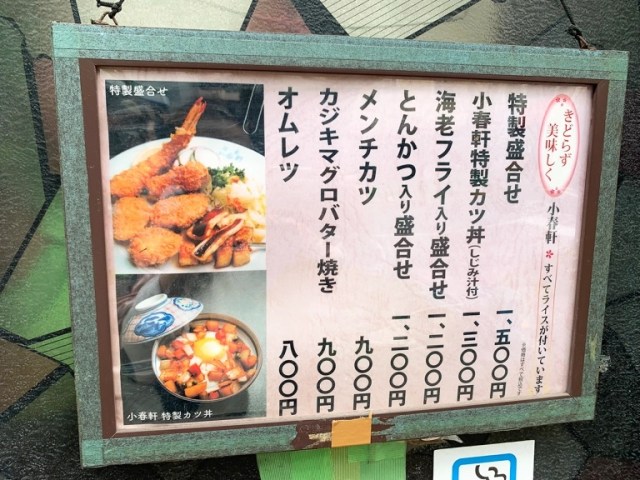
Koharuken is a small, unassuming restaurant just a block away from Ningyocho Station. Their menu board has the typically tempting list of katsu specialty restaurant items, but in the bottom left corner is a photo of the “Koharuken Special Katsudon,” and it doesn’t look like a katsudon you’ll find anywhere else in Japan.
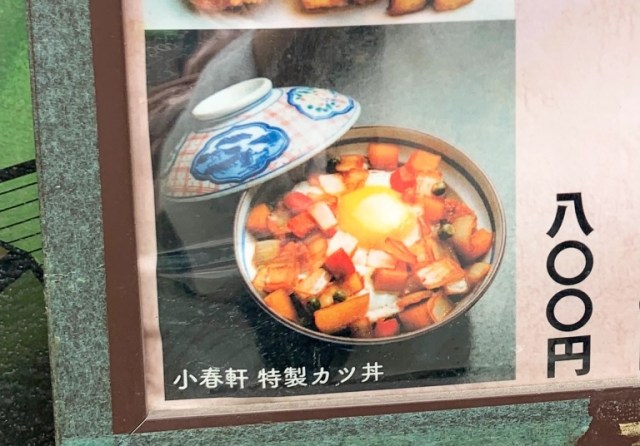
Traditionally, katsudon consists of a pork cutlet, egg, and rice. Maybe you might have some small shreds of onion mixed in with the egg, or some shredded cabbage if it’s an eggless katsudon with sauce. But the Koharuken Special Katsudon’s photo shows it topped with a variety of cubed vegetables, a katsudon topping we’d never seen before.

So, naturally, we had to try it.
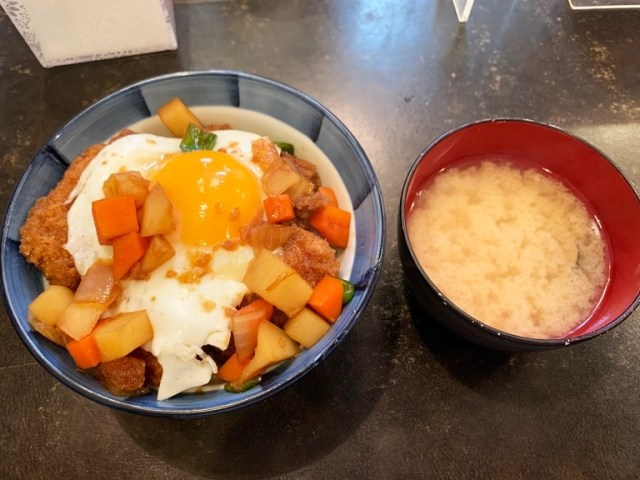
At 1,300 yen (US$9.90), which also gets you a side of miso soup with clams, it’s an affordable edible adventure, especially considering that Ningyocho is one of the more expensive parts of downtown Tokyo. It wasn’t until we had our Koharuken Special Katsudon in front of us that we realized it also splits the difference between the wrapped-in-egg katsu and the tojinai type by using a soft boiled egg, which you can eat by itself or break up to cover the rest of the bowl’s ingredients.
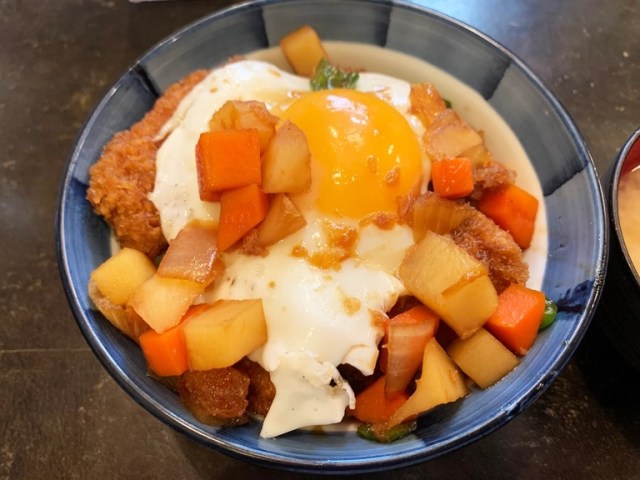
But like we mentioned above, while this was an unprecedented eating experience for us, the Koharuken Special Katsudon has been around for a long time…but with a catch. Koharuken was opened all the way back in 1912, when Japan was still in the Meiji period, by a man named Tanesaburo Kojima. Tanesaburo came up with the idea of adding cubed carrot, onion, green pepper, and potato to his restaurant’s katsudon, but eventually, for reasons lost to antiquity, Koharuken’s unique take on the dish disappeared from the menu.
The Kojima family still runs the restaurant today, and when the fourth-generation owner, Yuji, took over in 1995, he decided he wanted to bring his great-grandfather’s version of katsudon back to the menu. There was only one problem: Yuji had never eaten the dish, and had only heard stories of it. Thankfully, there was one person still around who did have first-hand experience the dish, Yuji’s father, Mikio, who had eaten it as a boy when Tanesaburo, his grandfather, cooked it for him.

Based on Mikio’s childhood memories, Yuji was able to bring back the Koharuken Special Katsudon, and now it’s the most popular item on the restaurant’s menu.
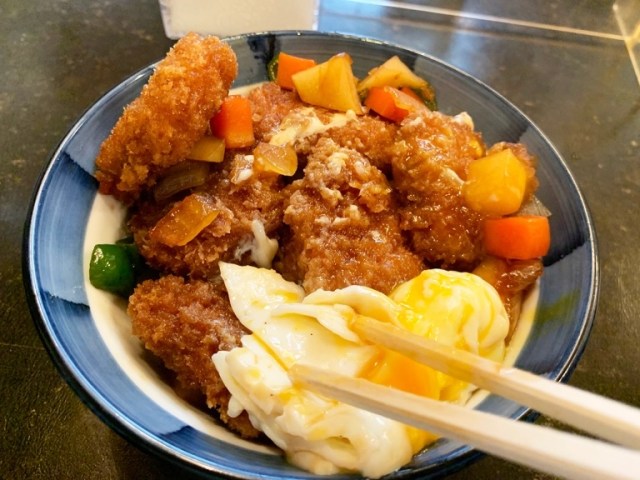
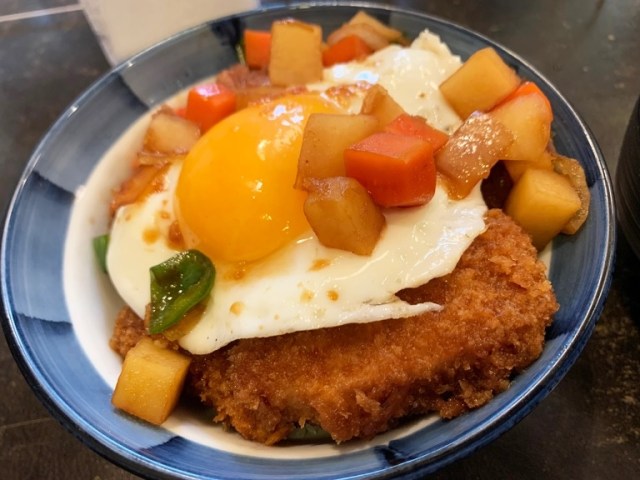
The Koharuken Special Katsudon falls into the “sauce katsudon” sub-category, with the bite-sized pieces of meat treated with a sweet sauce with some spicy/salty notes to excite a wide range of your taste receptors. Breaking up the soft-boiled egg’s yolk adds a rich, creamy element too.
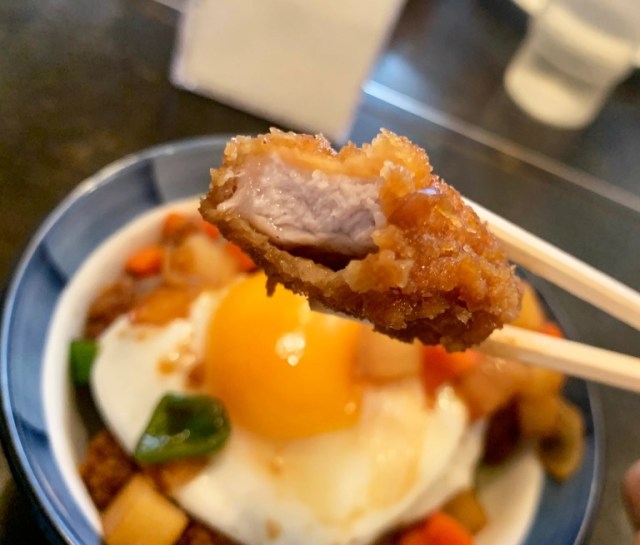
But of course, what really steals the show are the veggies. After being chopped, they’re stewed in demi-glace sauce, so they’re tender and flavorful.
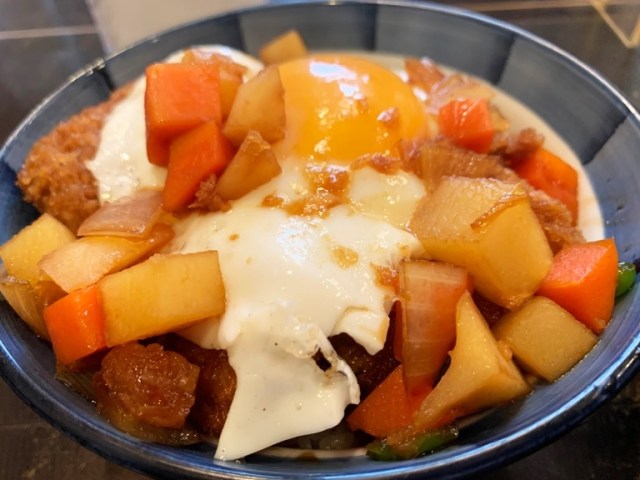
Having eaten more katsudon than we can count in our lives, it took a few moments for our minds to wrap themselves around the concept of having so many vegetables with our pork cutlet bowl, the potatoes in particular, since they’re not so commonly used in traditional Japanese cooking (curry rice and nikujaga notwithstanding). But after two or three bites, any weirdness we were feeling was replaced by bliss at the straightforward deliciousness, and we’re happy this is one new-to-most-people recipe from over a hundred years ago that the Kojima family was able to bring back.

Restaurant information
Koharuken / 小春軒
Address: Tokyo-to, Chuo-ku, Nihonbashi Ningyocho 1-7-9
東京都中央区日本橋人形町1-7-9
Open 11 a.m.-1:45 p.m., 5 p.m.-7:45 p.m. (weekdays), 11 a.m.-1:45 p.m. (Saturdays)
Closed Sundays and holidays

Reference: Ryori Okoku, Machi Nihonbashi
Photos ©SoraNews24

● Want to hear about SoraNews24’s latest articles as soon as they’re published? Follow us on Facebook and Twitter!


Credit:
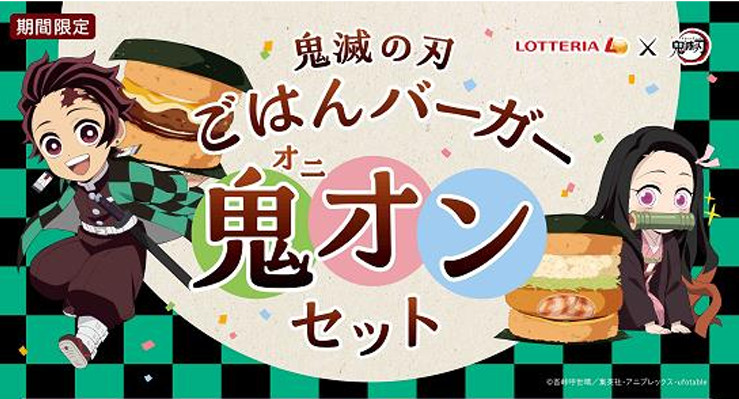
Lotteria teams up with Demon Slayer for epic hunger-slaying “Oni-on” combos

Plus, free Demon Slayer stickers with every “Oni-on” combo order!

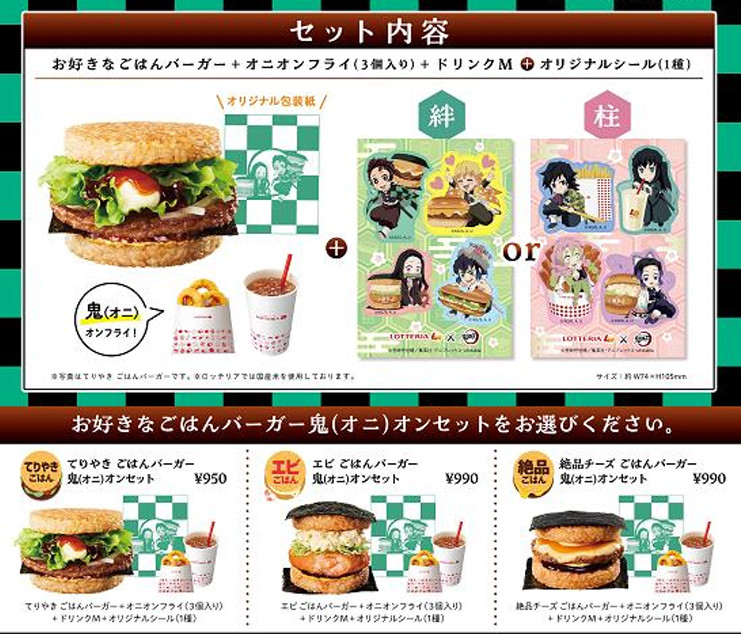
Demon Slayer fans, are you ready to snack? The popular anime and manga franchise is teaming up with Japanese fast-food restaurant Lotteria for some exclusive Demon Slayer food sets. Cleverly named the Demon Slayer Rice Burger Oni-on Sets, because “oni” is the word for “demon” in Japanese, these special set meals are served with onion rings and a drink.

The set comes with three different burgers to choose from, each made with rice “buns”, or cakes of rice, instead of bread: the Teriyaki Rice Burger, the Shrimp Rice Burger, and the Masterpiece Cheese Rice Burger.

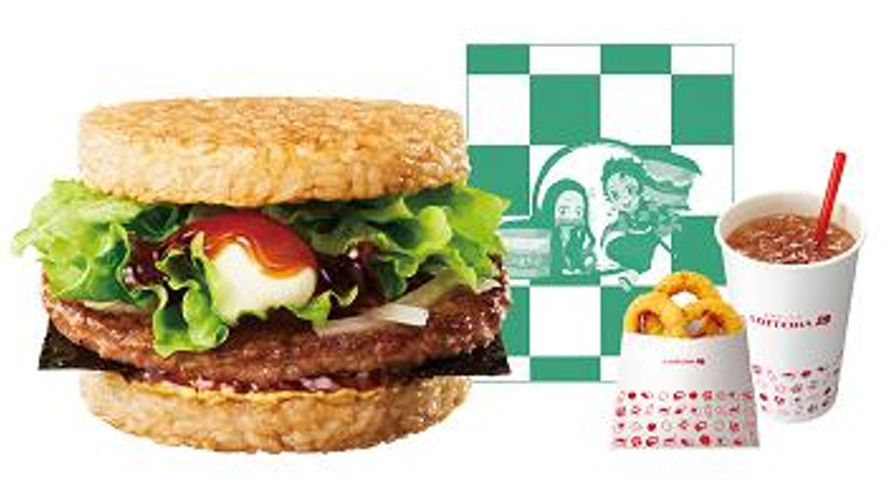
The Teriyaki Rice Burger (950 yen [US$7.72]) is a burger patty sandwiched together with Lotteria’s signature teriyaki sauce, mayonnaise, lettuce, sliced onions, mustard, and a sheet of baked seaweed for extra crispiness.

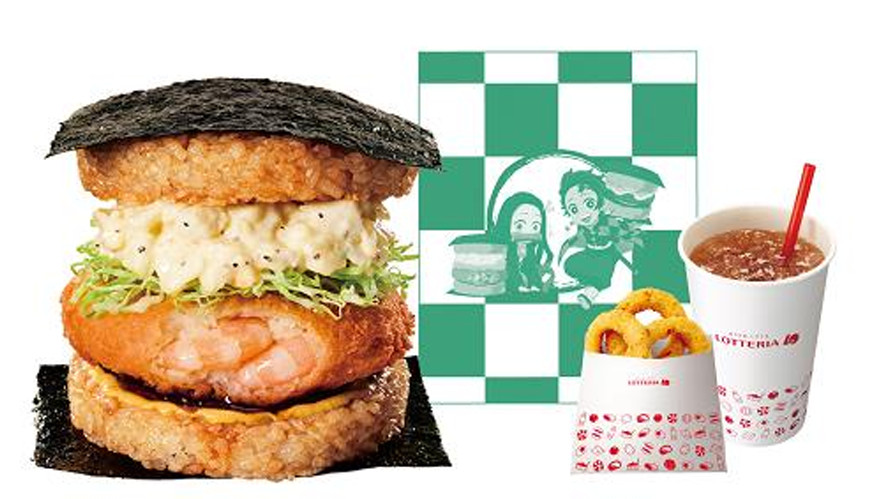
The Shrimp Rice Burger is composed of a shrimp patty made of tender, whiteleg shrimp lightly fried in finely ground panko crumbs for optimum crispiness. It’s perfectly complemented by Lotteria’s special tartar sauce, then accented by a topping of crunchy shredded cabbage and rounded out with Lotteria’s original teriyaki sauce and mustard. On the outside of the rice “buns” are sheets of baked seaweed, as if this shrimp sandwich is actually the world’s most elaborate rice ball.

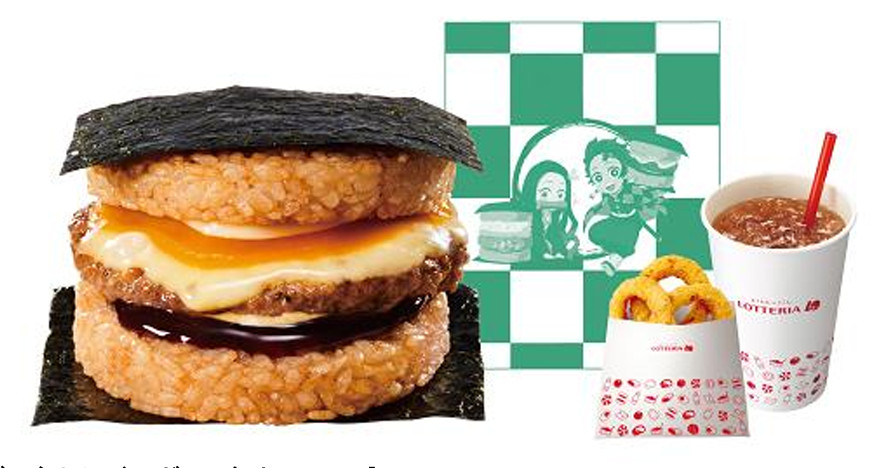
Last up for this special collaboration is the Masterpiece Cheese Rice Burger (990 yen), which is truly a testament to its name. It’s a specially crafted ground beef patty lightly seasoned with salt, pepper, and oregano and topped with gouda and red cheddar cheese. Mayonnaise dresses the top of the burger, while the bottom “bun” is dressed with Lotteria’s original teriyaki sauce and mustard. The whole sandwich is completed with two external sheets of baked seaweed.

All three come as a set with “Oni-on rings” (regular onion rings) and a medium drink, and each burger is also served in an original Demon Slayer burger wrapper featuring Tanjiro and Nezuko. But while Demon Slayer fans will undoubtedly find the burgers mouthwatering and the exclusive wrapper enticing, what they’ll really love is the free sticker sheet that comes with each order.

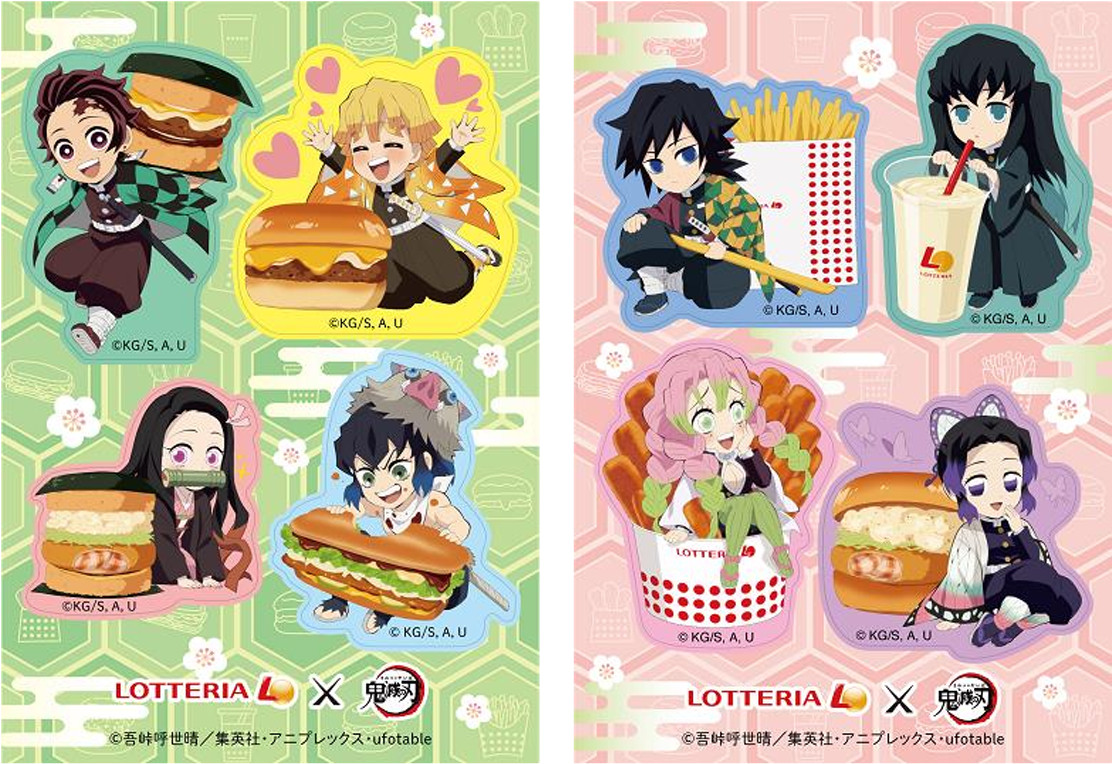
Anyone who purchases a Demon Slayer Rice Burger Oni-on Set will get to choose one of two sticker sheets featuring Demon Slayer characters posing with Lotteria menu items. One is called “Kizuna” (“Bond”) which features Tanjiro, Nezuko, Zenitsu, and Inosuke, and the other is called “Hashira” (“Pillar”), and features Giyu Tomioka, Shinobu Kocho, Muichiro Tokito, and Mitsuri Kanroji.

The stickers, as well as the burgers and their special Demon Slayer wrappers, are all being released in limited quantities, so although they will go up on the menu on April 7, it’d be better to go sooner rather than later, as your fellow Demon Slayer fans could take them all out before you get to them.

We hope you can make it in time, but if you don’t, you might still have the chance to eat Lotteria’s High Protein Sandwich–which is basically bacon and cheese sandwiched between two pieces of fried chicken that anyone would be crazy not to try.

Source, images: Lotteria
● Want to hear about SoraNews24’s latest articles as soon as they’re published? Follow us on Facebook and Twitter!


Credit:
World’s most elegant kickball game held at Kyoto’s Imperial Palace【Video】

Kickball the Heian way.

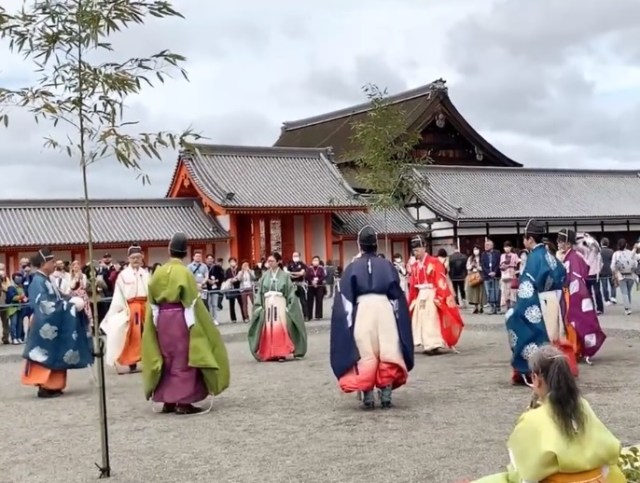
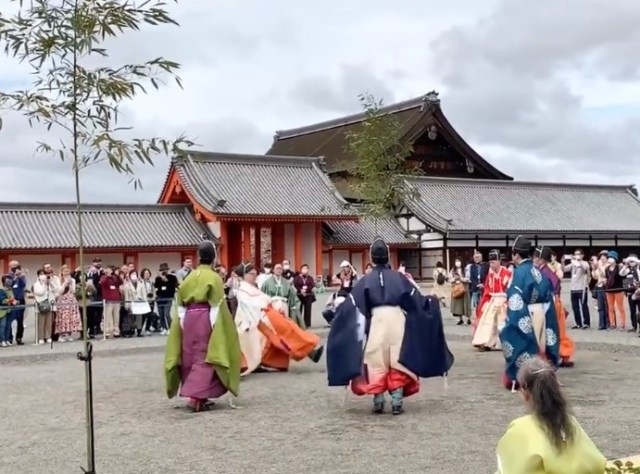
Japanese Twitter user @yoshimura0303 was recently out and about in Kyoto when he stumbled across a kemari game taking place. “Kemari” comes from the Japanese words keru, meaning “kick,” and mari, meaning “ball,” so the direct translation would be “kickball.”

However, this wasn’t the same “kickball” played by energetic kids in America who kick a rubber ball around a baseball field because they don’t have bats and gloves to play with. Kemari is a game that became popular with Japanese aristocrats and members of the imperial court all the way back in the Heian period (794-1185), and the kemari game @yoshimura0303 watched wasn’t being played in any old park, but at the the Kyoto Imperial Palace.

The game was part of a multi-day event organized by the Imperial Household Agency introducing aspects of courtly life from the era when the imperial family still resided in Kyoto. In keeping with that historical context, the participants all dressed in formal attire of the Heian period, wearing traditional sandals, billowy hakama pants, kimono with luxuriously lengthy sleeves, and high-peaked eboshi hats.

Kemari is a cooperative game, most similar to hacky sack, with the goal being to keep the rally going for as long as possible without the ball (which is made from deerskin) hitting the ground. As you can probably guess from kemari’s name, you’re only allowed to kick the ball, not use any other part of your body. As an added piece of difficulty, you can only use your right foot, not your left, and that restriction makes proper positioning particularly important, despite the stately attire of the aristocracy not being the easiest outfit to move around in.

Reactions to @yoshimura0303’s video have included:

“So elegant!”
“It looks really hard.”
“It’s like you went back in time.”
“I wish I could have seen this in-person.”
“Want to try it myself now.”

Unfortunately for that last commenter, it’s been several hundred years since kemari was commonly played in Japan, so finding a neighborhood league isn’t exactly easy to do. On the other hand, as long as you’re not a stickler for period-authentic clothing and ball materials, putting together a game with friends shouldn’t be too hard, especially since the non-competitive nature of kemari means you don’t need a referee. Just be sure you’re not playing somewhere where a bouncing ball is going to bother other people, especially if you’re playing in manners-minded Kyoto.

Source: Twitter/@yoshimura0303 via IT Media
Images: Twitter/@yoshimura0303
● Want to hear about SoraNews24’s latest articles as soon as they’re published? Follow us on Facebook and Twitter!


Credit:
Cup Noodles Breakfast brings American morning meal taste of pancakes and sausage to instant ramen

Even the distribution strategy is super-American.

Living in Japan, we’re pretty much spoiled for choice when it comes to instant ramen, and also when it comes to crazy ideas from Cup Noodle maker Nissin, like the instant ramen booster packs they came up with a while back.

But today we find ourselves looking out across the Pacific with envious hearts and growling stomachs, as Nissin USA has created Breakfast Cup Noodles, with all the traditional flavors of an American morning meal in a cup of instant ramen.

Dropped onto American store shelves with seemingly no advance notice on Wednesday, Cup Noodles’ new Breakfast flavor has the flavor of pancakes, maple syrup, sausage, and egg. The packaging refers to it as “ramen noodles in sauce,” suggesting that the broth might have a thicker consistency than what you’d find in orthodox ramen. In its press release Nissin USA says “Understanding the hustles of the morning grind, the saucy Cup Noodles Breakfast is ready to eat in just four minutes,” which is actually slightly longer than the three minutes most instant ramen takes, but still much less time than would be needed to scramble eggs, grill sausage, and whip up a stack of pancakes.

▼ Along with introducing Cup Noodles to the breakfast table, Nissin USA has also introduced “Cock-a-noodle-do!” to our shared lexicon.

Cup Noodles Breakfast isn’t just AMERICAN! in its flavor, but also in its distribution, as it’s available exclusively at Walmart, priced at US$1.18. Maybe if it turns out to be a hit Nissin USA will consider bringing over the Barbeque Sparerib Cup Noodle we have in Japan too.

Source: Cision PR Newswire via CNN Japan
Top image: Twitter/@OrigCupNoodles
● Want to hear about SoraNews24’s latest articles as soon as they’re published? Follow us on Facebook and Twitter!


Credit:
Live-action Evangelion stage play’s new poster stays the Eva course by being baffling

It wouldn’t be Evangelion if we could guess where it’s going, after all.

When the cast is shown for a live-action adaptation of an anime franchise, usually the photos fall into one of two categories. If the production is still in its early stages, usually there’ll just be some standard headshots of the actors and actresses, or if things are farther along, they might appear in costumes or poses recreating memorable scenes from the anime source material.

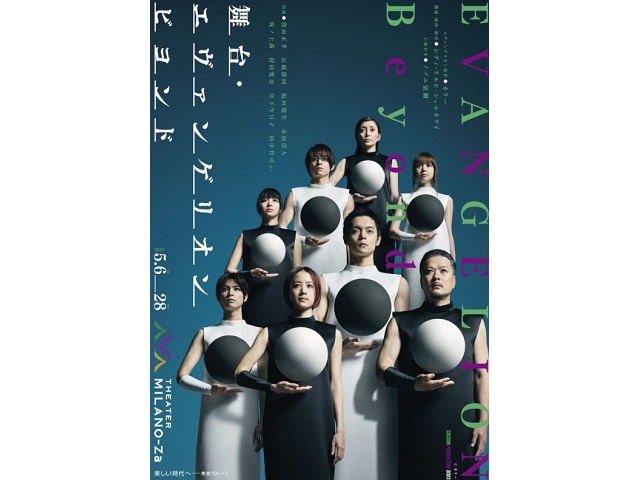
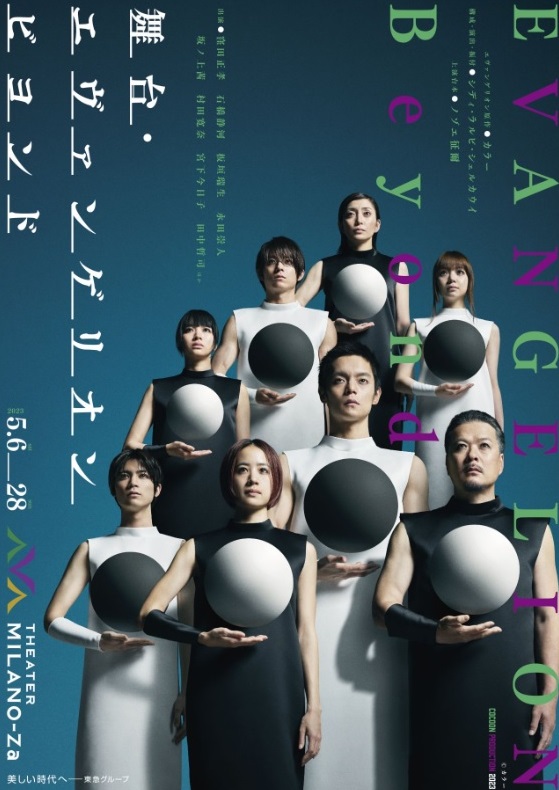
So people have been pretty startled to see the latest casting announcement for the upcoming live-action Evangelion stage play accompanied by this promotional photo.

Sure, it says “Evangelion Beyond” (the stage play’s official title) in the green-and-purple color scheme of Evangelion Unit-01, and the Japanese text also looks a little like the iconic Eva font. But for those who were expecting the cast to be dressed in plugsuits or for a giant robot or alien monster to appear on the poster, it’s hard to see a visual Eva connection, as demonstrated by Twitter reactions such as:

“Whaaaat?”
“Is this Eva?”
“Not at all what I was envisioning.”
“Who are these people?”
“I get the feeling everyone is going to start doing modern dance all of a sudden.”
“It looks intriguing, but I’m positive I won’t be able to understand it.”

The shock should have been slightly lessened, though, for those who have been following Evangelion Beyond’s development. Last month, the producers revealed that the live-action adaptation won’t feature the anime’s core character trio of Shinji, Rei, and Asuka. Instead, Evangelion Beyond, as the play is titled, is getting a brand-new protagonist named Soshi Tomori, played by actor Masataka Kumada.

Actually, it doesn’t sound like any of the anime’s characters will be part of the story, judging from the newly released preview description of the story. Like the anime, Evangelion Beyond deals with the repercussions of the arrival of alien invaders called Angels. In the play, though, it’s the special organization Mensch, led by supreme commander Saneyuki Kano, which develops the Evangelion units. Assisting Kano in this endeavor is his subordinate Etsuko Sakurai, and Kano’s son Toma is selected as a pilot for one of the four Eva units, along with fellow middle schoolers Hinata, Eri, and Nao, who are given bracelets as markers of their secret mission and assigned to Mensch field commander Iori. Toma then withdraws from the squad and disappears, followed by Iori reuniting with her old college lover Soshi, who becomes a teacher at the school the Eva pilot attend.

In addition to being a lot of ground to cover, all that sounds very different from the story described in last month’s Evangelion Beyond press release, although the new description does still contain the promise that “Soshi witnesses the opening of the door of a new tragedy.”

Let’s see if the play’s new teaser video can help make things clearer.

Nope, not even a little bit.

All that said, though the new cast photo has a lot of people scratching their heads, the overall online reaction seems to be more comically amused intrigue than outright confused outrage. And as any veteran fan can tell you, it’s hard enough figuring out what Eva is trying to say after watching it, so not being able to tell where the play is going right now is par for the course.

Evangelion Beyond opens May 6 at Theater Milano-Za in Tokyo’s Shinjuku neighborhood and runs until May 28, with tickets available online here.

Source: Oricon News via Livedoor News via Otakomu, Twitter, Twitter/livedoornews
Images: Bunkamura
● Want to hear about SoraNews24’s latest articles as soon as they’re published? Follow us on Facebook and Twitter!


Credit:
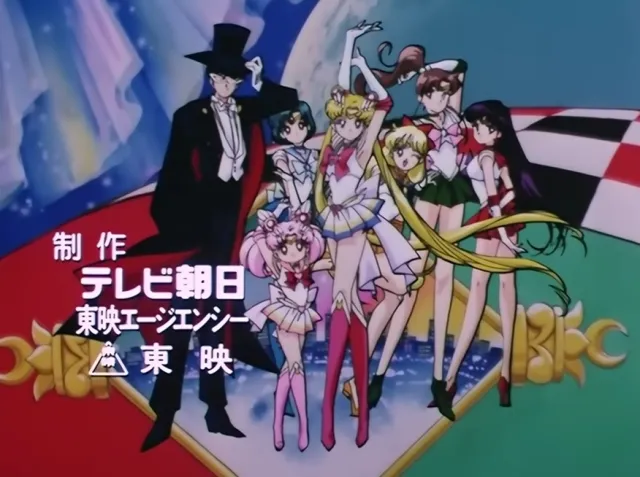
Sailor Moon SuperS and Sailor Stars go free to watch on YouTube ahead of Cosmos release

Fourth and fifth arcs of the ‘90s Sailor Moon TV anime are here to jog your memory before the newest theatrical features.

There’s a new Sailor Moon anime movie, Sailor Moon Cosmos, coming soon, and the darkly dramatic preview videos and all-star additions to the voice cast show that it’s something to get excited about. At the same time, for some fans, it’s also something to be confused about.

Sailor Moon Cosmos is, essentially, the fifth part of the franchise’s Sailor Moon Crystal remake, coming two years after the preceding Sailor Moon Eternal movies. Cosmos is also an adaptation of the original manga’s Stars arc, which started publication in 1996 and was adapted into the Sailor Moon Sailor Stars portion of the Sailor Moon ‘90s TV anime that same year. In other words, depending on how exactly you’ve been consuming the series, Cosmos may be coming years, or even decades, since the last time you saw/read the story so far, and so you might find yourself needing a refresher on what exactly is going on with Sailor Moon and her fellow Senshi as Cosmos opens.

Thankfully, there’s a solution to that problem, as Sailor Moon SuperS, the portion of the ‘90s anime that comes just before Sailor Stars, is now free to watch on YouTube, and soon Sailor Stars will be too.

▼ Sailor Moon SuperS Episode 1

The generous gesture comes from Toei, which is putting the series on its Toei Animation Museum channel. The first Sailor Moon SuperS (essentially season four of the ‘90s Sailor Moon) episode went up on March 27, and a new episode will be added every day.

▼ Understanding the importance of proper pacing, the first episode of SuperS only waits three minutes and 24 seconds after the opening theme before giving Sailor Jupiter screen time.

Sailor Stars will be also be following a one-new-episode-a-day format, with the first going up on May 5. With a total of 34 Sailor Stars episodes, that means the entire arc won’t be available by the time Cosmos premiers on June 9. That’s no doubt by design, though, since Cosmos is being released in two parts, with the second hitting theaters on June 30.

While the Sailor Moon SuperS and Sailor Stars episodes are free to watch, they won’t be eternal, as each will be viewable for two weeks after it’s posted to the Toei Animation Museum channel here.

Source: Press release
Images: YouTube/東映アニメーションミュージアムチャンネル
● Want to hear about SoraNews24’s latest articles as soon as they’re published? Follow us on Facebook and Twitter!


Credit:
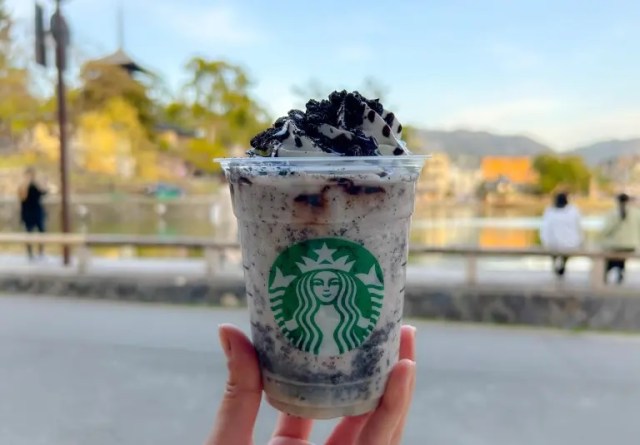
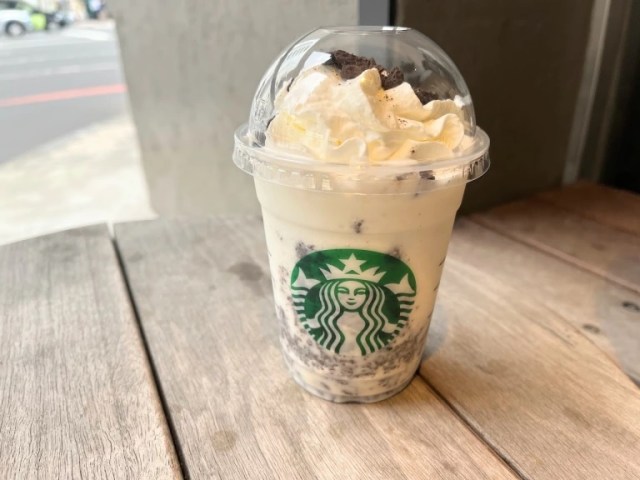
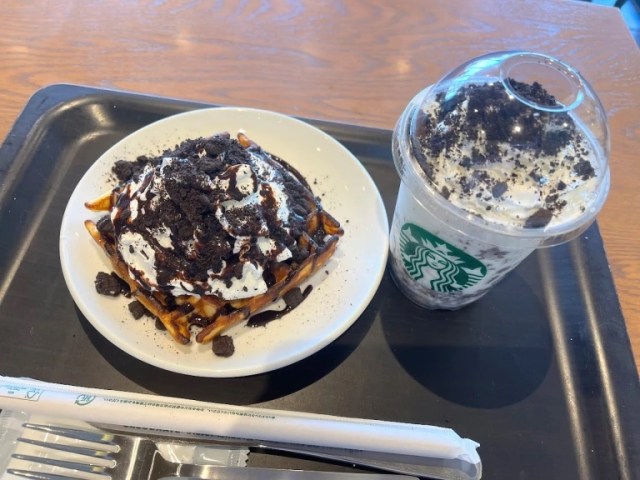
Starbucks Japan’s first-ever Snoopy Frappuccino is here!【Taste test】

Taste-testing Starbucks’ Snoopy Frappuccino and Snoopy Waffle.

The theme of Starbucks Japan’s new collaboration with the Peanuts franchise is “Happiness Is,” with the statement symbolically trailing off for you to finish with your own personal take on the matter. It’s a deep, complex question to ponder, but thankfully Starbucks itself provides a pretty good candidate with the first-ever Snoopy Frappuccino.

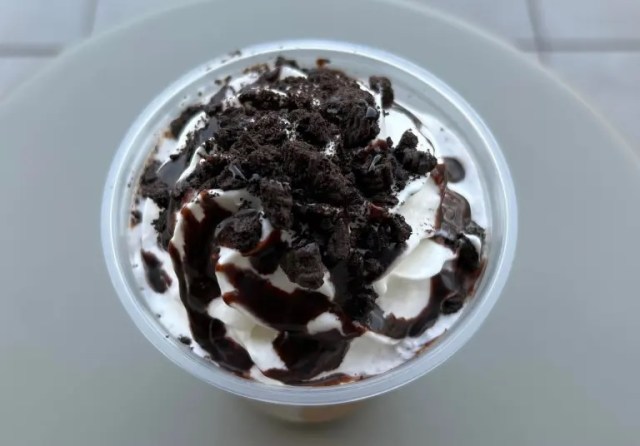
Its full name is the Snoopy Vanilla Cream Frappuccino with Crushed Cookies. That combination of ingredients wasn’t chosen only because it matches the color scheme of the world-famous beagle, but also, according to Starbucks, because cookies and ice cream are two of Snoopy’s favorite foods.

We’ll admit to not being deeply knowledgeable enough about Peanuts lore to say how closely associated Snoopy is with cookies and ice cream, but we’ll also happily confess to being pretty crazy about those sweets ourselves. So when the Snoopy Frappuccino went on sale March 29, we rushed over to our local Starbucks branch, with a smile on our face and the Peanuts piano theme playing in our head.

The base of the 648-yen (US$4.95) dessert drink is vanilla cream, which is accompanied by black cocoa cookies and syrup. We took a sip, and just like Snoopy’s straightforward and immediately charming character, there are no tricks or pretentiousness here, just an immediate, glee-inducing sensation of rich sweetness running along your taste receptors. It feels like you’re drinking a scoop of ice cream, which is something we have no complaints whatsoever about.

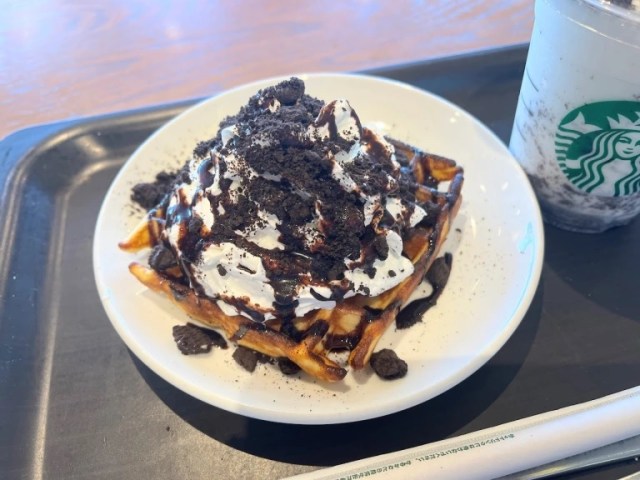
The Snoopy Frappuccino wasn’t the only thing we ordered on our visit. We paired our drink with another new arrival to the Starbucks Japan menu, the 400-yen Snoopy American Waffle with Crushed Cookies. Again, we’re not sure we 100-percent agree with Starbucks Japan’ s perception that this is an especially “American” way of preparing waffles, but we weren’t about to let some shaky nomenclature dissuade us from eating it.

Basically, this is taking the Snoopy Frappuccino and replacing the vanilla cream drink base with a waffle. As an added bonus, if you ask the Starbucks staff they’ll heat it up before serving it to you, making each bite a warm, ever so slightly gooey mix of waffle, cream, and bitter cocoa cookie bits.

The Snoopy Waffle was as excellent as the Snoopy Frappuccino, and we don’t regret indulging in either one in the slightest. If we could do it all over again, though, we probably wouldn’t have them in the same sitting, since together they’re a lot of whipped cream. So our recommendation is to space them out on separate days, spreading out your intakes of cream and happiness alike.

Photos ©SoraNews24
● Want to hear about SoraNews24’s latest articles as soon as they’re published? Follow us on Facebook and Twitter!


Credit: