A visit to “the most blessed kappa statues in all of Japan”【Photos】
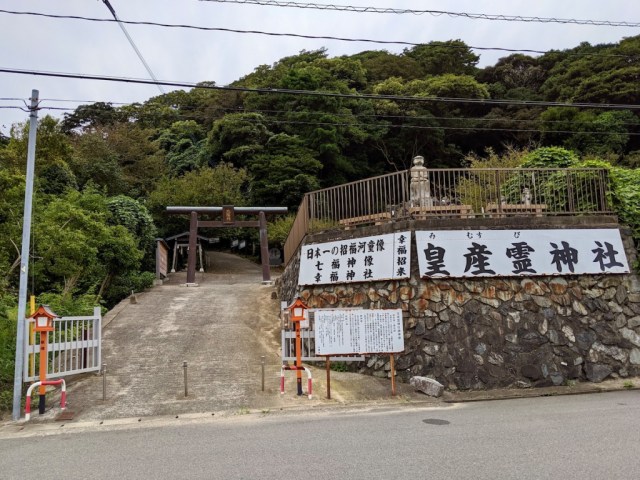
The fabled yokai water imps at this shrine want to make you happy for your whole life.

We’ve all had the experience of a sign along the road that makes us stop in our tracks and check out the proclaimed wonders for ourselves. For some people, maybe the magic words are “jumbo steaks,” “cold beer,” or “totally nude,” but the one that made us slam on our brakes while driving through Japan’s Fukuoka Prefecture promised “the most blessed kappa statues in Japan.”
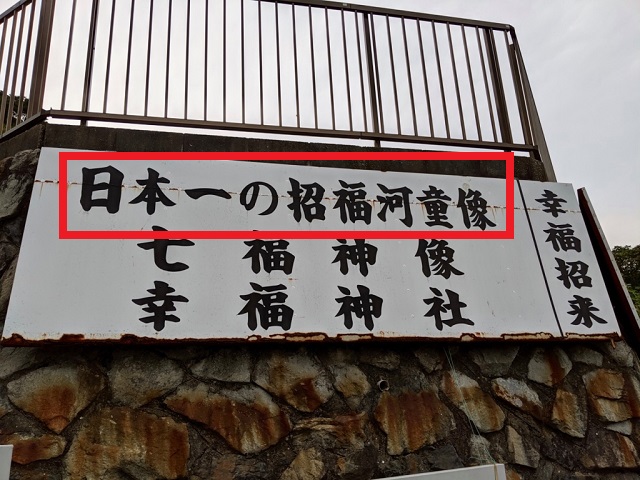
Sure, if they were just any old blessed kappa statues, we’d probably have kept on driving. But the most blessed ones in Japan? And since Japan is really the only country where you’ll find statues of the mythical water imps, that probably makes them the most blessed kappa statues in the world!

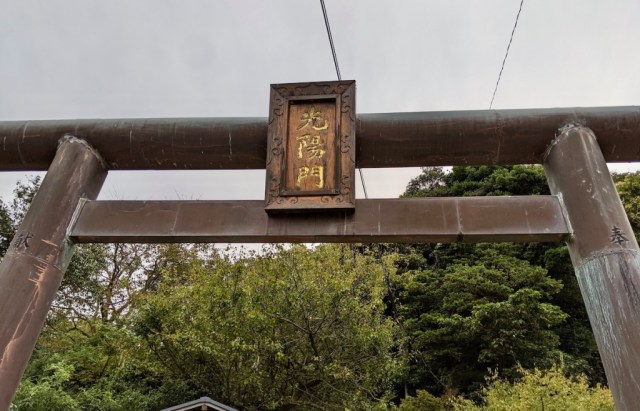
So we pulled over, got out of the car, and walked through the torii gate of Kitakyushu City’s Mimusubi Shrine, located on a hillside across the street from the coastline.
Once on the shrine grounds, it didn’t take long for us to find the kappa statues.
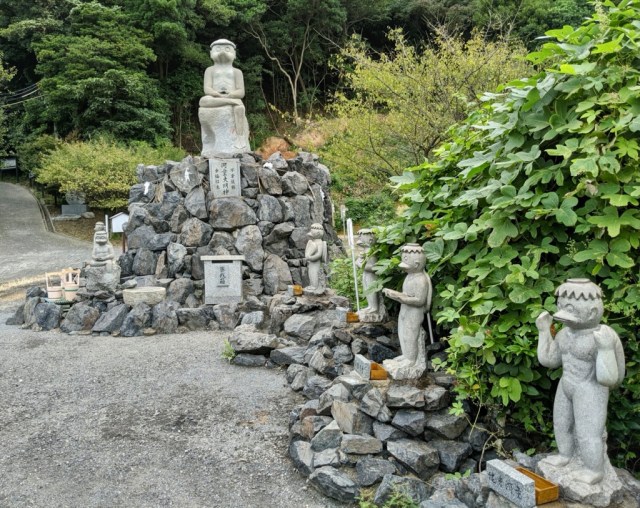
Kappa occupy a sort of a strange place in Japanese folklore. In some tales, they’re dangerous, evil monsters who drown children, consume human flesh, and want to steal a mystical orb-shaped organ called the shirikodama out of people’s buttholes. But in other stories, they’re harmlessly quirky creatures, and this kinder, gentler image is the one they have at Mimusubi Shrine.
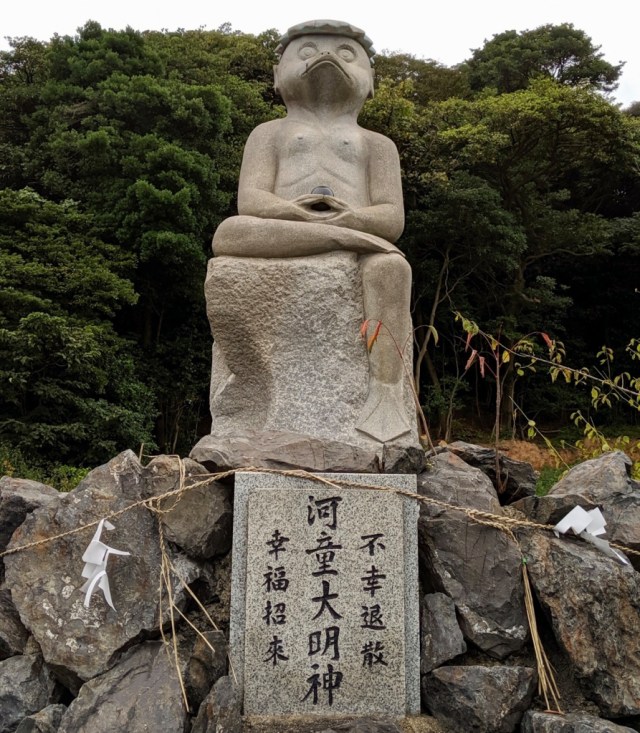
For example, this serene Zen-meditating kappa isn’t just here to impart a sense of calm with his stoically peaceful demeaner. Kappa have the power to absorb water, and Mimusubi Shrine says that if you channel your worries and sadness into a bucket of water, then use that bucket to wash the statue, it’ll absorb those negative emotions as well, freeing you from your woes.

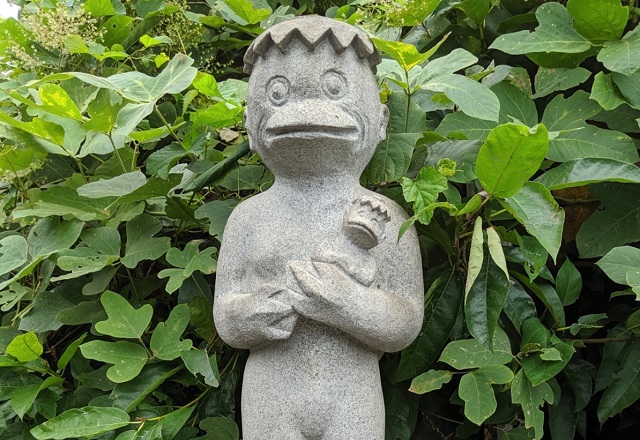
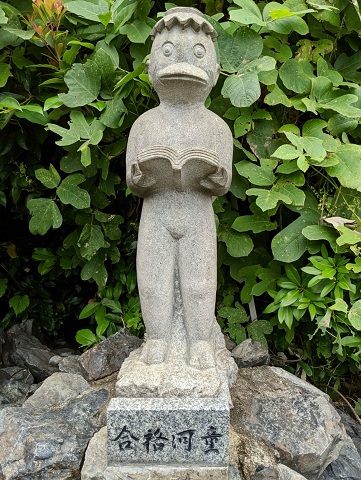
The other statues have their own purported benefits, and as a whole actually constitute a sort of life-long good-luck kappa plan. For example, if you’re still in school there’s the Exam-Passing Kappa, holding a tome of knowledge, that you offer a few coins to for good luck in your academic endeavors.
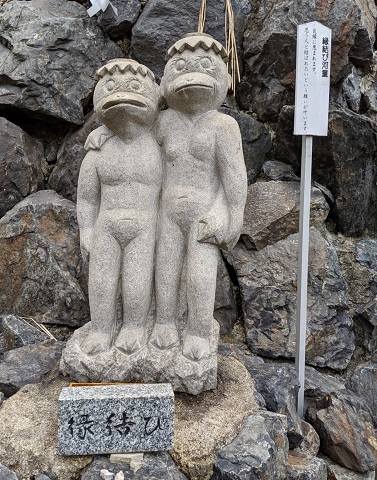
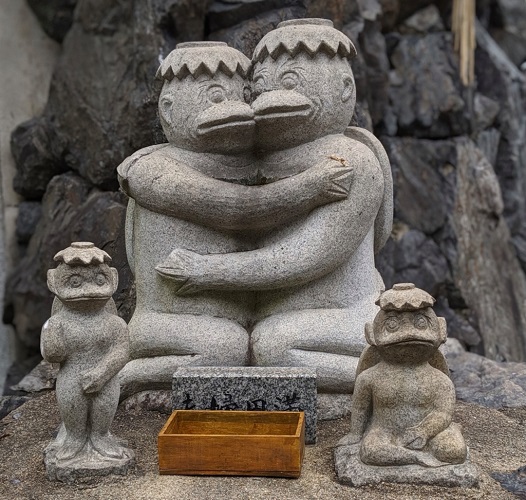
Then there’s a cozy couple called the Enmusubi Kappa, who’ll grant you good luck in finding the love of your life

…plus the Married Couple Kappa, for when you want to make sure the relationship stays happy even after you’ve tied the knot.
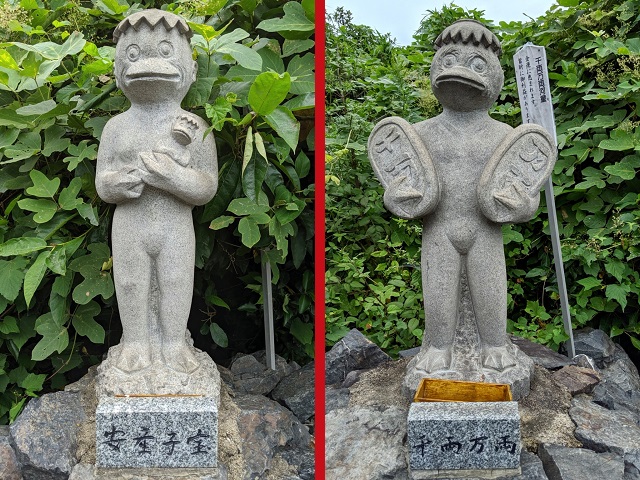
When you and your spouse are ready to make some little baby kappa, there’s the Safe Childbirth Kappa

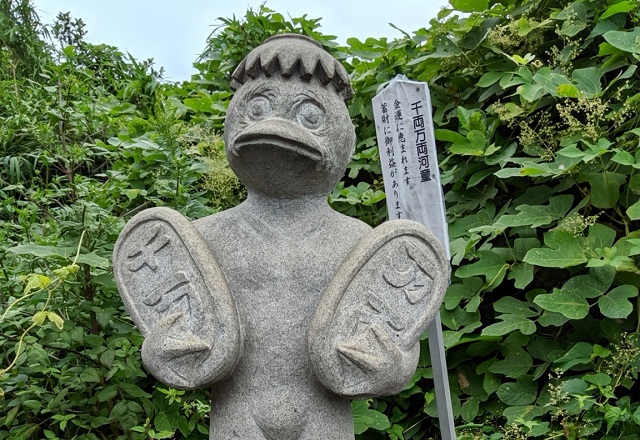
…and since kids aren’t cheap, the Prosperity Kappa, holding two gigantic coins.
And to make sure you’re able to enjoy that happy life for many, many years, there’s also the Health Kappa, who’s looking like he might be able to give that super-muscular Attack on Titan butt we saw the other day a run for its money.
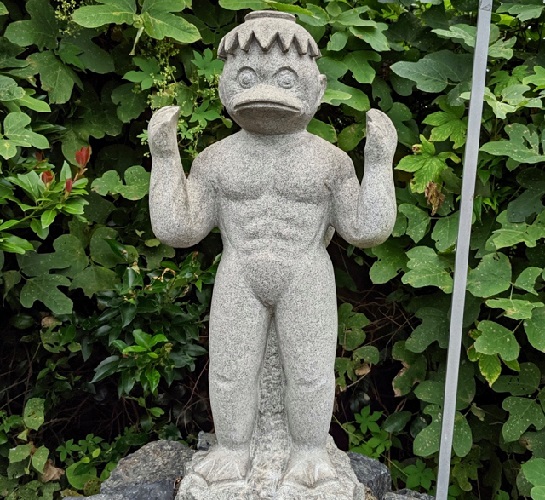
With Shinto having a less defined central leadership than many other religions, some other shrines may not fully recognize Mimusubi’s assertation that these are the most blessed kappa statues in Japan. Until someplace else challenges them for the title, though, we’ll take them at their word.

Shrine information
Mimusubi Shrine / 皇産霊神社
Address: Fukuoka-ken, Kitakyushu-shi,
福岡県北九州市門司区白野江481
Website

Photos ©SoraNews24
● Want to hear about SoraNews24’s latest articles as soon as they’re published? Follow us on Facebook and Twitter!


Credit:
“Drinkable pistachios”: A nutty matcha lover’s dream beverage

Pistachio and matcha are a match made in green tea heaven! 

In Tokyo’s swanky Omotesando district, just a stone’s throw away from Harajuku, there are plenty of trendy cafes for people to hang out and be seen in. These days, Chavaty is the name on everyone’s lips, as it’s a particularly cool spot for trendy types, drawing crowds of customers who queue up to eat and drink inside, even during the daytime on weekdays.

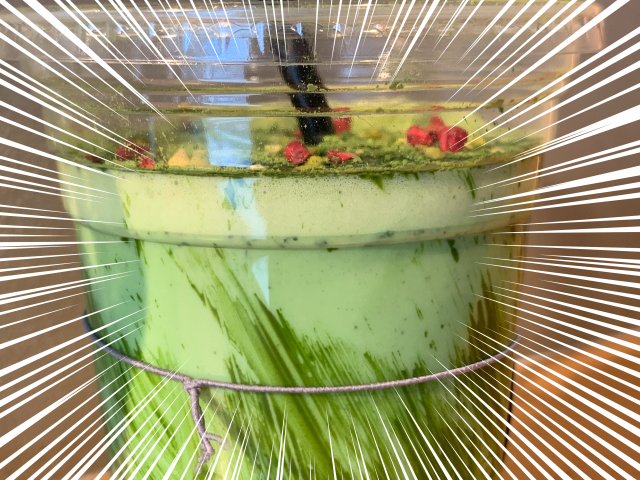
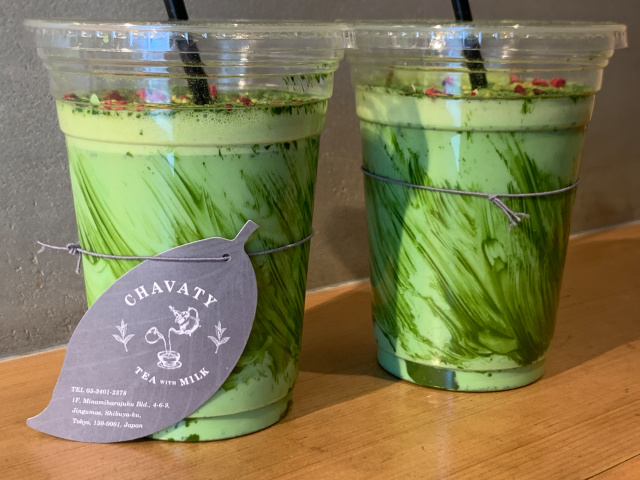
Now there’s more reason for people to line up at this tea latte specialty store, because from 25 May the new Pistachio Tea Latte (638 yen including tax) was released. Chavaty has the new drink on the menu at both its Omotesando and Kyoto branches, where it’s become incredibly popular for its rich flavour of pistachio, which it combines with the freshness of matcha. Our reporter, Idate Ayaka, who loves pistachios so much that she eats a small bag of them every day, immediately knew this was a bandwagon she had to jump on, so she recently made her way down to Chavaty in Omotesando to try it.

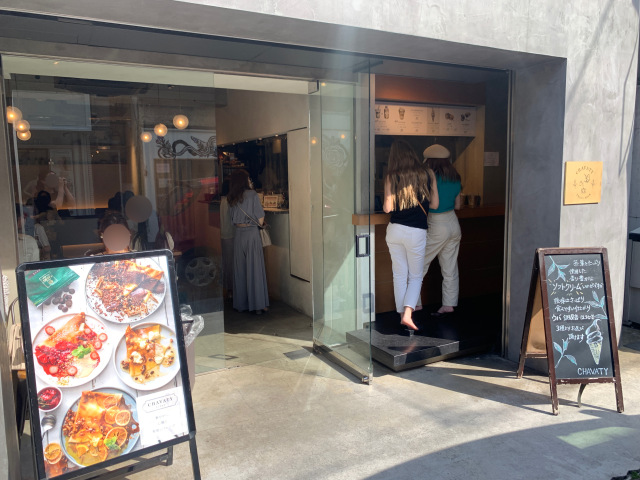
Even on the day she went, Chavaty had a queue of people outside waiting to get in. Luckily, though, the cafe has a takeout window, and Ayaka made a beeline for it as there were only a couple of people waiting to be served there.

After placing her order Ayaka waited around 10 minutes for the drink to be made, and when her Pistachio Tea Latte arrived, she could see straight away the reason why this drink was so popular.

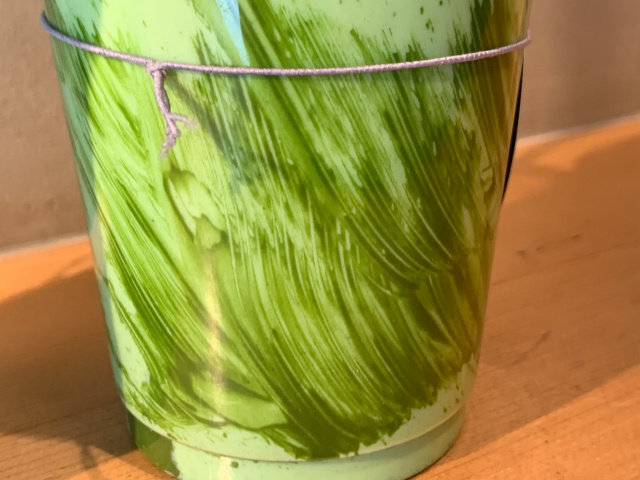
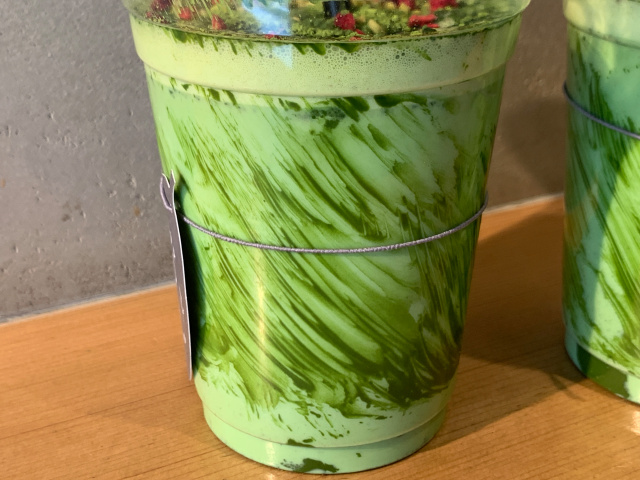
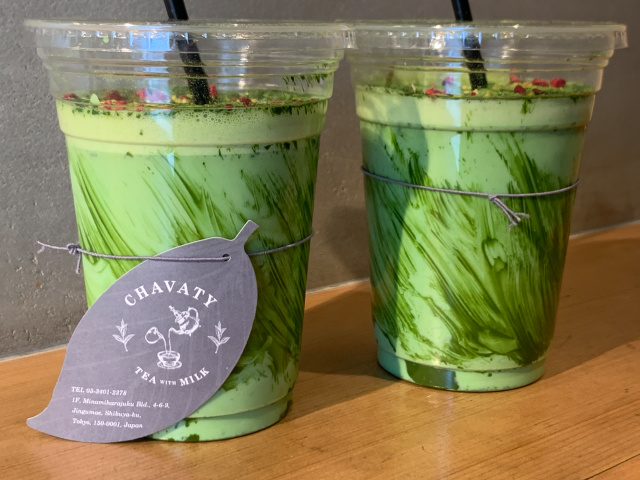
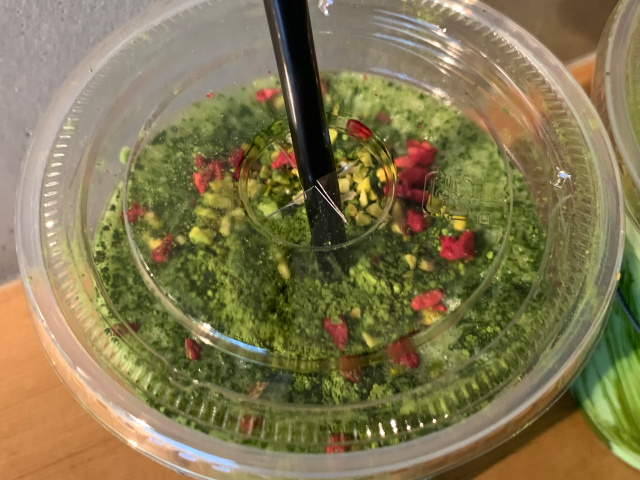
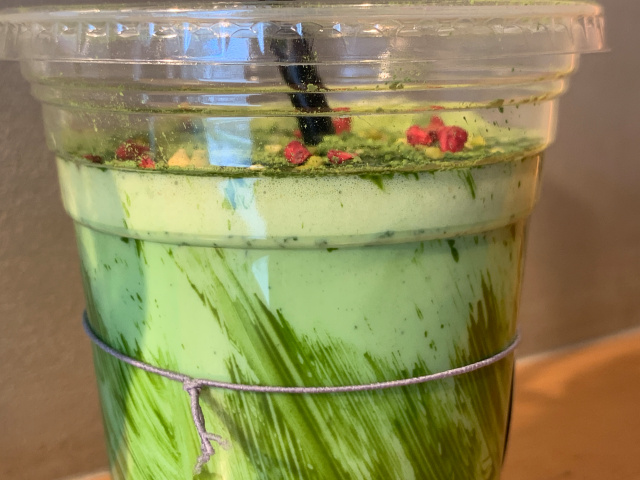
▼ The gorgeous green drink created a dark green pattern on the cup which looked like a dainty leaf or feather.

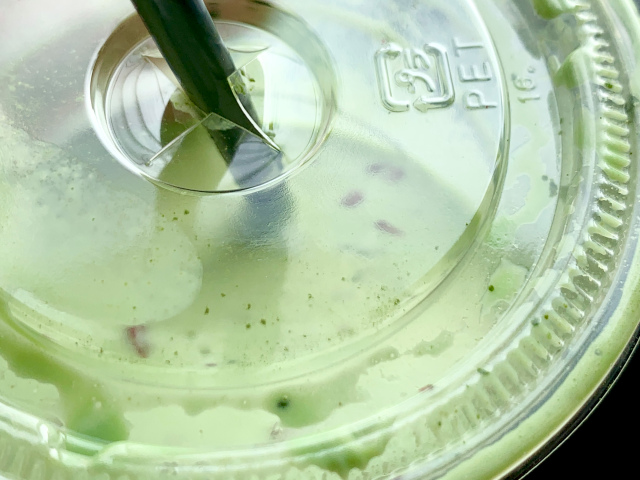
Looking at the drink, Ayaka found that the pistachio latte appeared to have very few matcha elements. Although it’s advertised as a drink that allows you to fully enjoy the combination of matcha and pistachios, at first glance, the only matcha she could see was in the topping, next to the dried raspberry pieces.

Enquiring with the staff, Ayaka discovered that the dark green pattern on the sides of the drink was made with matcha sauce, and it was recommended that she scrape the sides bit by bit while drinking the latte to gradually dissolve the matcha sauce into the beverage.

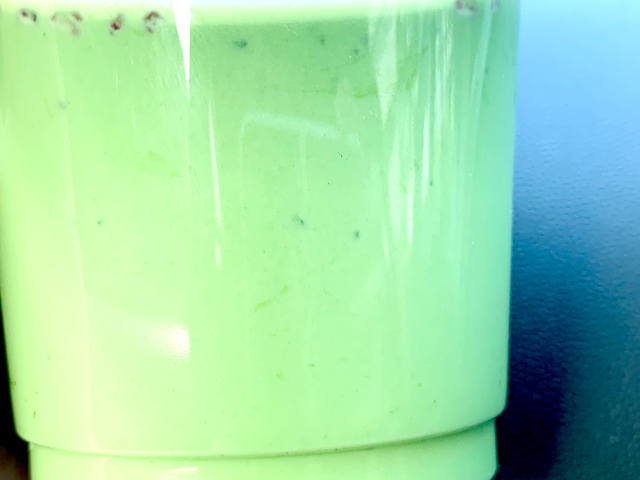
For starters, Ayaka took a sip of the drink as it was, without mixing any of the matcha powder or sauce into the liquid. Her eyes opened with delight as her taste buds were flooded with the fantastic flavour of pistachios. The latte tasted as if it had been made purely with cream and pistachios, and it was insanely delicious!

Ayaka has tried other drinks that bill themselves as “drinkable pistachios”, but none come as close to replicating the flavour as perfectly as this one. It was mercilessly pistachio, and worthy of the “drinkable pistachio” moniker.

Ayaka was happy enough to drink the latte as it was, but hoping to see a new side to her favourite nut, she mixed the matcha sauce into the liquid bit by bit, as recommended. This didn’t create a drastic change, but it did mellow out the pistachio flavour a little, and worked to help balance out the overwhelming nuttiness.

The matcha sauce idea is a great one, as some people might find the rich flavour of pistachios to be a bit cloying. Having the sauce on the sides allows you to control the flavour of the latte and adjust it to suit your preference, like an in-built D.I.Y customisation.

The raspberries provided a tart accent to the drink, and after enjoying a few sips, she decided to go all the way and mix everything into the drink, topping and all. Ayaka feared this might make her beloved pistachio flavour disappear, but when she took a sip, she found a refreshing drink without bitterness was born. Both the pistachio and matcha flavours were strong — evenly matched and utterly delicious!

Ayaka was incredibly impressed with the Pistachio Tea Latte, which allowed her to enjoy different intensities of flavour throughout the drink. Her only regret is that they don’t sell these in larger sizes as she could’ve happily sipped on this beverage for the rest of the day!

Ayaka highly recommends this drink to pistachio fans, and matcha fans looking for a new twist on green tea flavour. It’s only on sale until 27 June and will end as soon as stock runs out, though, so if you love pistachios and want to know what it’s like to drink them, you’ll want to head out to Chavaty soon.

Cafe Information

Chavaty Omotesando Store / チャバティ 表参道店
Address: Tokyo-to, Shibuya-ku, Jingumae 4-6-9
東京都渋谷区神宮前4-6-9
Hours: 10:00 a.m.-8:00 p.m. (last order 7:30 p.m.)
Website

Images © SoraNews24
● Want to hear about SoraNews24’s latest articles as soon as they’re published? Follow us on Facebook and Twitter!


Credit:
Cops in Japan use police box as shag shack, one goes on to have second affair with other officer

“I was unable to control myself” says sergeant who was involved with lower-ranking man.

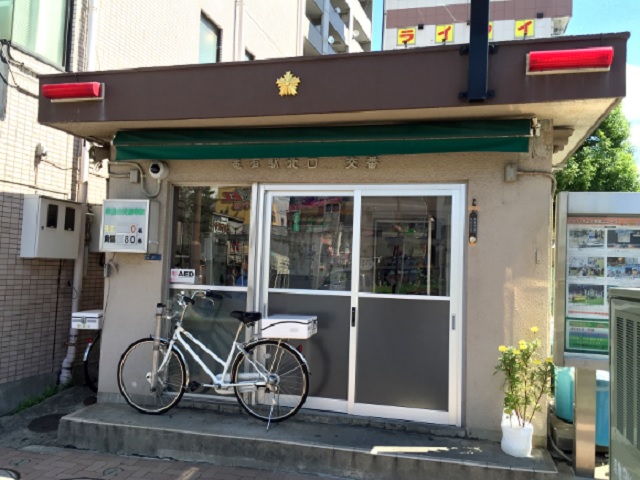
A unique aspect of Japanese cityscapes are koban, or “police boxes,” like the one pictured above. They’re essentially miniature police stations with an officer or two on duty should local residents need police assistance, and just about every neighborhood has one.

Another distinctly Japanese building is the love hotel, where consenting adults can pop into a private room for a few hours when they want to have sex but their homes aren’t an immediate option.

Koban and love hotels, of course, are supposed to be separate architectural structure entirely. Unfortunately, a pair of police officers in Nishinomiya, Hyogo Prefecture, decided to make their koban do double duty as a place for them to do the deed.

The amorous officers were a 29-year-old female police sergeant, who was assigned to a police box in the Koshien neighborhood, and a 26-year male senior police officer (despite the counterintuitive naming, the woman’s rank is actually one higher than the man’s).

Sometime in the fall of 2019, the two became romantically involved, and one evening while she was on duty in the police box, the woman called the man to come see her, after which they snuck off to the break room to have sex. Their relationship continued until at least the following February, which is when their second reported sexual liaison in the koban took place, this time in an on-site room for officers to nap in during their breaks.

▼ It’s more romantic than a patrol car, we suppose.

It’s unclear whether the two continued their relationship once spring came, but in March of 2020 the woman became involved with a different man in her division, a 33-year-old police sergeant. This time both parties apparently managed to keep their pants on, but the woman and her second police paramour did make use of the privacy of a police interview/statement room in order to kiss while the man was on duty.

Eventually a whistleblower came forward and reported the woman, triggering an internal investigation that revealed her relationship with the two men. The three members of the love triangle (which is, in fact, part of an even larger and messier love polygon, as all three of them are married) have admitted to the conduct, with the woman saying, “I was unable to control myself,” and the younger man saying, “I got carried away in the excitement.”

Both men received official admonitions, while the woman’s pay was docked by 10 percent for three months. The disciplinary discrepancy may have something to do with the woman being of a higher rank than the younger man, and the older man not having engaged in sexual activity on police property/while on duty. The reeducation in pay may turn out to be a moot point, however, as both the woman and the younger man resigned from their positions on Friday, the same date as their punishments were announced.

The situation brings to mind the incident last year when two other Hyogo police officers were also found to have been having sex at their police box — in that case as well, the higher-ranking officer, a man, had his pay reduced by 10 percent while the lower-ranking officer, a woman, was reprimanded without a reduction in pay. Additionally, in 2017 yet another pair of officers in Hyogo were found to have engaged in sexual activity inside the locker room of a prefectural police martial arts training dojo.

With the Hyogo police department no doubt wanting to put a stop to its recurring embarrassments, it would probably be wise for them to focus on serving and protecting the community, rather than servicing each other.

Source: Kobe Shimbun Next via Hachima Kiko
Top image: ©SoraNews24
Insert image: Pakutaso
● Want to hear about SoraNews24’s latest articles as soon as they’re published? Follow us on Facebook and Twitter!


Credit:
Ikea Japan adds epic matcha sweets to its menu for a limited time

Gorgeous celebration of matcha includes a very unusual tunnbröd you won’t find anywhere else in the world.

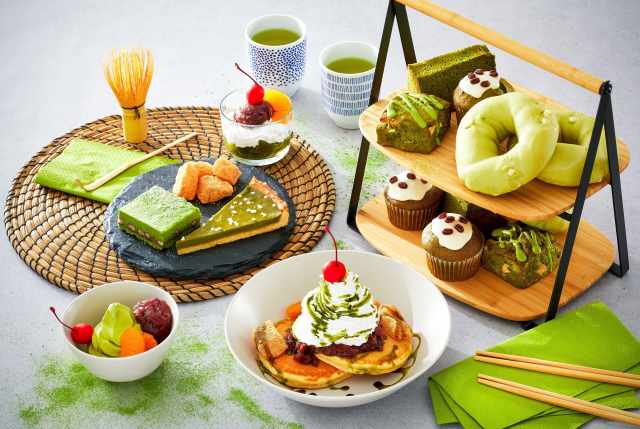
Every year, Ikea sweets go green in Japan for the annual “Matcha Sweets Fair“. The limited-time fair is an add-on to the chain’s original Swedish-themed menu, giving Ikea diners the chance to enjoy Japanese sweets with some Ikea flair, and this year the range is bigger than ever!

With a total of 11 sweets to choose from, there’s bound to be something here to whet your appetite. So let’s get to it and take a look at what’s on offer below!

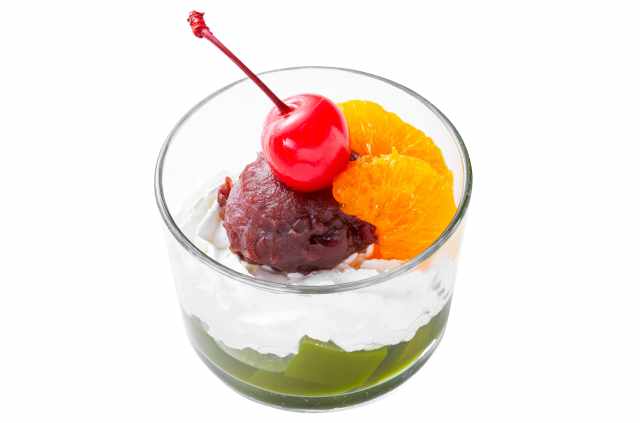
Matcha Anmitsu (299 yen, US$2.72)

Ikea’s take on the traditional Japanese anmitsu dessert contains smooth matcha jelly topped with cream, adzuki red bean paste, and fruit.

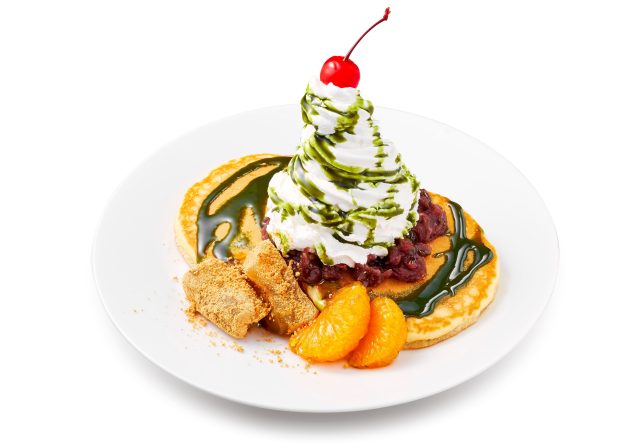
Matcha Tower Pancake (699 yen)

This delicious spectacle combines pancakes with matcha, warabi mochi (bracken starch dumplings) and adzuki beans, and is only available from 2:00 p.m. to 5:00 p.m. every day (from 3:00 p.m. at the Tokyo Bay branch).

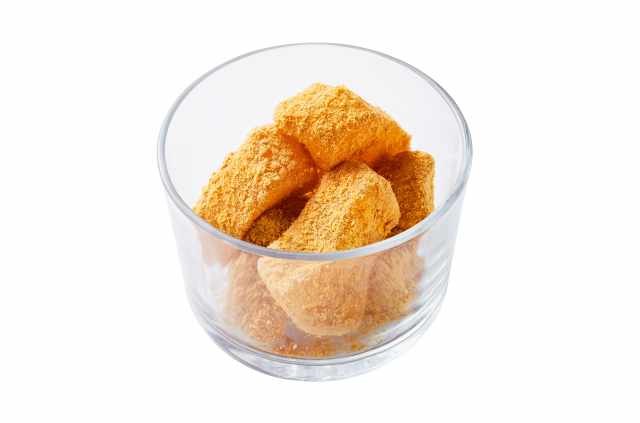
Warabimochi (249 yen)

Lovers of bracken starch dumplings will appreciate this serving of warabimochi, which is the one “Matcha Sweets Fair” item that doesn’t contain any matcha, opting for a dusting of kinako (toasted soybean flour) instead.

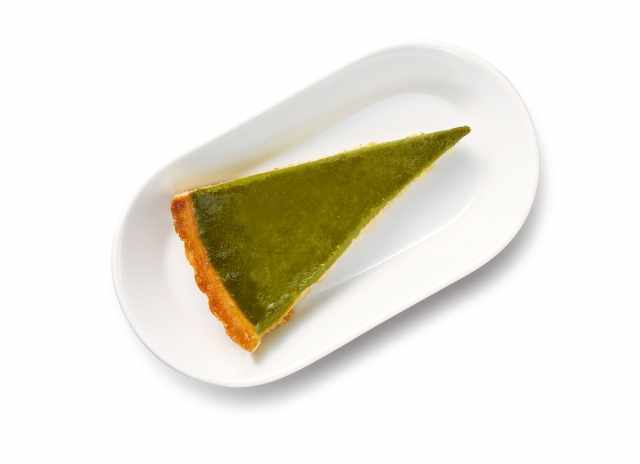
Matcha Tart (399 yen)

This simple tart allows you to enjoy the delicious taste and aroma of matcha, with a crunchy biscuit base.

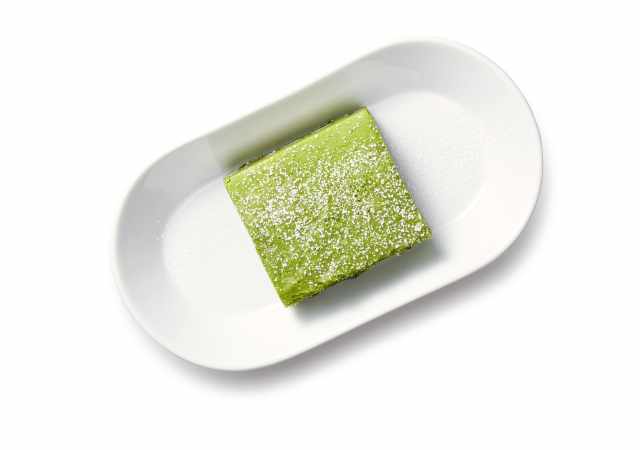
Matcha Brownie (329 yen)

This gorgeous bright green item is said to be an “elegant” brownie with a smooth texture and rich matcha flavor.

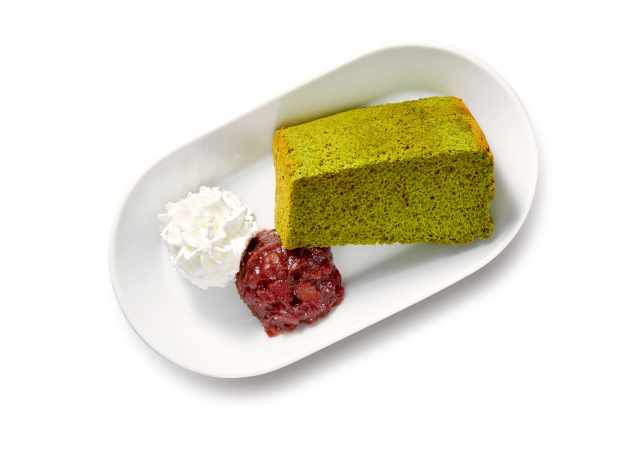
Matcha chiffon cake (299 yen)

The light and airy texture of this chiffon cake is complemented by a side of cream and adzuki red bean paste.

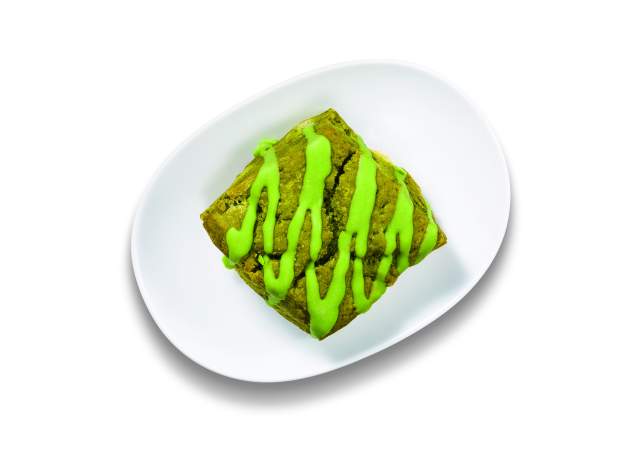
Matcha scone (249 yen)

This crunchy scone is a crowd favourite that appears on the menu at every Matcha Sweets Fair.

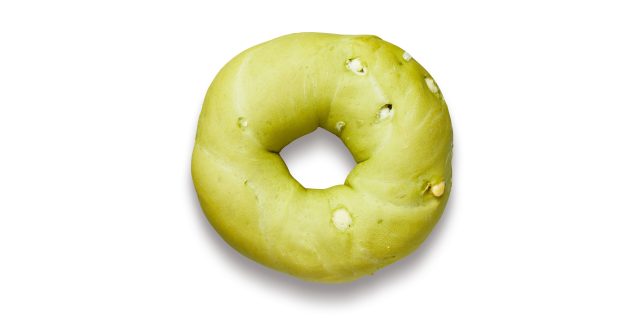
Matcha bagel (199 yen)

White chocolate and matcha combine forces for a very sweet green bagel.

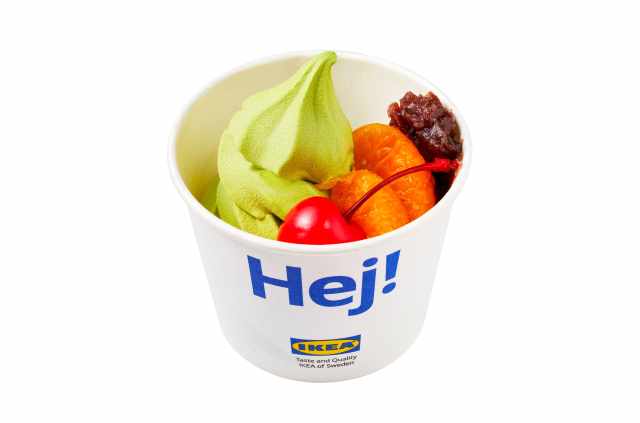
Matcha Anmitsu-style Sundae (250 yen)

The anmitsu dessert appears again, this time in a cup with a serving of matcha soft serve ice cream.

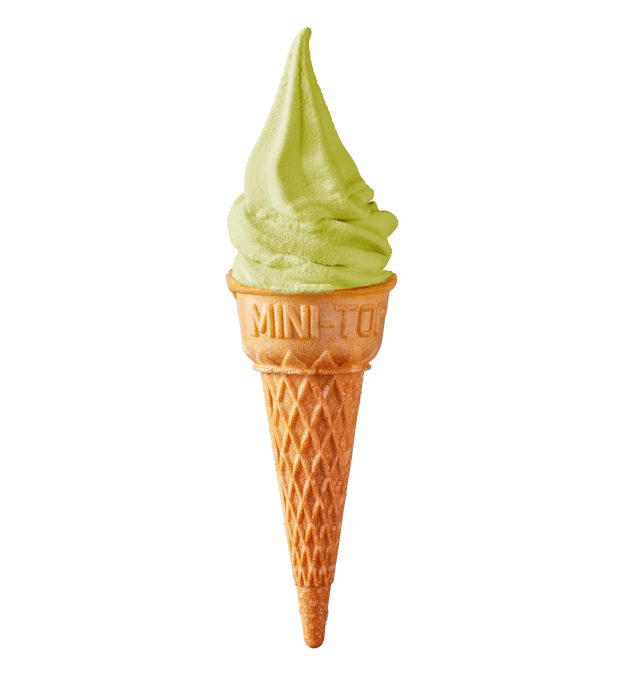
Matcha Soft Serve (120 yen)

Soft, creamy, and absolutely delicious, this soft serve lets you enjoy the taste and scent of premium matcha.

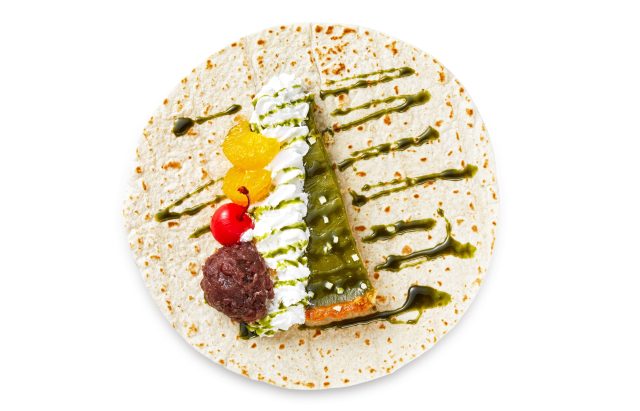
Matcha Tunnbröd (390 yen)

This Swedish flatbread usually comes with savoury fillings, but this one is filled with the sweet flavours of cream, adzuki red bean paste, fruit and a whole matcha tart slice! This fusion anmitsu-tart-tunnbröd is definitely the highlight of the matcha fair, but as tunnbröds are a specialty of the chain’s Harajuku location, where you’ll also find the world’s first Ikea convenience store, this special dessert is only available at the Harajuku branch.

The Matcha Sweets Fair runs until 27 June at Ikea stores around Japan, except the branch at Shinjuku, as it only has a deli corner. Some products will be discontinued once they sell out, so if you’d like to feast on Ikea matcha, be sure to pop by soon, and if you’re in Shibuya, you’ll get to enjoy a veritable bevvy of veggie dogs while you’re there!

Images: PR Times
● Want to hear about SoraNews24’s latest articles as soon as they’re published? Follow us on Facebook and Twitter!


Credit:
You can now buy text messages from “your Mom” from Japanese capsule toy machines

Step aside, school girl love letter machines. It’s Mom’s turn.

As you might recall, some of the stranger things you can buy out of Japanese capsule toy vending machines are letters supposedly written by a devoted little sister or a schoolgirl with a crush on you. Now, though, there’s a new series of gacha prizes with messages from someone who loves you very much: your mom.

OK, so technically these simulated text messages are coming from capsule toy maker Tama Kyu. Still, they’re very much the sort of texts the kind and caring woman who gave birth to you would send.

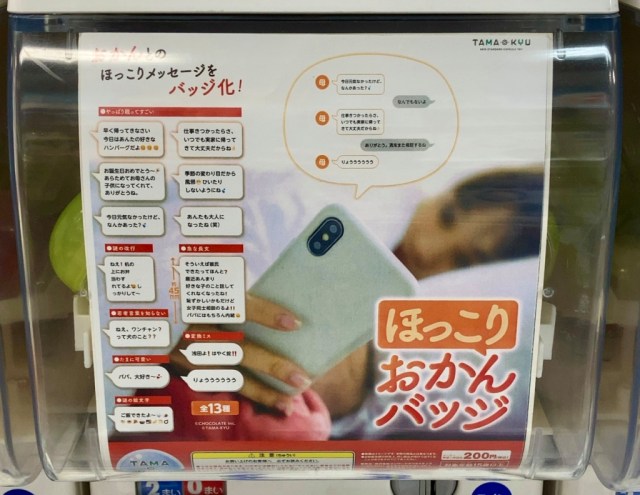
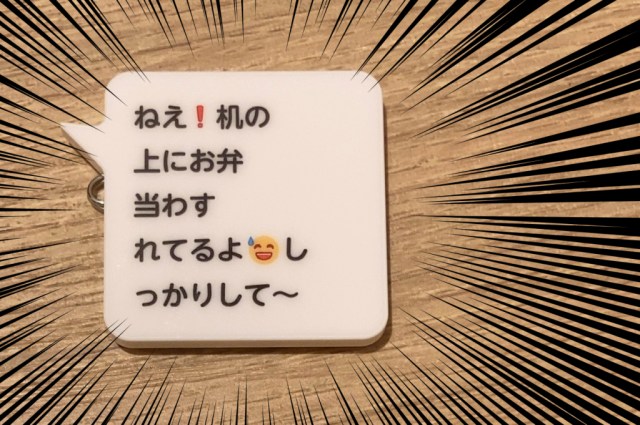
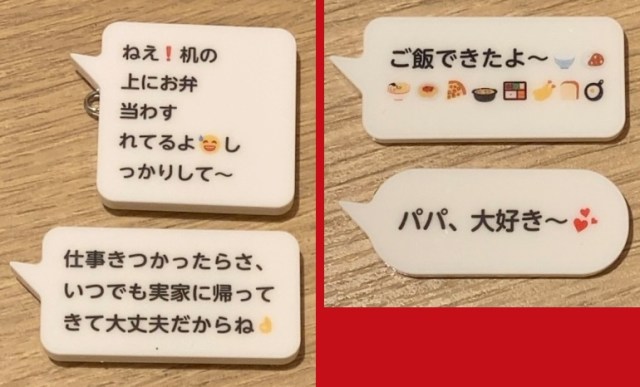
Feeling the need for a maternal boost, we decided to pick up a few of the Hokkori Okan Badges, or “Heartwarming Mom Pins,” each of which is shaped like a texting app text bubble.

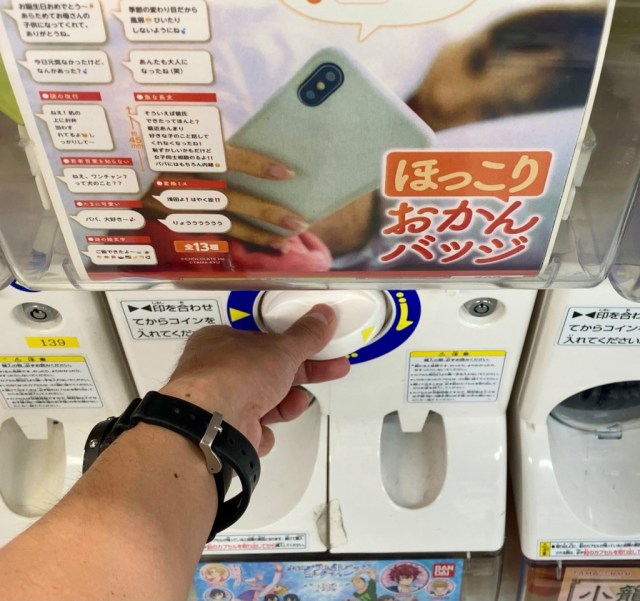
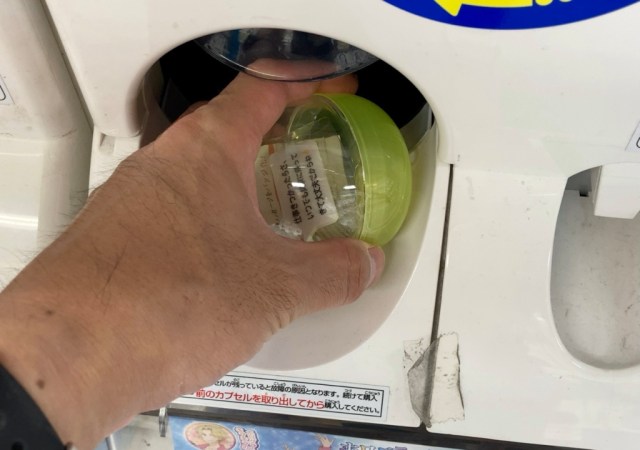
After putting in our 200 yen (US$1.90), we turned the crank, received our capsule, and popped it open to see what Mom had to say, and it immediately brought a tear to our eye:

“If work is grinding you down, you can always come back home, anytime.”

Thanks, Mom (sniff)! Yeah, sometimes the nine-to-five (or eight-to-ten) here in the big city takes a lot out of us. We’re still hanging in there, though, but it’s nice to know that if things ever get really bad, there’s always a place where we can go for a hug and a pep talk.

Of course, texting with your mom isn’t always heart-to-heart correspondence. Sometimes it’s weirdly formatted messages, the product of her still not quite having the hang of typing on her smartphone, no matter how many times you show her how to do it.

“Hey! You forgot
to take your lun
ch with you.
Stay
sharp!”

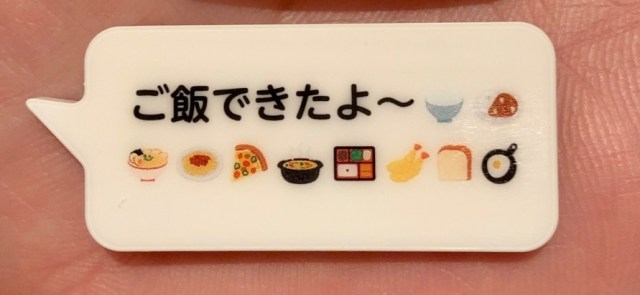
Then again, some moms are more techno-savvy and perhaps overly eager to show off their emoji skills, following “Dinner is ready” with pictures of rice, curry, ramen, spaghetti, pizza, hot pot, a bento boxed lunch, tempura shrimp, a loaf of bread, and a fried egg.

▼ Umm, thanks Mom, but we don’t think we can eat that much. Yes, we know you think we’re down to skin-and-bones, but still.

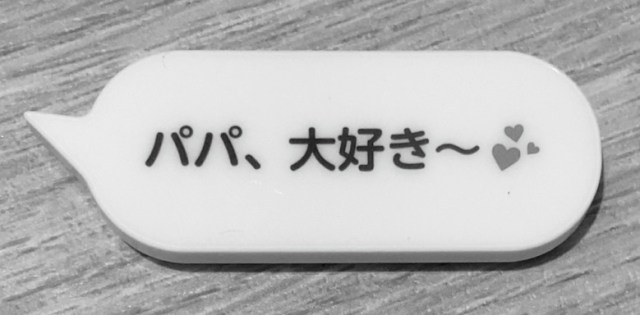
And who could forget that classic: the text your mom meant to send to your dad, but ended up sending to you by accident.

“I love you, Hubby!”

▼ Technically it says “I love you, Papa,” but it’s fairly common for Japanese married couples to call each other “Mama” and “Papa” after they have kids.

In total, there are 13 different messages from Mom in the series, and while they may not have the sheer zaniness of some other capsule toys, they’re actually a pretty sweet idea, and also a good reminder that we should call our mom and see how she’s doing. And if instead of getting sweet messages from your parents you’ve been getting salty ones from online trolls, Tama Kyu has you covered on that front too.

Photos ©SoraNews24
● Want to hear about SoraNews24’s latest articles as soon as they’re published? Follow us on Facebook and Twitter!


Credit:
Japan continues to shun processed fish sticks, opts for minimally processed fish cubes instead

Everything tastes better when it’s a cube!

It’s certainly no secret that Japan is a country that loves to eat fish and in a variety of ways from sushi to soups to a nice grilled filet. But it might surprise some to learn that by and large people here don’t really go for the taste of the humble fish stick or “fish finger” if you will.

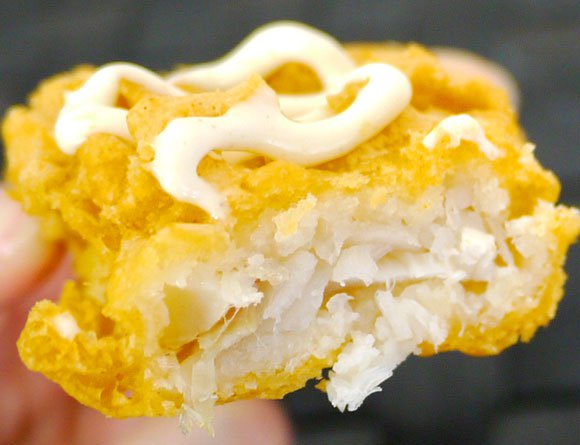
Heavily processed and battered white fish meat does exist in Japan, mainly as a cheap bento side dish and in the Filet-O-Fish at McDonald’s. That’s about the limit that it’s tolerated though, with supermarket freezer sections only offering a smattering of frozen processed fish meat.

▼ KFC also flirted with Kentucky Fried Fish,  but it never stuck around

Photo ©SoraNews24

It’s not terribly clear why this is. Some might say it’s a general awareness of food quality that causes people in Japan to stay away from conglomerated meats from unclear origins. However, chicken nuggets are everywhere despite being made in a very similar manner, so people here clearly aren’t that averse to highly processed foods.

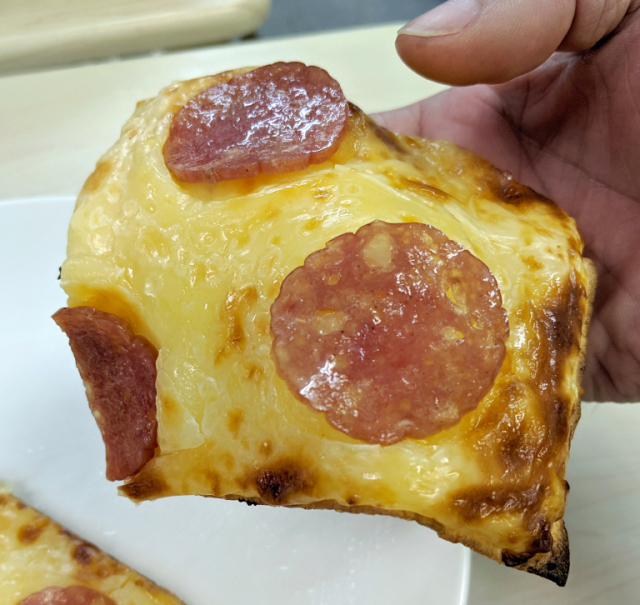
▼ Heck, we even found fish meat that had been processed into a pepperoni pizza, now that’s processing!

Photo ©SoraNews24

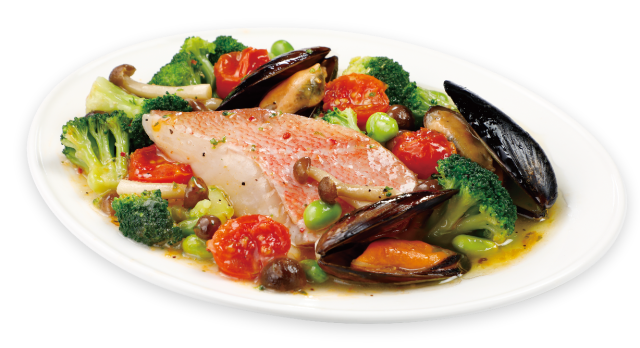
More likely it’s just a conception of what fish “should” be in the minds of Japanese diners. To draw comparisons, it might be like how a lover of pork ribs might flinch at the concept of Spam. Or more universally, fish sticks to Japanese people might be seen the same way that anyone would view eating processed broccoli sticks coated in bread. That probably wouldn’t taste so bad, but most people’s initial reaction to it would probably be to ask; “Why even bother doing this?”

▼ The Japanese standard for fish served with the global standard for broccoli

However, eating unprocessed fish has its drawbacks. It’s full of bones that are a nuisance at best and dangerous at worst. It can be time consuming and messy to cook and leave a less-than-pleasant smelling amount of waste when finished.

According to major retailer Aeon, who also runs a number of supermarket chains, these issues, combined with a drastic increase in home cooking due to COVID-19, have led to an increased demand for a simpler way to cook fish. These are the perfect conditions for fish sticks to finally dominate in Japan, right?

Wrong!

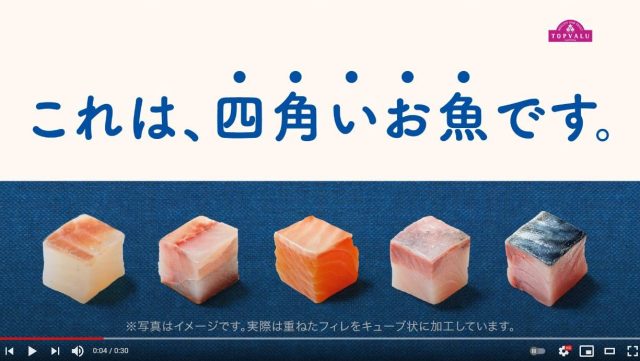
Aeon instead went to great lengths to develop fish meat that was both minimally processed but easy to cook and eat. The fruits of this labor is Papatto Dekiru Osakana Okazu (“Fish Side Dish In a Jiffy”) which is sold under Aeon’s Top Valu store brand and available in five types of fish: Pacific cod, horse mackerel, salmon, yellowtail, and chub mackerel.

Despite their very inorganic shape, this meat undergoes the bare minimum of processing, if you would even call it “processing.” In a nutshell, the bones are removed from the fish filets which are then stacked into a layered sheet and pressed together while freezing, with no binding agent used at all.

These frozen sheets of fish are then cut up into cubes, dusted with flour and packaged. It’s all much easier said than done, because getting the different cuts of fish to merge as one and stay that way throughout thawing and cooking took a lot of trial and error. In the end though, Aeon says that this method ended up using more of the fish’s meat and ultimately reduced waste, because even the thinner meat near the tail of the fish was usable this way.

The result is a boneless bite-size cut of fish that only needs to be plopped into a frying pan to cook. Aeon is hoping that this simplicity will encourage home cooks to experiment more with dishes using fish such as pastas and salads.

These fish cubes have only hit seafood sections on 12 May for about 358 yen (US$3.26) a pack, so it remains to be seen if they’ll catch on. If the day ever comes that we see skilfish or warasubo sold in cubes, it’ll probably be safe to say that it was a success.

Source: Top Value, FNN Prime Online, PR Times
Top image: YouTube/トップバリュ公式チャンネル【TOPVALU】
Insert images: PR Times (Unless otherwise stated)
● Want to hear about SoraNews24’s latest articles as soon as they’re published? Follow us on Facebook and Twitter!


Credit: