First-ever carbon-neutral sake coming in October
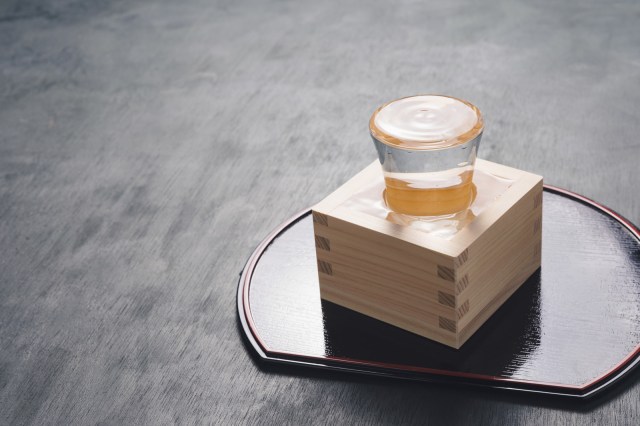
Sip some sustainable sake soon.

With a lot of focus being put on products that are sustainable and ethical, the Japanese alcohol known as nihonshu in Japan, or just sake abroad, really has a lot going for it. For centuries, it has been an all-natural, additive-free, and vegan alcoholic drink in its standard form, made with three simple ingredients: rice, water, and yeast.

That alone would make sake a great choice for those with environmental or ethical concerns, but one brewery in Kobe, Hyogo Prefecture still thinks more can be done. Kobe Shushinkan is a prestigious sake brewery that dates back to 1751, has won many awards, and even had its sake served at the Nobel Prize ceremony.

Now they are embarking on a bold new campaign to make their entire business environmentally sustainable, starting with the world’s first carbon-emission-free sake, Fukuju Junmaishu Eco Zero.
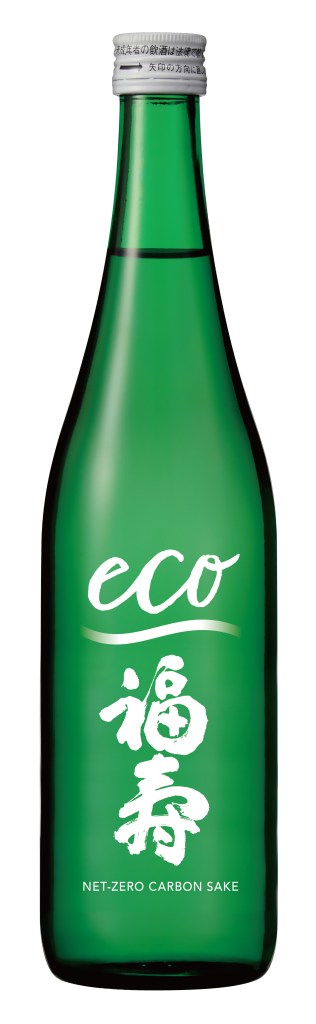
This version of Kobe Shushinkan’s famous Fukuju brand of sake accomplishes this in four different ways. First, they switched their energy sources to Kobe’s non-fossil-burning sources for electricity and carbon-neutral liquified natural gas to run the brewing. They have also taken numerous steps around the brewery to reduce overall electricity consumption such as LED lighting.

In the brewing process itself, instead of milling the rice grains down to 70 percent as they normally do Kobe Shushinkan will only mill them down to 80 percent. By milling less of the rice grains, less power is used and as a result the sake has a more complex and earthy taste than the highly fruity flavors of sake made from heavily milled rice like daiginjo.

Normally in sake brewing something called “shubo” is used. Literally translating to “sake mother” this mass of mushy steamed rice is used to cultivate the yeast needed to ferment the sake. However, since the steaming process consumes energy, this step has been eliminated in the production of Eco Zero. Instead, dried yeast is used to reduce the environmental burden and speed up the entire brewing process.

▼ A quick and very informative video showing shubo being prepared

Finally, the bottles themselves do not have any labels which require additional materials and energy to produce. Instead, a lead-free ink is applied directly to the bottle through electrostatic coating. These bottles will grace liquor shelves starting 20 October for an expected retail price of about 1,500 yen (US$11) per 720-milliliter (24-ounce) bottle.

Eco Zero is only the first step in Kobe Shushinkan’s Sustainable Journey initiative in which it aims to have complete emission-free brewing by 2030 and extend this to all aspects of their supply chain by 2050, including farming and distribution to the 15 countries where Fukuju sake is sold. They also plan to share these techniques with other breweries so that the entire industry can move in a greener direction together.

In addition to adhering to basic social responsibility, Kobe Shushinkan also has a vested interest in curbing climate change and protecting the environment. Sake brewing is deeply connected to the water and land of the local environment in which its made. So for them and for all of us, saving the environment also means saving great tasting sake.

Source: PR Times
Top image: Pakutaso
Insert image: PR Times
● Want to hear about SoraNews24’s latest articles as soon as they’re published? Follow us on Facebook and Twitter!


Credit:

The Sailor Scouts and their Sanrio sidekicks are finally here with adorable new collectable goods

Plus…new pairings have been announced!

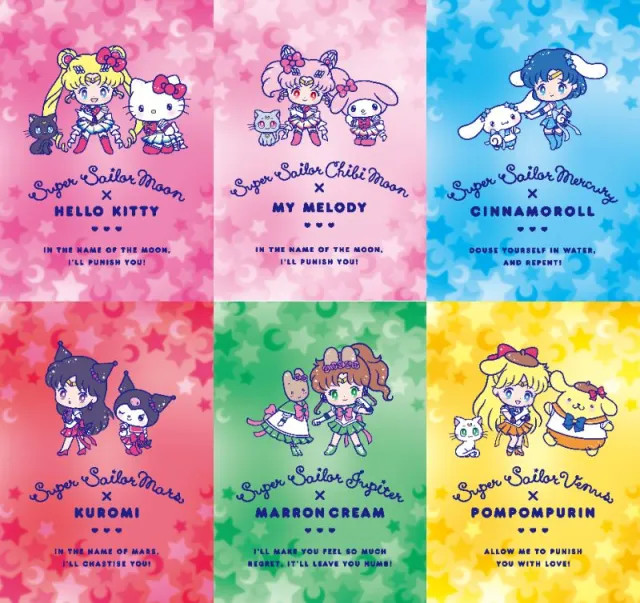
It’s here! The dream kawaii collaboration between Sailor Moon and Sanrio is finally here! Way back in January they teased us with a few concept images that paired up a Sailor Scout with a Sanrio character similar in style or personality, but they hadn’t announced how these new pairings would be used–until now! The Pretty Guardian Sailor Moon Eternal x Sanrio Characters line will be composed of almost a dozen different collectible accessories.

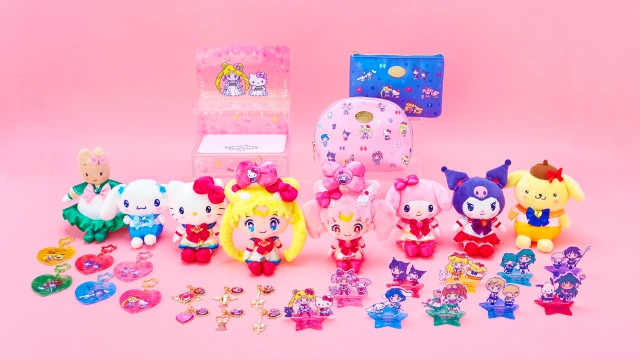
The line, which is part of the celebration of Sailor Moon’s 30th Anniversary, features the Sailor Scouts and their partners dressed in their Super Scout uniforms from the Sailor Moon Eternal movie, which came out last year. While the Sanrio characters are wearing outfits to match their Scout, the Sailor Scouts are designed like their Sanrio character sidekick, down to their defining features and accessories.

The pairings are:
● Super Sailor Moon and Hello Kitty
● Super Sailor Chibi Moon and My Melody
● Super Sailor Mercury and Cinnamoroll
● Super Sailor Mars and Kuromi
● Super Sailor Jupiter and Marron Cream
● Super Sailor Venus and Pom Pom Purin

And of course, the cats of Sailor Moon also appear with their respective master and sidekick: Luna with Sailor Moon and Hello Kitty, Artemis with Sailor Venus and Pom Pom Purin, and Diana with Sailor Chibi Moon and My Melody.

The first round of goods comes out on August 18 and includes a wide variety of accessories like plush keychains, acrylic keychains, acrylic standees, charms, different kinds of zippered pouches, accessory stands, clear files, and pens.

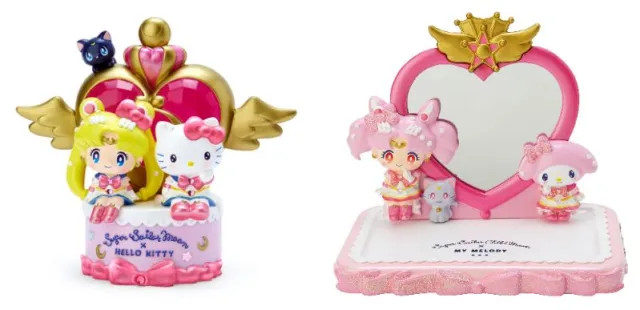
They’ll be joined on October 27 by some really cool vanity and decorative goods, including a Super Sailor Moon and Hello Kitty room light (6,930 yen [US$51.45]) and a Super Sailor Mini Moon and My Melody jewelry tray with a mirror (5,940 yen). Both of these have a large transformation brooch as their main feature, so decorating your room with them is sure to bring you back to your childhood.

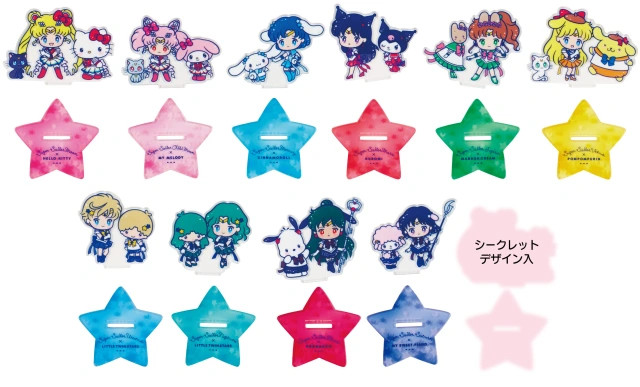
Of course, there aren’t just six Sailor Scouts–there are ten of them! With the announcement of the products came an unveiling of four more pairings featuring the outer Sailor Scouts:
● Super Sailor Uranus with Little Twin Stars Kiki

● Super Sailor Neptune with Little Twin Stars Lala
● Super Sailor Pluto with Pochacco
● Super Sailor Saturn with My Sweet Piano

These newly revealed pairs are going to come in the form of originally-designed acrylic standees, and they’re so cute! Lala and Kiki’s hair colors were changed to match Neptune’s and Uranus’, and Pluto and Saturn were given ears to match Pochacco and My Sweet Piano. They’re so adorable we just can’t stand it.

Among the standee designs, there will also be a secret design they aren’t announcing…what could it be? We can only look forward to finding out when the goods are released!

When August 18 and October 27 roll around, you’ll be able to find these items at all Sanrio Shops around the country, as well as department stores where Sanrio goods are sold and the Sanrio Online Shop. Make sure you mark your calendars because these adorable products are sure to sell out fast!

And for more 30th Anniversary Sailor Moon celebrations, don’t forget to check out the Sailor Moon Anna Sui collection, the Sailor Moon Jimmy Choo boots,  and the Sailor Moon purse, clothing, and accessories collections from Samatha Group. There are so many ways to honor everyone’s favorite magical girl, we just don’t know what to pick!

Source, images: Press release
● Want to hear about SoraNews24’s latest articles as soon as they’re published? Follow us on Facebook and Twitter!


Credit:
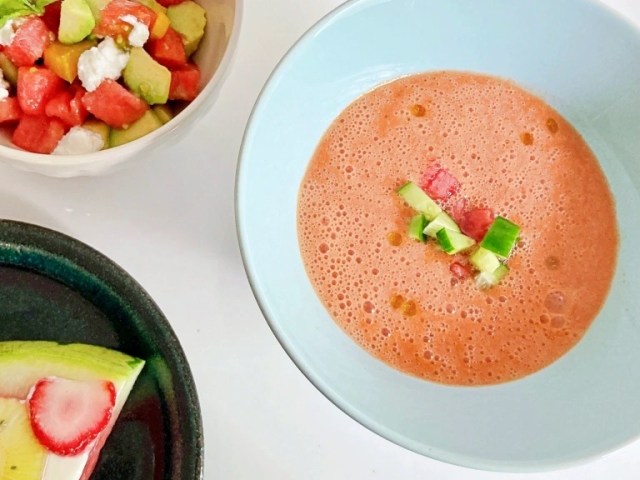
Watermelon soup? We test out a strangely alluring recipe from Ajinomoto【Recipe】

Going beyond watermelon smoothies with watermelon gazpacho.

In Japan, watermelon is sometimes called “the king of fruits.” Could it also, though, be the king of soups?

Food and beverage company Ajinomoto thinks it has the potential, as they recently shared a recipe for watermelon gazpacho, which our Japanese-language reporter Aoi Kuroneko was quick to try out.

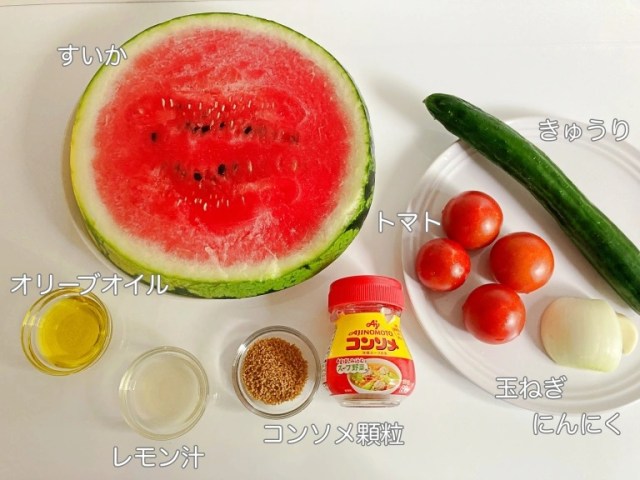
Ingredients (for four servings)

Watermelon (350 grams [12.3 ounces])
Cucumber (70 grams [2.5 ounces])
Tomato (120 grams [4.2 ounces])
Onion (30 grams [1.1 ounces])
Garlic (1/2 clove)
Olive oil (1 tablespoon)
Lemon juice (2 teaspoons)
Consommé powder (2 teaspoons)

Step 1: Chop the watermelon, cucumber, and tomatoes.

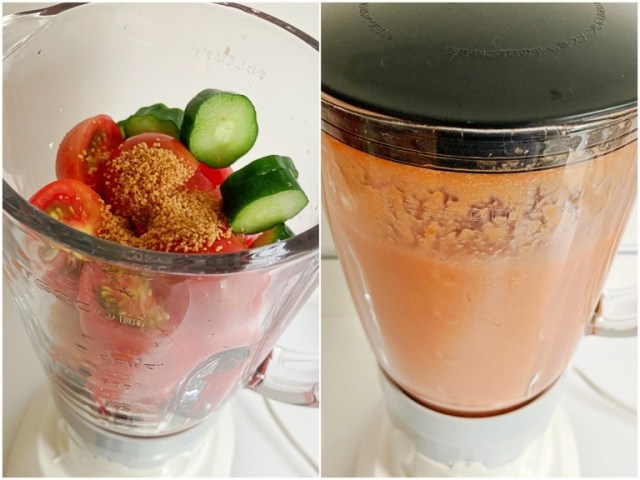
Step 2: Set aside 50 grams of watermelon and 20 crams of cucumber. Place the rest of the watermelon and cucumbers into a blender, along with the tomato, olive oil, lemon juice, and consommé powder. Blend the mixture until smooth.

Step 3: Dice the onion and garlic, add them to the mixture, and blend once more.

Step 4: Pour the blended mixture into a bowl and place in the refrigerator to chill.

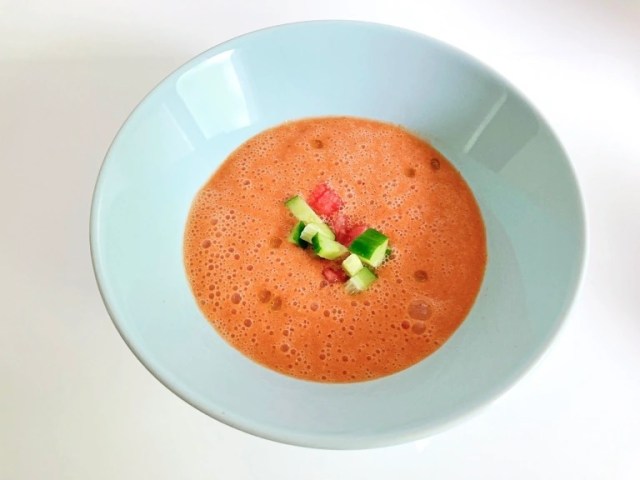
Step 5: Once the mixture is chilled (this may take a few hours), add the watermelon and cucumber you set aside in Step 1 as a topping, and your watermelon gazpacho is ready!

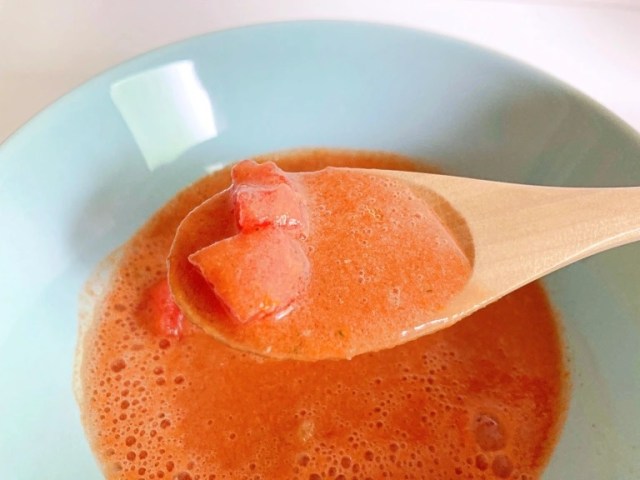
Setting aside the chilling, the whole thing only requires about five minutes of active prep work, which isn’t bad at all for something that comes out looking as pretty as this. As for how it tastes, let’s go to Aoi’s taste-test notes:

“From the very first moment, the watermelon makes its presence felt! This is a refreshingly chilly soup that lets you really enjoy the melon’s sweetness.

Olive oil turns out to be surprisingly compatible with watermelon, and the lemon juice and garlic are just enough to bring the soup’s sweet notes into sharper focus without covering it up, and there’s no unpleasant bitterness from the tomato or cucumber either.

All in all, this is a very unique, but also very good, soup.”

With no boiling, simmering, or other cooking involved, it’s also pretty easy to adjust the recipe to better suit your tastes, whether that means adding in more onion for a spicier finish or using a squirt more of lemon juice for extra tartness. Also, as a soup, increasing or decreasing the amount you make is a snap, making it easy to whip up a batch for a party, make use of leftover watermelon you’ve got in the fridge, or any other time you’re craving a new spin on the king of fruits.

Source: Ajinomoto
Photos © SoraNews24
● Want to hear about SoraNews24’s latest articles as soon as they’re published? Follow us on Facebook and Twitter!


Credit:
Become a sumo wrestler with the new top knot hairband from Japan

Channel your inner rikishi with a head-turning new fashion accessory.

These days, we’re all looking to add a touch more joy to our lives, and Japanese company Felissimo has long been using the power of humour to do just that, through its “You + More” sub-brand, which sounds similar to “Humour“.

Over the years, You + More has been making us smile with jellyfish-inspired umbrellas and ramen noodle towels, and now our smiles are set to widen even further, with the addition of a new product called the “Akogare no Ooichoo-fuu Hea ga Kanau Rikishi Narikiri Hea Bando“, which translates to “Longed-for Top Knot-Style Hair Comes True Wrestler Impersonator Hair Band“.

▼ Yep, that name pretty much sums it up. 

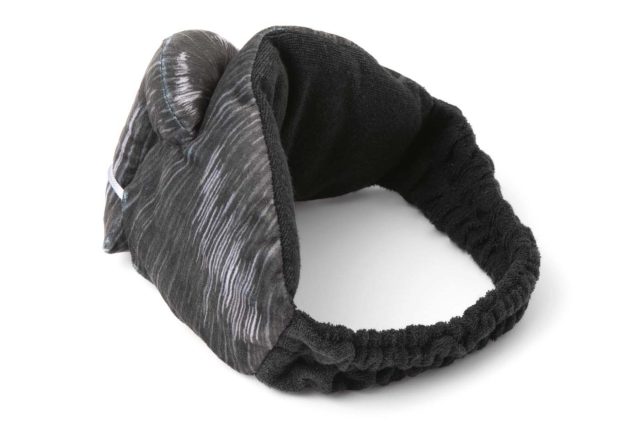
This new hairband lets you channel your inner sumo wrestler with a realistic-looking top knot, complete with carefully placed white highlights to add shine to areas and give it a rounded, full, 3-D look.

▼ Made from cotton, the hair band is elasticised for comfort.

As most of us wouldn’t have the courage to wear such an eye-catching headpiece outdoors, the hair band is designed to be used at home, for those times when you need to keep your hair out of your face.

▼ Like during your skin-cleansing routine.

You can also wear it during post-bath downtimes, or when lounging around the house. Be careful when wearing it during mealtimes, though, or else you might find yourself eating giant portions like a sumo wrestler too.

The hairband can be purchased online for 2,090 yen (US$15.25), and if you’d like to add more sumo items to your home to match your hairband, you can always invest in You + More’s other humorous sumo products, like the salt-shaker that adds ceremonial salt to your fries!

Source, images: Felissimo 
● Want to hear about SoraNews24’s latest articles as soon as they’re published? Follow us on Facebook and Twitter!


Credit:

Autonomous beverage and snack car now testing in Chiba City

It’s like some kind of vending mechanical robot or something!

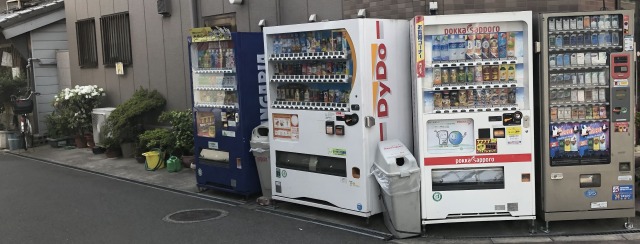
Japan certainly is a country full of vending machines. In fact, there is said to be one vending machine for every 34 people living here. That’s an amazing number, and yet I’m still left wondering if they could be more convenient somehow. I mean, they all pretty much just sit there and don’t really do anything to actively provide me with cool beverages.

▼ Just look at these shiftless layabouts, hanging out on the street corner all day and night.

Photo ©SoraNews24

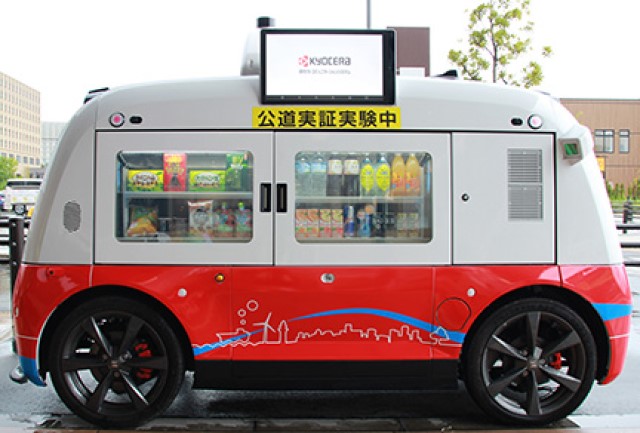
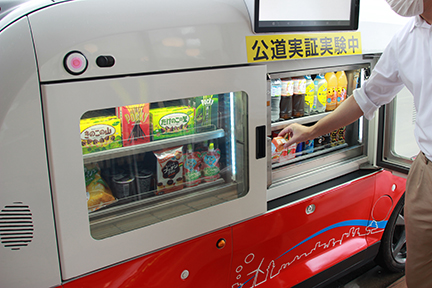
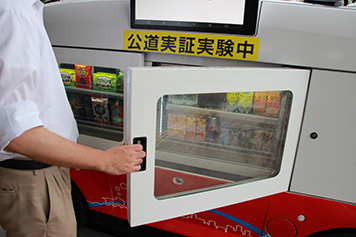
Kyocera Communication Systems is now working on filling that small gap with an unmanned vending machine on wheels so to speak. The as yet unnamed machine is about the size of a very small car, 2.5 meters (8 feet) in length, 1.3 meters (4 feet) wide, and up to two meters (6.5 feet) tall.

Without any driver it will cruise a predetermined route on city streets, especially around areas that might need it like public parks or apartment complexes. After getting stocked with hot or cold beverages and temperature sensitive snacks like chocolate and jelly, it will move at about 15 kilometers per hour (9 miles per hour) and sell its goods via the attached touch panel and a smartphone payment system.

With the cooperation of Chiba City and approval by the Kanto Transport Bureau, this little car will putt around the Wakaba 3-Chome district of Chiba, five days a week including weekends, between the hours of 10 a.m. and 6 p.m.

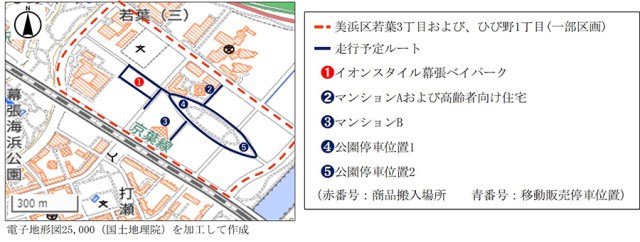
▼ A map of the snack car’s route

First it will scoot around the perimeter of the Aeon Style Makuhari Bay Park shopping center, then do a lap around the cigar-shaped Wakaba 3-Chome Park while also swinging by large condominium complexes located on each side of it.

However, since this is a trial run, service times will be irregular and trips will be called off during inclement weather or if the car requires maintenance. Also, even though the vehicle is autonomous, it will be constantly monitored and immediately overridden in the event it is about to have an accident or be hijacked by snack-marauders.

Nevertheless, for the time it’s active, Kyocera’s snack and drink car will certainly bring an added touch of high-tech convenience to an already very convenient country. And yet as I type this in my seventh-floor office I have to wonder: Would it be so hard to make one of these things that can fly?

Source: PR Times
Images: PR Times (unless otherwise noted)
● Want to hear about SoraNews24’s latest articles as soon as they’re published? Follow us on Facebook and Twitter!


Credit:
Sukiyabashi Jiro Sushi Rice: How good is rice from Japan’s legendary sushi restaurant?

Recreating the expensive restaurant experience at home with authentic ingredients, at a fraction of the price you’d usually pay for them.

Sukiyabashi Jiro in Tokyo’s posh Ginza district is often touted as one of the best sushi restaurants in the world. The restaurant shot to global fame with the 2011 documentary Jiro Dreams of Sushi, and since then it’s been visited by some of the most famous people in the world, including Barack Obama and David Beckham.

Notoriously hard to get into, and with courses costing hundreds of dollars per person, the restaurant remains out of reach for a lot of people, including our food-loving reporter Mr Sato. So when he heard there was a way to get a taste of the restaurant’s sushi rice at an affordable price, he immediately went out to find it.

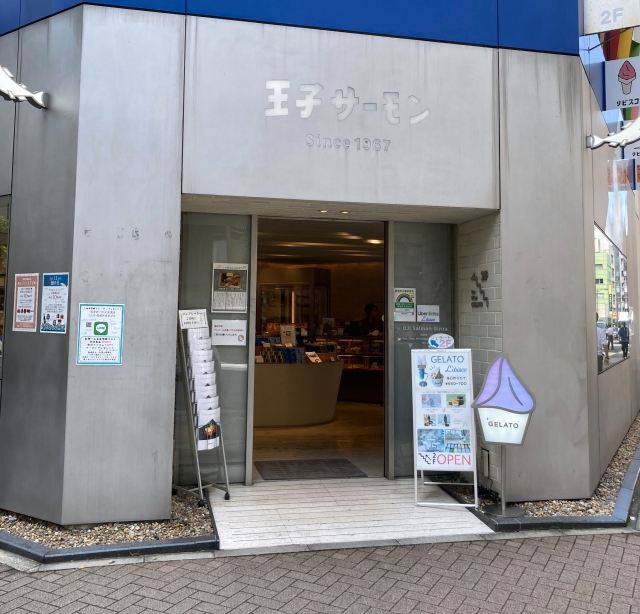
▼ Sukiyabashi Jiro’s sushi rice can be purchased at the Ginza branch of salmon specialist store Oji Salmon.

This store wants customers to enjoy their top-quality fish with the best quality rice, and so for them, nothing less than Sukiyabashi’s sushi rice will do.

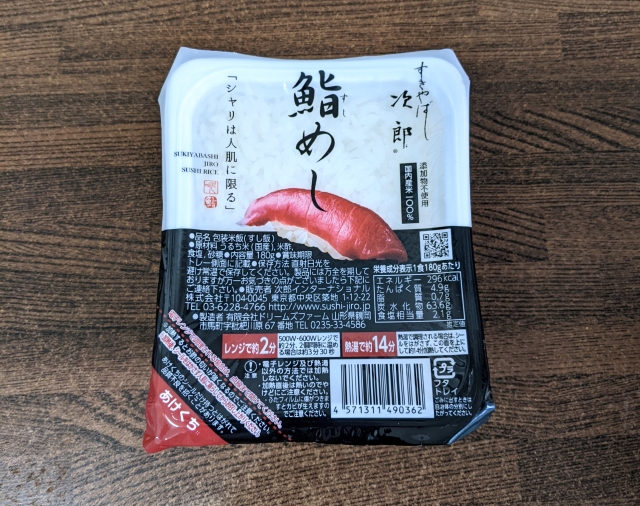
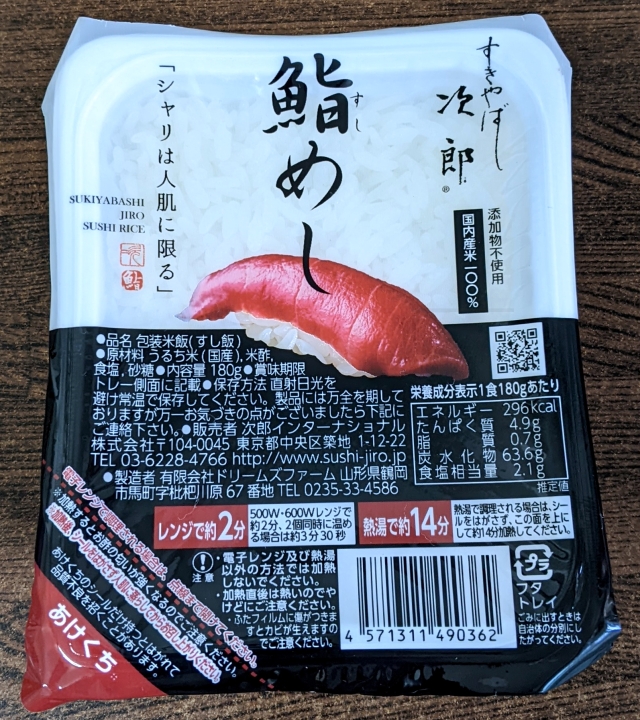
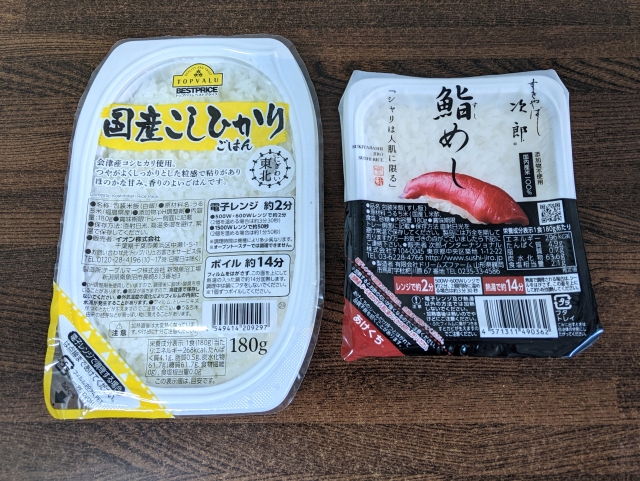
▼ The rice is sold in ready-made packs that only need to be heated before eating.

As sushi aficionados will know, sushi rice is just as important as the fish that’s placed upon it, and Sukiyabashi Jiro itself believes it to be the most important component, saying, “The decisive factor in the taste of sushi is the sushi rice”.

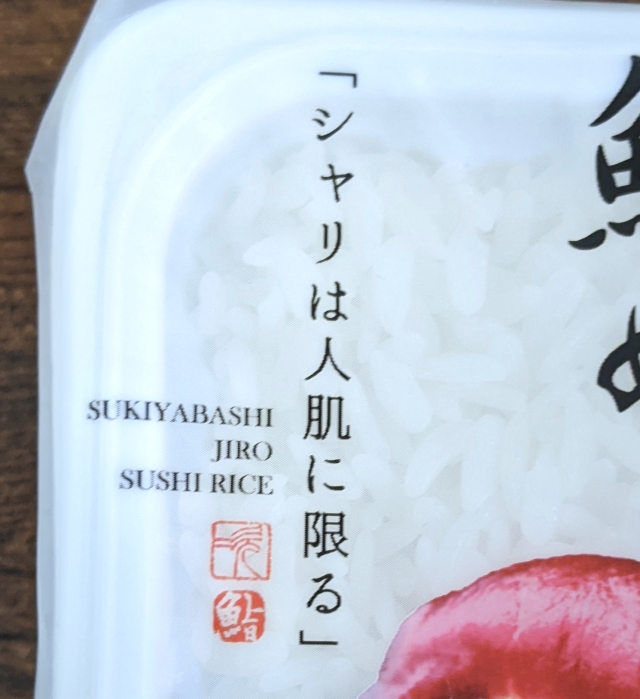
This set the bar high for Mr Sato’s expectations, especially when he saw the blurb on the package that read: “シャリは人肌に限る” (“Shari wa hitohada ni kagiru”), “The warmth of human skin is best for sushi rice”. This is a quote by Jiro Ono, the 96-year-old sushi master who owns the restaurant, and it signifies the level of detail given to the rice, which is best served at the same warmth as human skin.

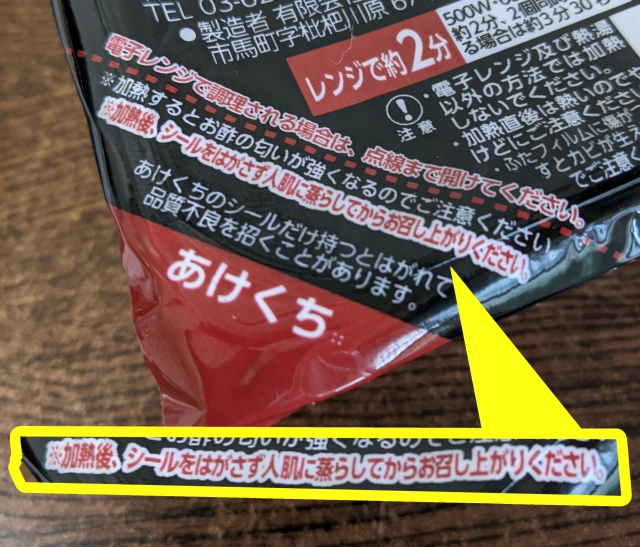
The directions on the pack ask that the customer follow Ono’s advice by keeping the seal on the pack after heating to allow it to steam until it reaches the temperature of human skin.

Mr Sato decided to honour Ono’s advice as best as he possibly could, and just to see if the rice really was worth the hype, he picked up a pack of own-brand Topvalu rice from an Aeon-run My Basket corner store to compare.

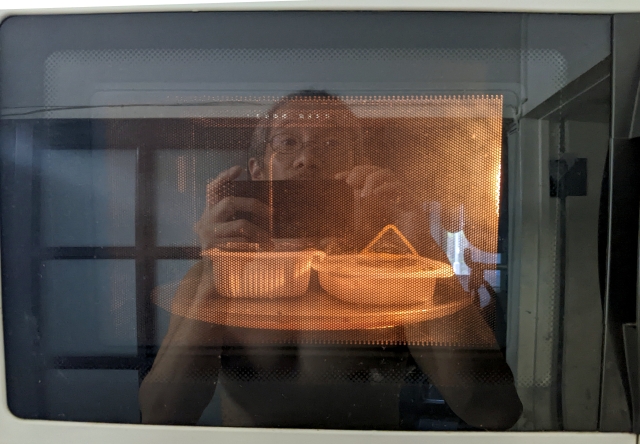
Both packs required two minutes of heating in a microwave at 500 Watts, so Mr Sato heated them together.

After heating, he let the packs steam in their packages for a while before peeling off their plastic seals to test the temperature.

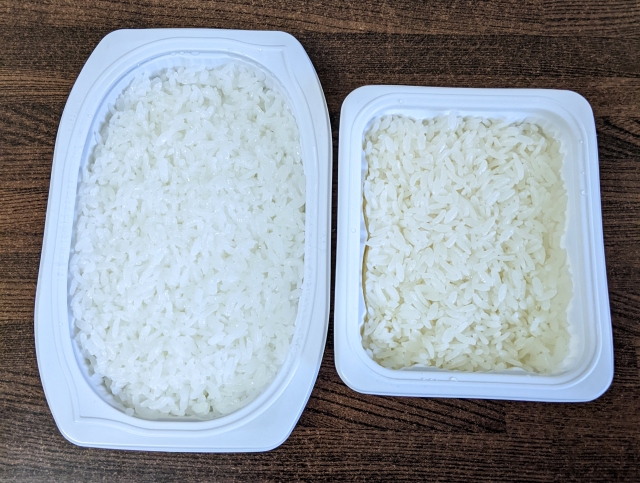
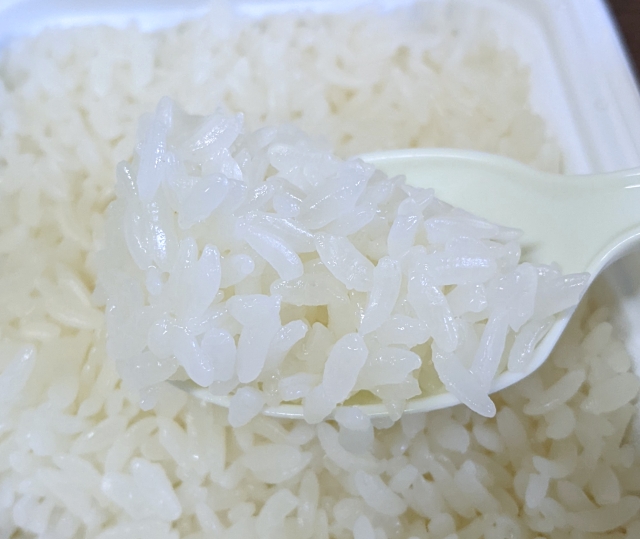
They seemed just about right, so Mr Sato took a taste, starting with the Topvalu rice, which was glistening with a pure white shine. It was delicious enough — nothing out of the norm, and a good-quality standard offering.

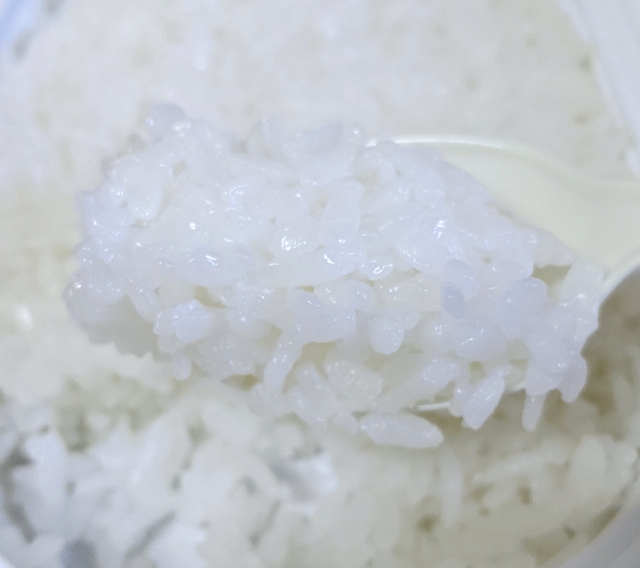
While the Topvalu rice was plain and unseasoned, Sukiyabashi Jiro’s rice is sushi rice, so the aroma of vinegar was present. The rice wasn’t as glossy as as the cheaper Topvalu version, but the quality was undeniable, as the grains were beautifully shaped, and held together to create just the right consistency. It wasn’t falling off the spoon, but it wasn’t joined together in one massive clump either — the consistency was perfect.

The mouthfeel was sublime, and the taste was slightly astringent, which is to be expected when eating sushi rice on its own. Of course, Sukiyabashi Jiro advises that the rice not be eaten on its own, and instead be enjoyed as hand-moulded nigiri sushi or handmade makizushi, as that’s when the flavour really shines.

Unfortunately, Mr Sato didn’t have enough money on him to buy rice and fish when he was out that day, so he might just have to make a return trip to Oji Salmon to fulfil his own dreams of fully recreating the Sukiyabashi Jiro experience at home. At 560 yen (US$4.16) a pack, it’s an affordable way to enjoy a taste of luxury, and once he finds another pack of Sukiyabashi Jiro seaweed, he’ll be all set for a perfect sushi evening.

Store Information
Oji Salmon Ginza Store / 王子サーモン 銀座店
Address: Tokyo-to, Chuo-ku, Ginza 3-7-12
東京都中央区銀座3-7-12
Open 10:30 a.m.-8:00 p.m. (weekdays); 10:30 a.m.-7:00 p.m. (weekends and public holidays)

Images ©SoraNews24
● Want to hear about SoraNews24’s latest articles as soon as they’re published? Follow us on Facebook and Twitter!


Credit:
Yokohama’s “Manhole Actress” becomes spokesperson for city’s sewage system

Popular Kamen Rider villain takes on a new fight.

Manholes have been enjoying a great deal of popularity in Japan recently. Maintenance hole covers featuring famous anime and video game characters have become tourist attractions and Tokyo even went as far a gamifying the act of manhole inspection with big cash prizes.

Manholes even began featuring in pop culture, such as the long-running kid’s tokusatsu action series Kamen Rider, in its 2018-2019 season Kamen Rider Zi-O during which the character Another Kiva appears. Without going too much into deep Kamen Rider lore, Another Kiva is basically the demonized version of homicidal jilted lover Yuko Kitajima, who also happens to use a manhole lid as her weapon of choice.

▼ A montage of Yuko flipping her lid

Although the character’s appearance only lasted two episodes, she made an impact. This was in no small part due to the acting chops of Yumiko Shaku, who manages to make throwing a manhole cover around look very natural. Shaku’s role in Kamen Rider Zi-O earned her the title of “Manhole Joyu” (“Manhole Actress”).

“I wasn’t aware of it, but Kamen Rider Zi-O really went viral,” Shaku told media, “It was like my name was associated with manhole covers, and I’m thankful that I got a lot of work from it.” She added with a laugh, “I will do my best as the Manhole Joyu from here on out.”

She said all this at a ceremony honoring her inauguration as the Yokohama Sewerage 150th Anniversary Public Relations Ambassador on 26 July. She was also given a replica manhole lid to pose with for photos. Since Shaku is a Yokohama resident herself, the selection was all too ideal.

▼ A video of the inauguration

Readers of the news celebrated Shaku’s achievement, and some wondered if we should take this opportunity to rethink the way we view and speak about manholes.

“And so, the legend of Manhole Joyu begins.”
“Oh, I remember her from Mecha Godzilla!”
“Manholes are falling apart these days, so good for her to help fix them.”
“‘Manhole’ is a very sexist term. We really should start calling them ‘maintenance holes.’”
“She got the title of Manhole Joyu really quickly.”
“She should learn to do the sewer voice too.”

“Sewer voice” (geisuido voice) is a Japanese term among the many that describe that extremely low, guttural death metal voice. It would be pretty cool if Shaku could do that too, but I imagine she’ll be too busy to learn it during her tenure as PR Ambassador which will continue until 31 March, 2023. 

With the modern sewerage system of Yokohama turning 150 this year, many celebrations and awareness raising campaigns are surely planned. Shaku will play a central role in promoting and appearing at these events while she’s in office, and if we’re really lucky, maybe throw a maintenance hole cover at someone in a monster costume.

Source: Nikkan Sports, Hachima Kiko
Top image: Pakutaso
● Want to hear about SoraNews24’s latest articles as soon as they’re published? Follow us on Facebook and Twitter!


Credit: