Almost all Japanese women say they dislike random gacha/blind-box toys in survey

06:13 cherishe 0 Comments

Instead of the supposed excitement and mystery, many fans just want the item they want.

Between capsule toy machines and blind-box figures, pins, and other trinkets, you could say this is the golden age for random-purchase fan merch in Japan. Part of the appeal, ostensibly, is the excitement born from uncertainty, since you won’t know what you’ve got until after you make the purchase, but are fans really happy about this arrangement?

To investigate, Tokyo-based consulting firm Hamaru Strategy conducted its Consumer Opinion Survey on Random Goods, collecting 35,866 online responses between March 38 and April 3. 85.7 percent of the respondents were women, and 84.6 percent were working adults.

The initial results of the survey have been released, and the most eye-catching statistic is how overwhelmingly the respondents say they dislike random purchases, with 89.9 percent saying they dislike or hate the system, and only 2.9 percent having positive feelings about it.

Do you like random purchases?
● I strongly dislike them: Chosen by 61.5 percent of respondents
● I dislike them: 28.4 percent
● I like them: 2.4 percent
● I strongly like them: 0.5 percent
● I neither like nor dislike them: 7.3 percent

It’s not like this is a case of non-fans simply dismissing the idea of random purchases without ever trying them for themselves, either. The majority of the respondents, 52.7 percent, said they’ve made random purchases of fan items more than 40 times, meaning that “I don’t like the system” is an opinion they’ve arrived at based on ample personal experience.

When asked why they dislike random purchases, the top response was, predictably, “I might not get the item I want,” chosen by 98.5 percent of survey participants in the dislike/strongly dislike demographic. This was followed by “It ends up costing me more than it would to buy the item if it was sold normally” (91.6 percent) and complaints about rampant scalpers (85.4 percent). Somewhat touchingly, 80.9 percent of respondents also said they feel bad because, with random-character merchandise, if they end up with an item they’re disappointed with, there’s another fan out there who would have loved to have it for themselves.

▼ Somewhere out these is someone whose favorite Rayearth character is Ascot.

Of course, manufacturers have an economic incentive to offer items as random purchases, since it encourages fans to make multiple purchases in order to get the item they want. Perhaps understanding this, when the survey asked participants what sort of system they’d like to see either instead of or offered alongside random purchases, 89.7 percent said they’d be willing to pay a higher price in order to be able to choose the exact item they want. 55 percent said they want the option to purchase a complete, no-duplicate set, which is something that many stores offer for blind-box items, but isn’t available for capsule machine toys. 40.4 percent said they’d like manufacturers to set up some sort of official framework through which fans can exchange unwanted items with other purchasers, and 16.8 percent said they’d like to see some sort of discount on price kick in as you continue to make purchases and chase after the item you really want.

The idea of an option to pay extra and specify which item you want has some complexities. On one hand, 63.3 percent of the respondents said that they’ve purchased a model of an originally random-purchase item that they wanted from a reseller, paying more than the original sale price. That suggests that manufacturers are leaving money on the table, since the majority of the participants are willing to pay higher prices as long as they can be sure of getting what they want. On the other hand, manufacturers would have to double the price in order to make up for a lost sale resulting from a buyer not having to make a second purchase, which might be too much of a markup for customers to stomach. Adding another layer to the situation is that 85.2 percent of the respondents said that they’ve had times when random-buy merchandise has dulled their enthusiasm for a series or franchise, raising the question of whether the extra cash from multiple purchases is worth eroding interest in the work itself.

It’s worth pointing out that the survey questions specified that they were not asking about consumers’ opinions on trading card packs or video game loot boxes, which have their own quirks related to scarcity, competitive balance, and other factors. And again, with the survey participants being overwhelmingly adult women, it’s possible that the responses would be different among men or teens. At the very least, though, the data shows that not everyone enjoys the leap of faith required for capsule and blind-box toys.

Source: PR Times
Photos ©SoraNews24
● Want to hear about SoraNews24’s latest articles as soon as they’re published? Follow us on Facebook and Twitter!


Credit:

0 comments:

Move aside, convenience store egg sando – there’s a better version of the iconic sandwich in Japan

22:13 cherishe 0 Comments

At just around a buck, the egg sandwich at this chain is enough to make convenience stores weep.

As the world goes crazy for Japanese convenience store egg sandwiches, or “egg sando” as they’re commonly known in the English-speaking community, locals in Japan have discovered a new place to buy them, at a supermarket called Trial.

This Fukuoka-born chain has been making inroads into the rest of the country recently, impressing everyone with its bargain-priced food, and its ambassador, Los Angeles Dodgers baseball player Yoshinobu Yamamoto.

▼ Japan-born Yamamoto appears in a commercial for the chain, which plays up the “try” pun in its name.

Last year, Trial Holdings spent roughly 382.6 billion yen (US$2.55 billion) to purchase the Seiyu supermarket chain, which was controlled by U.S. private equity fund KKR. This move has seen an increase in Trial stores around Japan, introducing more people to its impressively cheap wares.

One of the items that’s been creating a buzz with locals is the sandwiches, which aren’t just cheap, but packed to the brim with fillings.

Out of all the sandwiches on offer, one of the best is the “Shiroi Tappuri Tamago Sando“, which roughly translates as “Loaded Egg Sandwich on White Bread“. Priced at a tiny 199 yen (US$1.25), but overflowing with a generous egg filling, this sandwich is incredibly great value.

▼  A sandwich so well priced it would make convenience stores weep.

As it turns out, these egg sandwiches are a Trial specialty, and they live up to their name by being absolutely loaded with ingredients.

▼ Each two-pack contains three whole eggs!

You won’t find this much egg in a regular convenience store egg sando, so if you’re looking for protein as well as value-for-money, Trial’s sandwich is a true hidden gem.

▼ With so much going for it, there’s one question that needs answering: How does it taste?

Well, the flavour actually turns out to be the best thing about it, as the thickly sliced bread is delectably moist and slightly sweet, enhancing the flavour of the egg. The sheer volume of egg is like heaven on the tongue, squishing beautifully on the palate with a texture like cream, while the egg pieces throughout add just the right amount of contrast.

Now that you know about the wonders of Trial’s egg sandwich, here’s another surprise we only recently discovered – you can also purchase Trial sandwiches at Seiyu.

After trying the egg sando, we’re now tempted to move to an area with a Seiyu or Trial so we can enjoy them on the regular. It just goes to show that sometimes, well oftentimes, Japanese supermarkets can be greater than Japanese convenience stores, so remember to keep an eye out for them during your travels.

Related: Trial Store Locations
Photos ©SoraNews24

● Want to hear about SoraNews24’s latest articles as soon as they’re published? Follow us on Facebook and Twitter!


Credit:
0 comments:

Japan’s awesomely beautiful Alpen Route snow corridor is now open

19:13 cherishe 0 Comments

This part of Japan gets so much snow you have to wait until spring to see it, but the wait is over!

We’re half-way through spring, but it’s only now that one of Japan’s best snow sightseeing spots can be fully enjoyed. The Tateyama Kurobe Alpen Route is a is a series of bus, cable car, and ropeway routes that connect Toyama City with the town of Omachi in Nagano, passing through breathtaking mountain scenery along the way.

Because of the high altitude, the route becomes snowed in during the winter and closes at the end of November. Work to clear the roads starts in late January or early February, with the blanket of snow so thick and obscuring that the bulldozers involved have to navigate by GPS. It’s not until April that the route reopens, but still with enough snow for amazing ice corridors in the section of the route called Yuki no Otani, or the Great Snow Valley.

The Kurobe Alpen Route has just reopened for 2026 as of April 15. It’s undeniably awesome-looking, but there are a couple of logistic challenges in visiting this uniquely beautiful part of Japan, the first of which is that private vehicles aren’t allowed on the majority of the route, so you’ll need to arrange for transportation with one of the licensed bus operators. The other potential problem is that the two endpoints of the route, Tateyama and Omachi, aren’t major tourism destinations in and of themselves, so the complete Alpen Route can be kind of tough to smoothly slide into the rest of your Japan travel itinerary.

There are alternatives to doing the entire end-to-end course, though, and one of them is being offered by Kyukeimura Noto Chirihama, a hotel located on the coast of the Noto Peninsula in Ishikawa Prefecture, not far from the historical town of Kanazawa, one of the most popular places to visit on the northern coast of Japan. Because Ishikawa and Toyama are neighbors, to celebrate the Alpen Route’s reopening Kyukeimura is offering a Tateyama Snow Walk Tour that’ll get you to the Great Snow Valley and back to the hotel as a day trip

Since you’re going from the coast to the mountains, you’ll get to see various types of scenery along the way as the tour takes you on the cable car from Tateyama Station to Bijodaira, whisking you 500 meters (1,640 feet) above your starting point, passing through the foothill forests.

From Bijodaira you’ll travel by bus through the Midagahara section of the route, with spring vegetation and waterfalls flowing strong from the thawed snow.

And finally you’ll arrive at Murodo, where the Great Snow Valley is, for two and a half hours to snap photos and marvel at the serene, surreal sight of the snow corridors.

Kyukeimura’s Tateyama Snow Walk Tour is being offered on April 25, as part of a two-night-stay package at the hotel, but the Great Snow Valley will be accessible to visitors through June 25, with independent transportation bookings available through the official Tateyama Kurobe Alpen Route website. If you do decide to use the Noto Peninsula as a base to visit part of the route, though, don’t forget about the new Pokémon manhole covers in the area.

Related: Kyukeimura Noto Chirihama, Tateyama Kurobe Alpen Route official website
Source: PR Times, Tateyama Kurobe Alpen Route
Top image: PR Times
Insert images: Tateyama Kurobe Alpen Route, PR Times
● Want to hear about SoraNews24’s latest articles as soon as they’re published? Follow us on Facebook and Twitter!


Credit:
0 comments:

Police in Japan warn of scam artists posing as cops to collect fines for breaking new bike rules

11:13 cherishe 0 Comments

Luckily there’s an easy way to tell if you’re dealing with a legitimate law enforcement officer or a con artist.

Bike riding has been largely unregulated in Japan for several decades, but big changes came at the start of this month with the introduction of the blue ticket (“aoikippu” in Japanese) system. This new legal framework brings bike riding closer to driving a car, and while cyclists don’t need a license, they will now have to pay fines for violating the rules of the road.

As we recently discussed, things such as running red lights, using a cell phone or umbrella while riding, or riding against the flow of traffic now carry potential fines of up to 12,000 yen (US$77), and failure to pay can result in criminal charges and a mandated court appearance. But with the public still getting accustomed to the new rules, there’s also ample opportunity for scam artists to prey on apprehensive cyclists, and in just two weeks since the start of the blue ticket system, there have been at least four instances of scam artists posing as police officers and trying to collect payments for claimed infractions.

The first of these occurred on April 4, when a bicycling high school student in the town of Kure, Hiroshima Prefecture, was flagged down by a man who said he’d failed to use proper hand signals when making a turn, and then collected 2,000 yen from the teen as supposed payment of his fine. Three other incidents took place on consecutive days from April 12-14. On the 12th, a bicycling 43-year-old man in Oyama, Tochigi Prefecture was told to stop by the man in the passenger seat of a car that approached him, saying he’d run a red light and now would have to pay 15,000 yen. The cyclist begrudgingly handed over the money, but when he came upon a police car 10 minutes later, he stopped to tell the officer he didn’t think it was fair that he’d had to pay for an honest mistake, at which point the officer told him he’d been scammed.

A two-conman team was also involved in an attempt in Muroran, Hokkaido Prefecture, on the morning of April 13, when they stopped a junior high school student who was bicycling to school at the time, perhaps hoping that fear of being late for class would pressure him to speedily hand over the 5,000 yen they said he had to pay for failing to use hand signals. However, the savvy kid realized that something fishy was going on, and when he asked to see the men’s police badges, they ran off.

Things didn’t go as well for a HS student in Kagoshima City, Kagoshima Prefecture on the night of the 14th, however. While he was on his bike, a car with two men inside pulled up next to him, saying “Stop, we’re the police” and telling him he’d have to pay 6,000 yen for failing to use hand signals. The scammers applied extra pressure to get him to pay up then and there, saying that if he tried to pay via bank transfer he’d also have to pay interest accrued on the fine during the payment processing time, so he handed over the cash to them instead.

The distances between Hiroshima (circled in red on the map below), Tochigi (orange), Hokkaido (green). and Kagoshima (blue) suggest that separate fraudsters were involved in the different incidents, and that criminals in other parts of Japan might be trying out similar tactics.

There are a few common elements to the incidents, which serve as things to be on the lookout for to protect yourself from falling victim to these schemes. First, and most importantly, the actual police will never ask you to pay a blue ticket fine on the spot. Following the scams, multiple police departments have put out reminder statements that on-the-spot payment isn’t allowed, and you’re supposed to instead pay at either a post office or bank.

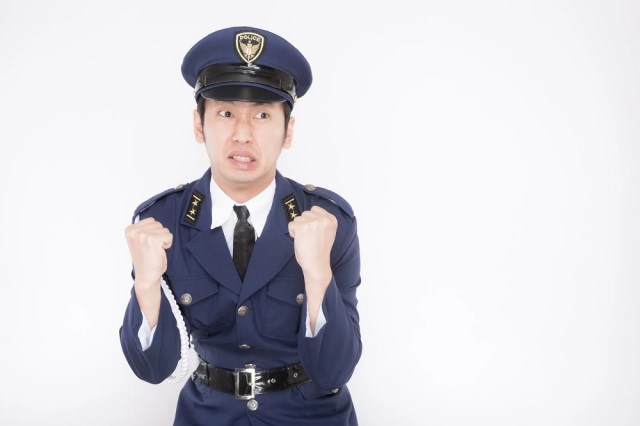
Second, in none of the incidents were the scammers wearing police uniforms or riding in official patrol cars. While Japan does have plainclothes detectives and unmarked police vehicles, they aren’t normally used for traffic duty. It’s highly unlikely that any jurisdiction would approve of undercover tactics for enforcing the new bicycling rules, and failure to produce a badge after claiming to have the authority to issue fines is another certain sign that you’re dealing with a scammer.

▼ A legitimate blue ticket stop should involve a badge but no cash, not the other way around.

It’s also worth noting that three of the scams involved failure to use hand signals. Technically, these are required under the new regulations. Cyclists are supposed to indicate turns (an arm extended to the side for a turn in that direction, or bent at the elbow with the fingertips pointing upwards for a turn in the opposite direction) and stops (extended with the fingertips pointing down and palm facing back), and with a fine of 5,000 yen for failing to comply. However, with one of the criteria for the issuance of blue tickets being that the behavior is unsafe, hand signals are in a gray area in that they require taking a hand off of the handlebars, so strict compliance could be considered a safety hazard for the rider. It’s perhaps for that reason that the hand signal requirement is being less emphasized in public awareness campaigns and posters than many of the other new rules. Not using hand signals seems like one of the technical infractions that police officers are most likely to let slide, and the comparative lack of pressure to comply by the rule might also make it an attractive excuse for scam artists to demand payment.

Source: Sankei Shimbun, Asahi Shimbun, HTB News, TBS News Dig
Top image: Pakutaso
Insert images: D Maps (edited by SoraNews24), Pakutaso
● Want to hear about SoraNews24’s latest articles as soon as they’re published? Follow us on Facebook and Twitter!


Credit:
0 comments:

Brand-new Pokémon manhole covers coming to help the recovery of a disaster-stricken part of Japan

08:13 cherishe 0 Comments

Noto Peninsula is ready to welcome travelers again, and these Pokémon are ready to help them do it.

There are two major goals for the Pokéfuta/Poké Lids project. One of them, of course, is to put smiles on the faces of fans by installing adorable and artistic Pokémon-themed manhole covers in Japanese cities, but the second purpose of the Pokéfuta is to help revitalize communities by encouraging people to visit and support local businesses while they’re on their real-world Pokémon search.

That’s why the newest batch of Pokéfuta is set to be installed this week on the Noto Peninsula of Ishikawa Prefecture. This beautiful section of the northern coast of Japan’s main island of Honshu was hit by a powerful earthquake in the early hours of New Year’s Day on 2024. As is often the case in disaster-stricken rural areas, clearing away wreckage and rebuilding infrastructure was not a quick or simple endeavor, but Noto is ready to receive travelers again, and there are now six new reasons to visit in the form of half a dozen new Pokéfuta.

Each cover has a unique design and is located in a different town on the peninsula. Starting off, we’ve got the above scene of Snorlax, Plusle, and Minun on the Pokéfuta at Anamizu Station in the town of Anamizu, which is loved by locals for its cherry blossoms.

Eevee evolution Sylveon and a pair of Luvdiscs are waiting at Mitsuke Beach in Suzu, where the rocky Mitsuke Island is a symbol of the town and crab, oysters, and Noto kuroge wagyu beef delight foodies.

Speaking of evolutions, after working his way up from Magikarp status, Gyarados has earned a little rest and relaxation at Yuttari Park, in Nanao, a town known for tis hot springs, where Politoed and Poliwag are also enjoying the water.

Greninja poses dramatically, and Darumaka somewhat less so, on their Pokéfuta at the Furattohomu roadside station souvenir shop in Wajima, where lacquerware from local artisans are among the items on offer.

Noto is also the name of a town on the Noto Peninsula, and it’s getting a Pokéfuta with Roselia, Minior, and Lotad inside its Yanagida Botanical Park, where cherry blossom season is wrapping up but beautiful azaleas, roses, wisteria, and irises will be coming into bloom in the coming weeks and months.

And finally, Wattrels soar through the sky and a Gorebyss frolics in the waves at Sekaiichi no Bench, “The World’s Longest Bench,” in the town of Shika on the west coast of the peninsula. Recognized by Guiness at the time of its construction in 1989, it no longer holds the distinction of being the longest in the world, but at 460.9 meters (1,512.1 feet) in length, you can be pretty sure of finding space to sit.

▼ Map showing the locations of Ishikawa’s six new Noto Peninsula Pokémon manhole covers, plus the preexisting one in the city of Kanazawa, further to the south.

All six Pokéfuta are scheduled to be installed and viewable on April 29. And if you’re looking for even more Pokémon manhole covers along the northern coast of Japan’s main island, we’ve got a whole bunch more for you here.

Source: Pokéfuta official website, PR Times
Featured image: Pokéfuta official website
Top image: Pokémon with You

Insert images: Pokéfuta official website (1, 2, 3, 4, 5, 6)
● Want to hear about SoraNews24’s latest articles as soon as they’re published? Follow us on Facebook and Twitter!


Credit:
0 comments:

Soaking in glimmering water and the essence of prehistoric plants at a Hokkaido hot spring

07:13 cherishe 0 Comments

A botanical bath at an affordable price.

In the far reaches of Japan, in the city of Obihiro in Hokkaido, our sauna and hot spring-loving reporter Seiji Nakazawa was almost set to head back home to Tokyo, but before he did so, he couldn’t resist going for a soak. He struck up a conversation with some locals to find a good hot spring to visit, and he was recommended Oberiberi Hot Spring Suikoen.

▼ It turned out to be really popular.

The long-established facility, having been founded back in 1922, is a roughly 10–20-minute bus ride from Obihiro Station, or an almost 40-minute walk, so it’s not exactly easy to get to.

When Seiji arrived there he was pleased to find that there was no sense of it being run-down.

In fact, the automatic doors and the smooth wooden floors gave off a polished, modern feeling. Seiji doesn’t necessarily look for modernity in a hot spring, but the cleanliness of the building was a very welcome quality.

Seiji is well-accustomed to Tokyo’s fairly reasonably-priced super sentos—large relaxation and entertainment facilities with a variety of baths and saunas, often spread out across several floors, and which can also sometimes function as a cheap alternative to hotel accommodationbut the entrance fee to Suikoen still felt incredibly cheap.

At just 630 yen (US$3.40), including the rental fees for a face towel and bath towel, it’s at a level that would allow for daily visits. Visitors who foresee themselves returning often can even buy a book of 11 tickets for 5,000 yen.

▼ Admission is just 500 yen if you bring your own towels.

While Seiji could justify daily visits at that price, even if the baths turned out to be mediocre, he was blown away by the facilities in the bathing area. In the indoor section alone, there are large baths like the moor hot spring.

Most hot springs draw their numerous benefits from minerals within the earth. Moor hot springs function a little differently, being of a more botanical nature. Long ago, sprawling wild vegetation adorned the banks of the nearby Tokachi River, which, over vast periods of time, accumulated and formed layers of lignite. The hot spring water filters through these layers and develops into reddish-brown, tea-colored moor water, characterized by its high content of plant-derived organic matter, and the humic and fulvic acids contained within are known for being exceptionally gentle on the skin and highly moisturizing.

The baths outside are just as spacious as the ones inside, and the sauna room is also very roomy. Seiji went through the full cycle of sauna activities, starting in the sauna room, before taking a cold plunge. After that, he settled on a reclining chair outside to bask in the outside air. The person sitting in the chair next to him kept moaning in comfort and relaxation, to which Seiji might normally feel a degree of annoyance, but this time, he instead couldn’t help but feel himself agreeing: it really felt refreshingly comfortable.

The sauna room was set at about 90 degrees Celsius (194 degrees Fahrenheit), and the cold water was probably around 15 degrees Celsius (59 degrees Fahrenheit). The cold water seemed to soak into Seiji’s body, and the lack of any stinging sharpness made for a pleasant experience. On his way out, Seiji found a sign noting the name “Suikoen” originates from how the cold spring water of this area appeared to be shining.

▼ Suikoen is written with the kanji characters for “water” (水), “shine” (光), and “garden” (園), but doesn’t contain the kanji for hot/bath water (湯) that’s often featured in hot spring names.

With glimmering cold water and moisturizing hot water, the two combine to create an experience unlike anything Seiji had had before, truly a place where you can experience nature’s benefits through your skin.

Location information
Oberioberi Onsen Suikoen / オベリベリ温泉水光園
Address: Hokkaido, Obihiro-shi, Higashi 10-jo Minami, 5-chome, 6-banchi
北海道帯広市東10条南5丁目6番地
Open 11:00 a.m.–11:00 p.m.
Closed New Year’s Day
Website

Photos ©SoraNews24
● Want to hear about SoraNews24’s latest articles as soon as they’re published? Follow us on Facebook and Twitter!


Credit:

0 comments:

61-year-old Japanese fisherman falls off boat and defies odds to swim to safety

20:13 cherishe 0 Comments

Captain Crunch Time.

Having an accident at sea is one of the more horrific things to happen to a person. Many people would not be able to overcome that feeling of cold loneliness, aside from the potentially deadly creatures lurking beneath the surface of the water, and with absolutely no sign of hope in sight.

And despite all that, some people manage to rise to the occasion, such as one 61-year-old fishing boat captain who stumbled while climbing down from the wheelhouse of his boat and fell into the sea below. He wasn’t wearing a life vest, and according to the Japan Coast Guard statistics, anyone’s chances of surviving a fall overboard drop from 87 percent to 47 percent without one.

The water temperature at the time was about 18 degrees Celsius (64 degrees Fahrenheit), which admittedly doesn’t sound so cold but could have ended his life right then and there. The first danger is the shocking sensation of his warm body suddenly and unexpectedly hitting the relatively cold water. This instantly makes you take a considerably large gasp inward, and if your head isn’t above water for that, then you can drown instantly. This sensation also causes your heart rate to spike, and at 61 years of age, that could very easily trigger cardiac arrest.

This man succumbed to neither of these things, however, and he was probably well aware that time was of the essence and there was no way he could catch up with his boat that he had set to auto-navigation moments earlier. So, he got his bearings and swam for the nearest island he could see.

That happened to be Tojima Island off the coast of Ehime Prefecture, about one kilometer (0.6 miles) away. The captain’s situation then became a race against time, as swim failure could set in as fast as 10 minutes, wherein the blood flow to his limbs would drop and he would lose effective control of them. Hypothermia also becomes a danger in as quickly as 30 minutes, depending on the person’s physical condition.

▼ The boat was passing through Tojima and the Miura Peninsula.

This particular captain, however, must have been made of wrought iron and duct tape, because he managed to make it all the way to Tojima in about 50 minutes. It must have been a swim taken on pure adrenaline to allow him to overcome the multiple ways he could have died at any moment.

Meanwhile, back on the boat, the other two crew members were unaware their captain had gone overboard. It wasn’t until they collided with an aquaculture raft that they realized and got word out to the Coast Guard, who later found him alive.

Readers of the news online could only be in awe at what an insanely strong person this must have been.

“He’s superhuman.”
“A total monster of physical strength. The exercise from swimming probably helped with the hypothermia, but the stamina to go for 50 minutes like that.”
“Most fishermen know that one kilometer is doable if you pace yourself and don’t panic.”
“I just hope he wears a life vest from now on.”
“Let’s not forget the wet clothes weighing him down that whole time.”
“Those other guys are lucky too that they only crashed into an aquaculture raft.”
“That’s some John McClane endurance.”
“I’m about his age, and I would have died in a minute.”

I’m quite a bit younger than him, and I have trouble standing up suddenly if I’ve been sitting for 50 minutes, let alone swimming in the sea for that long. Hopefully, that man was able to recover from that ordeal and get back in the captain’s chair again. He’s the kind of guy you want to have around if a giant shark terrorizes your beach or terrorists take over a luxury high-rise.

Source: ITV6, Hachima Kiko, Canadian Safe Boating Council
Top image: Pakutaso
Insert image: ©SoraNews24
● Want to hear about SoraNews24’s latest articles as soon as they’re published? Follow us on Facebook and Twitter!


Credit:
0 comments:

Pikachu to cuddle with kimono-clad beauty on Tokyo street as part of flower art event

12:13 cherishe 0 Comments

Exhibition near Tokyo Station mixes flowers, anime, and ukiyo-e aesthetics.

Even in a country filled with cute characters, Pikachu stands out as one of the most huggable in Japan. Thankfully, there’s a huge variety of plushies to let fans give the Pokémon mascot a squeeze, but this weekend Pikachu will be doing cuddling of a different sort, as he gets some snuggles from this kimono-clad young lady.

If you’re a fan of a broad range of Japanese art, you’ll recognize not only the anime aesthetics of Pikachu, but also the ukiyo-e style of painting from the Edo period. Ukiyo-e brought art ownership to the common people thanks to the efficiencies of woodblock printing, but this cuddly crossover scene will be available for everyone to enjoy via a different medium: flower artwork.

2026 marks both the 30th anniversary of the start of the Pokémon franchise and the 25th anniversary of the founding of Hanae Japan, a creative art group that makes giant mosaics out of flowers for public display.

Hanae Japan annually hosts the Tokyo Flower Carpet event in downtown Tokyo’s Marunouchi neighborhood, right by Tokyo Station. An ukiyo-e Pokémon design, based on the concept illustration above, is going to be one of this year’s highlights, with the faithfulness to both Pokémon and ukiyo-e artistic sensibilities making it feel like either Pikachu, his lady friend, or both of them have travelled through time for their rendezvous.

The event will also feature flower artwork created by students of special-needs schools, with a grand total of 10 works on display.

Admission to Tokyo Flower Carpet is free, and there’s no charge to watch the kabuki performance at the venue on its first day or the bugaku (classical Japanese court music and dance) performance on the last, as there are free standing spaces for spectators.

Tokyo Flower Carpet will be held from April 17 to 19 on the median of Gyoko-dori Street (shown in the map above), which connects the west side of Tokyo Station with the eastern edge of the Imperial Palace gardens. As an open-air event in a public space, there’s no listed opening or closing time, though odds are they’ll be breaking down the exhibits on Sunday night (the flowers are slated to be recycled into paper following the event), so you’ll probably want to shoot for an afternoon visit if you’re going on the 19th.

Source: PR Times
Top image: PR Times
Insert images: PR Times (1, 2)
● Want to hear about SoraNews24’s latest articles as soon as they’re published? Follow us on Facebook and Twitter!


Credit:

0 comments:

Sanrio’s best-loved butthole defies physics in adorable sumo collaboration[Photos]

06:13 cherishe 0 Comments

Pompompurin’s charm point apparently can’t be concealed.

Late last year, Sanrio unveiled its collaboration with the Japan Sumo Association, in which Hello Kitty and her friends wear sumo-inspired outfits for a line of merch to offered through SuMALL, the association’s official online shop. Cute characters and a sport that involves burly near-naked men grappling with each other might not seem like the most obvious partnership, but the team-up has proven popular enough for a second round of merch that once again features four Sanrio stars, with one of their buttholes receiving even more attention that usual.

Part of the new Sanrio sumo offerings is a collection of rubber character keychains. In keeping with the designs for the collaboration, Hello Kitty is still dressed in the kimono and billowy hakama pants of a sumo yobidashi, or ring announcer, and Kuromi has donned the traditional garb of the gyoji/referee.

That leaves it up to Cinnamoroll and Pompompurin to strap on the kesho mawashi aprons worn by sumo wrestlers before the start of their bouts.

While we’ve previously seen the Sanrio characters wearing these costumes on towels, pouches, and other flat-surface illustrations, the keychains are the first time for them to be rendered in three dimensions, which means we can circle around back and see the mawashi (sumo loincloth) that Pompompurin is wearing…

…which somehow still leaves his butthole visible?!?

It’s unclear exactly what’s supposed to be happening here. Has Pompompurin’s loincloth been wrapped so tightly that it’s riding up between his cheeks and showing the contours of his cavity? Is his loincloth made out of some sort of semi-see-through green material? Is it tailored with a strategically placed cutout? Or is it just that, with Pompompurin’s Japanese fanbase widely considering his butthole to be an especially charming point of his appearance, the hole is somehow able to bend spacetime and always make itself visible to fans? Whatever the reason, he’s managed to pull off the feat of simultaneously wearing a loincloth that still leaves the most iconic part of his anatomy visible.

▼ For those wondering, Cinnamoroll’s tail would block the line of sight to his cavity, and it isn’t customarily depicted in illustrations of him anyway.

The Sanrio sumo keychains go on sale April 27, priced at 1,430 yen (US$9.25) through the SuMALL online store here, meaning you can sport one while visiting the Sanrio Exhibition: The Beginning of Kawaii even that’s going on in Tokyo this spring.

Source: SuMALL via Hachima Kiko
Top image: SuMALL
Insert images: SuMALL (1, 2, 3)
● Want to hear about SoraNews24’s latest articles as soon as they’re published? Follow us on Facebook and Twitter!


Credit:
0 comments:

7-Eleven Japan now sells… hot takoyaki!

21:13 cherishe 0 Comments

A wildly popular local specialty takes Japanese convenience store food to a hot new level.

You never know what wonders await you when you pop into a Japanese convenience store, but this month you’ll want to make a pit stop at 7-Eleven, because that’s where a new find awaits: takoyaki!

Set to tempt you from the hot food display on the counter, these takoyaki are fried in-store and served fresh, ensuring a delightful, gooey texture. Made with a rich bonito-based broth, for a tasty burst of seafood umami, the 7-Eleven takoyaki also contain large pieces of octopus for a luxurious and satisfying eating experience.

The fried, battered octopus balls come with two beloved toppings, takoyaki sauce and mayonnaise, which are served separately in a handy squeeze-pack, ensuring you can enjoy the best flavours every time.

According to 7-Eleven, the new product was devised in response to the recent expansion of the takoyaki market. With more and more people falling in love with Japan’s fried octopus balls, they wanted to offer them to local and international customers, which led to the development of their very own signature variety.

▼ The 7-Eleven takoyaki will be sold in packs of three for 213 yen (US$1.34) or packs of six for 427 yen.

With none of the other top convenience store chains, namely Lawson and Family Mart, selling hot takoyaki, this new addition to 7-Eleven’s lineup is an exciting release that has the chain edging out the competition yet again. After wowing us with a viral chocolate sprinkle sakura bread sandwich earlier this month, 7-Eleven really knows how to please its customers, and we can’t wait to try its octopus balls when they’re released nationwide from 21 April.

Source, images: Press release
● Want to hear about SoraNews24’s latest articles as soon as they’re published? Follow us on Facebook and Twitter!


Credit:
0 comments: